 French
 Spanish
 German
 Italian
 English
Are you hesitant to drink tap water? You are not alone. Between viruses, chlorine, pesticides, and heavy metals, many French people are questioning the composition and actual quality of the water they consume. And we understand them: these contaminants regularly make headlines in health news.
However, it remains the most controlled food in the country, with strict regulations enforced throughout the year.
So, why does this mistrust persist? And above all, is it really justified?
In this article, we sort through the concerns and the reality. With clear explanations and simple solutions for you and your family.
What is the quality of tap water in France?
In France, the distributed water is among the most monitored in the world. Every day, it undergoes strict controls. Nothing is left to chance. The result: an adherence rate of about 98%, making it drinkable and safe for the majority of households.
But beware: “drinkable” does not mean “perfect.” Why? Because the composition and quality of the water are not the same everywhere. They vary from one municipality to another: more chlorinated in some cities, higher pesticide levels in agricultural areas, old pipes in certain sectors… In other words, your water does not have the same history as that of your neighbor.
To know its quality, you can consult the official health analyses, or explore in detail what your tap water contains to better understand what is in your glass.
But then, concretely: what are these different contaminants that can be found in tap water networks today? And above all, what risks do they pose to human health?
Drinking tap water: what are the health risks?
Even though tap water meets strict standards, it is not completely free of pollutants. Dangerous compounds can slip into your glass depending on the region, the soils, local agriculture, or the condition of the pipes.
And it is precisely these substances that raise the most questions.
So, which ones are most commonly found and what health risks do they pose?
Nitrates
The nitrates present in the drinking water distribution network mainly come from agricultural activities: fertilizer applications, intensive farming, and runoff into groundwater. Their concentration therefore varies according to rural areas and soil conditions.
But the danger of nitrates in water mainly comes from their transformation into nitrites: derived compounds that, in excess, can disrupt the transport of oxygen in the blood. And at excessively high levels, they become risky for infants, who are more sensitive to this transformation.
Chlorine
If there is chlorine in the composition of tap water, it is not by chance: it is what eliminates bacteria. An essential protection!
But it has a downside: even in small amounts, it can alter the taste and smell of the water. Some sensitive individuals may also experience slight irritations. In other words, the risk to humans remains minimal, but the enjoyment can take a hit.
Pesticides
The pesticides present mainly come from agricultural areas, where various products used to treat crops seep into the soils and reach the groundwater. Some regions are therefore more exposed than others.
The real problem? Some of them are closely monitored because they are suspected of acting as endocrine disruptors or having potential carcinogenic effects on humans.
But good news: solutions exist to eliminate them effectively!
💧Also read: How to filter pesticides from tap water?
Pharmaceutical residues and endocrine disruptors
Antibiotics, anti-inflammatories… These pharmaceutical residues are not eliminated by wastewater treatment processes. The result: these chemicals end up in tap water.
And even if the concentrations remain low, some compounds can act as endocrine disruptors and interfere with hormonal balance. This “invisible” presence, difficult to control, raises concerns among many consumers. Indeed, the effects can be genotoxic and reprotoxic.
Heavy metals (lead, cadmium)
Heavy metals are found in tap water for two reasons: old pipes in certain buildings and industrial pollution that settles in soils and groundwater. These are notably the sources of lead and cadmium in water. The latter being concentrated in fertilizers from intensive agriculture.
They are among the most monitored contaminants because they accumulate in the body and affect our metabolism: the nervous system, the kidneys, but also immunity and, in the long term, cardiovascular health.
PFAS (“forever chemicals”)
PFAS are those ultra-resistant chemical substances found everywhere: non-stick pans, waterproof textiles, food packaging, cosmetics… But their durability also makes them dangerous: they degrade very slowly.
The result: they accumulate in the environment, contaminate soils, groundwater, and end up in tap water.
The most concerning? These forever pollutants are associated with hormonal, immune, and cardiovascular risks, which explains the growing concern.
However, to protect yourself effectively, LAVIE offers a water filter against PFAS tailored to your needs.
Drink tap water or bottled water: what to choose?
When trust in tap water wanes, the first reaction is often to turn to bottled water. An option perceived as “safer.” However, when looked at more closely, this solution is not as flawless as it seems.
- From a health perspective, it is not a guarantee of purity.
Several tests have revealed microplastics in many bottled and mineral waters. Some samples have even shown traces of PFAS, evidence that the plastic packaging or the source exploited may be to blame. In other words: bottled water does not necessarily rhyme with healthier drinking water, and may even be the opposite.
- From an economic perspective, it is a poor calculation.
Over the year, buying packs costs much more than a home filtration system. Not to mention the logistics: transporting, storing, sorting, recycling… Bottled and mineral waters create an impractical daily routine.
- And ecologically, it is a disaster.
Billions of bottles are produced each year, a large portion of which ends up burned, buried, or in nature. Recycling remains too low, and plastic pollution continues to explode.
In short, bottled water is neither healthier, nor more sustainable, nor more practical.
The most coherent solution is tap water. Provided, of course, that a reliable filtration system is used.
How to have healthier water in daily life?
To truly improve the composition of your water, the most effective technique is filtration. It is what allows direct action on harmful elements. But faced with the multitude of purification systems, it is essential to know how to recognize the best tap water filter for your needs.
Here is a clear comparison of the main filtration technologies to help you choose the most suitable option.
|
Filtered, reduced, or eliminated element |
Classic filtering pitcher |
Tap filter |

Osmosis system |

Under-sink Opropre filter |

LAVIE purifier |
Serenity pack (Opropre + LAVIE PURE) |
| Chlorine | ✅ | ✅ | ✅ | ✅ | ✅ | ✅ |
| sediments | ✅ | 🟠 | ✅ | ✅ | ❌ | ✅ |
| Bacteria | ❌ | ❌ | ❌ | ❌ | ✅ | ✅ |
| Viruses | ❌ | ❌ | ❌ | ❌ | ✅ | ✅ |
| Medications | ❌ | ❌ | ✅ | ✅ | ✅ | ✅ |
| Pesticides | ❌ | ❌ | ✅ | ✅ | ✅ | ✅ |
| Heavy metals | 🟠 | 🟠 | ✅ | ✅ | ❌ | ✅ |
| PFAS | ❌ | ❌ | ✅ | ✅ | ❌ | ✅ |
| Microplastics | ❌ | ❌ | ✅ | ✅ | ❌ | ✅ |
| Conservation of beneficial minerals | ❌ | 🟠 | ❌ | ✅ | ✅ | ✅ |
| Discover | Discover | Discover |
LAVIE UV-A Carafe: healthier water without a filter
The LAVIE UV-A carafe represents next-generation purification: zero filter, zero plastic, just the power of UV-A light.
Its patented technology triggers a natural phenomenon called photolysis: when the rays pass through the glass bottle, it transforms chlorine into reactive compounds capable of neutralizing pesticides, traces of pharmaceuticals, bacteria, and viruses.
All without affecting essential minerals like calcium and magnesium.
The result: soft, healthy filtered water, free from off-tastes and without any consumables to replace.
The LAVIE UV-A carafe proves that purification can be effective and waste-free.

Opropre Turquoise: powerful and sustainable filtration
Installed under the sink, Opropre Turquoise offers ultra-high-performance filtration designed to target the most resistant substances: PFAS, heavy metals, micro and nanoplastics, pharmaceuticals… Its combination of coconut activated carbon and specific resin captures these contaminants while allowing essential minerals that your body needs to pass through.
Its greatest asset? A returnable, rechargeable, and recyclable cartridge: every six months, you send it back, LAVIE recharges it with new activated carbon, and the old one is fully recycled.
A reliable, sustainable solution that perfectly complements the LAVIE UV-A carafe for safer water, directly from your tap.

The classic filter carafe: a limited, even dangerous solution
Classic filter jugs (Brita, Philips, and other models) reassure with their promise: to improve taste and retain unwanted substances. But in reality, their action remains very limited. They primarily reduce chlorine while depleting water of essential minerals and lowering its pH towards acidity.
As for more serious contaminants (viruses, heavy metals, pharmaceutical residues…), they largely pass through.
And the most problematic aspect comes afterward: filters that are slow to be changed turn the jug into a real bacterial breeding ground. All this is compounded by the production of disposable cartridges that need to be replaced every month, which are not recyclable.
In other words, a treatment that is not very ecological, not sustainable, and far from beneficial for health.
It is better to turn to a filter jug alternative that is truly effective and safe.
The water osmosis system: effective, but with serious drawbacks
The osmosis system for tap water is often presented as the most radical solution. And it is true: it eliminates a huge portion of contaminants, especially the most resistant ones. But this performance comes at a cost.
An osmosis system rejects large quantities of water (up to 4 liters wasted for 1 liter consumed), requires regular and costly maintenance, and removes essential minerals, leaving water too poor for daily consumption.
The result: a significant ecological impact and a high price, both at purchase and in use.
For all these reasons, this treatment is rarely suitable for typical domestic use.
Drinking tap water? Yes, with the right filtration
The distributed tap water is the most logical option: healthy, economical, and ecological. But because it can contain traces of contaminants depending on the regions, filtration quickly becomes essential to ensure its quality. This raises the question of how to filter your tap water?
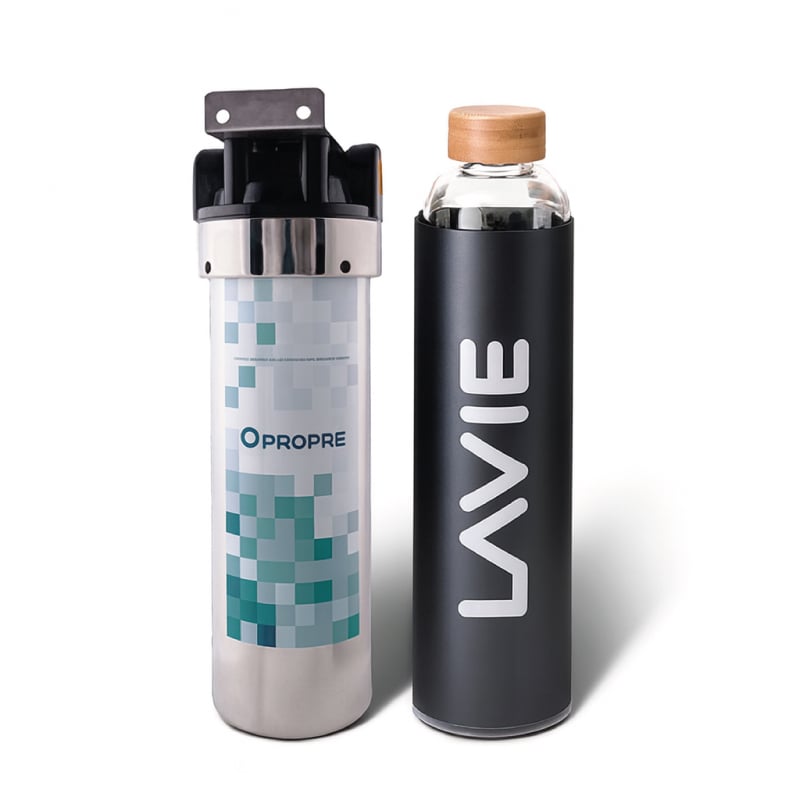
This is where the LAVIE Serenity Pack (LAVIE UV-A Jug + Opropre Turquoise) comes into play.
Opropre paves the way: it captures PFAS, heavy metals (lead, mercury, arsenic…), microplastics, and nanoplastics thanks to its blend of coconut activated carbon and ultra-efficient resins.
Then the LAVIE UV-A jug takes over: its light neutralizes pollutants without affecting the essential minerals that make water beneficial for your body.
You now have filtered water that is purer, safer, and with a better taste, directly from your tap.
Simple, effective, and good for the environment!