 French
 Spanish
 German
 Italian
 English
Don’t know which water to drink anymore? Many French people are asking the question: “tap water or bottled water?” And it’s logical.
Tap water raises concerns: nitrates, chlorine, PFAS, heavy metals… Traces of contaminants that raise questions.
As for bottled water, whether mineral or spring, long perceived as “safer”, it no longer inspires the same trust. The Nestlé scandal marked a turning point: the group used banned treatments for years. The result: the image of these waters has been weakened.
So what should we drink on a daily basis?
Behind this question lie three stakes: health risk, because the waters you consume must be potable and balanced; budget, as packs are becoming increasingly expensive; and ecology, with millions of plastic bottles produced and transported, generating catastrophic pollution.
So, which water is the healthiest and most logical to drink today? Let’s take stock.
Why is tap water so concerning?
Tap water is often criticized even though it is the most controlled food in France. Strict health regulations, daily analyses and tests, and ongoing monitoring.
If distrust persists, it is mainly due to its sometimes chlorinated taste, quality variations from one region to another, and its composition, particularly the discovery of traces of certain pollutants. However, in the majority of cases, drinking tap water remains safe, regulated, and perfectly compliant.
And it even has advantages that make all the difference.
The advantages of tap water
The first advantage is its unbeatable price. It is up to 250 times cheaper than bottled water. For a family, each liter represents enormous savings.
Next, there is practicality. No need to rush to the supermarket, carry packs, or find a place to store them. The water is already there, in your kitchen, available at will. It’s hard to make it simpler.
From an ecological standpoint, it ticks all the boxes. No transportation and no plastic waste. In contrast, commercial water requires a heavy, energy-consuming, and highly polluting cycle that weighs on the environment.
It also has a very important asset: it is subject to strict and regular monitoring, ensuring quality that meets French standards. Such treatment and safety are not as present for bottled spring and mineral waters.
And above all, it never runs out. No empty shelves, no shortages, no unexpected breaks. It remains a reliable and permanently accessible resource.
Tap water has serious benefits. But it is not perfect either. Let’s now see what can pose a problem.
The disadvantages of tap water
The first disadvantage is the traces of certain chemicals. Even though the standards are strict, it can contain pesticides, PFAS, pharmaceutical residues, and heavy metals in certain quantities.
It also depends on the regions: its composition varies according to territories. In rural areas, for example, agricultural use over several years increases the presence of pesticide metabolites. These levels remain regulated, but they naturally fuel distrust towards distribution networks.
Then comes the question of taste and odor. Chlorine, which is essential, can give an unpleasant taste and smell. This is often what drives consumers towards bottled spring or mineral water. It is not a real health problem, but a tasting experience that is unappealing.
In light of these limitations, more and more households are choosing to install the best tap water filter suited to their needs. The goal: to improve taste, reduce the presence of contaminants, and drink more peacefully on a daily basis.
💧Read also: What is the best system to filter tap water?
Is bottled water as “pure” as we think?
Bottled waters enjoy stronger consumer trust. They are labeled as “natural” and therefore necessarily healthier. But in reality, this is far from the case. Several analyses have shown the presence of PFAS and other elements.
Contrary to popular belief, commercial water is not as controlled as tap water.
Upon closer inspection, it even presents several major disadvantages for health.
The advantages of bottled water
Even though we now know it is not as pure as once thought, bottled water still has some advantages. The first is its generally neutral taste. Since it is not chlorinated, it may seem more pleasant to drink for some people, especially in regions where tap water has a marked taste.
It is also theoretically free from chemical treatment. Taken from deep sources, it is supposed to be protected from certain surface pollutants, which in principle avoids the chlorine disinfection intended to ensure potability. This should be put into perspective, whether for mineral or spring waters, but it partly explains the trust consumers place in it.
Another benefit: it is convenient when traveling, especially in areas where tap water is not potable or when traveling abroad. Its one-liter portable format remains a positive point, even if it is not a daily criterion.
So there are advantages, but they quickly become limited when compared to the disadvantages.
The disadvantages of bottled water
Bottled water reassures. But in reality, it accumulates many disadvantages for us and for the planet.
The first is its disastrous impact on the environment. To produce it, plastic, oil, and energy are needed, followed by heavy road transport. All this for a few minutes of consumption.
The result: a gigantic volume of plastic waste. Bottles cause pollution that is hard to eliminate, and current recycling remains insufficient.
The second problem is its very high cost. Bottled water is up to 250 times more expensive than tap water. For a family, the financial difference quickly becomes enormous.
Next comes the actual composition of these so-called spring or mineral waters. Several tests have shown the presence of microplastics, nanoplastics, PFAS, or even pesticide metabolites in certain bottles, even among the most well-known brands. As Que Choisir reminds us, 90% of the detected particles are nanoplastics, capable of crossing the digestive barrier, reaching the bloodstream, and potentially affecting certain organs.
Another health point: it is not subject to the same controls as that from distribution networks. It is not required to meet potability standards. Some mineral and spring waters, for example, have fluoride levels exceeding the thresholds recommended by the WHO.
In summary, bottled water seems safe, but scientific studies prove otherwise.
Tap water or bottled water: which is the better option?
One thing is certain: neither is perfect. Bottled water reassures, but it is expensive, pollutes significantly, and may contain traces of harmful contaminants.
Tap water, on the other hand, may have a chlorinated taste and contain certain chemical residues. However, it retains a decisive advantage: it is much more monitored, accessible, and economical.
Let’s break it down point by point:
- For health, both options can have toxic elements that impact our metabolism. However, tap water has a major asset: its quality can be easily improved with appropriate filtration.
- For taste, bottled spring or mineral water seems more pleasant. But once filtered, the water from your home loses its chlorine taste and becomes more neutral, more flavorful.
- For budget, the calculation is quick: the water in your home is up to 250 times cheaper than bottled water. Investing in a filtration system is therefore highly cost-effective.
- And for ecology, there is no debate: zero transport, zero waste. Tap water wins hands down.
The answer is clear: tap water, especially when filtered, remains today the most logical, healthiest, and most sustainable choice.
How to improve the quality of tap water?
Improving the quality of your drinking water comes down to a simple solution: filtering it at home. Filtration makes the water much more pleasant and healthier on a daily basis.
But with filter jugs, under-sink filters, UV systems, and reverse osmosis, it is difficult to know how to filter tap water effectively.
To clarify, here is a table of filtration technologies to identify those that yield the best results.
|
Filtered, reduced, or eliminated element |
Classic filter jug |
Tap filter |

Reverse osmosis system |

Under-sink Opropre filter |

LAVIE Purifier |
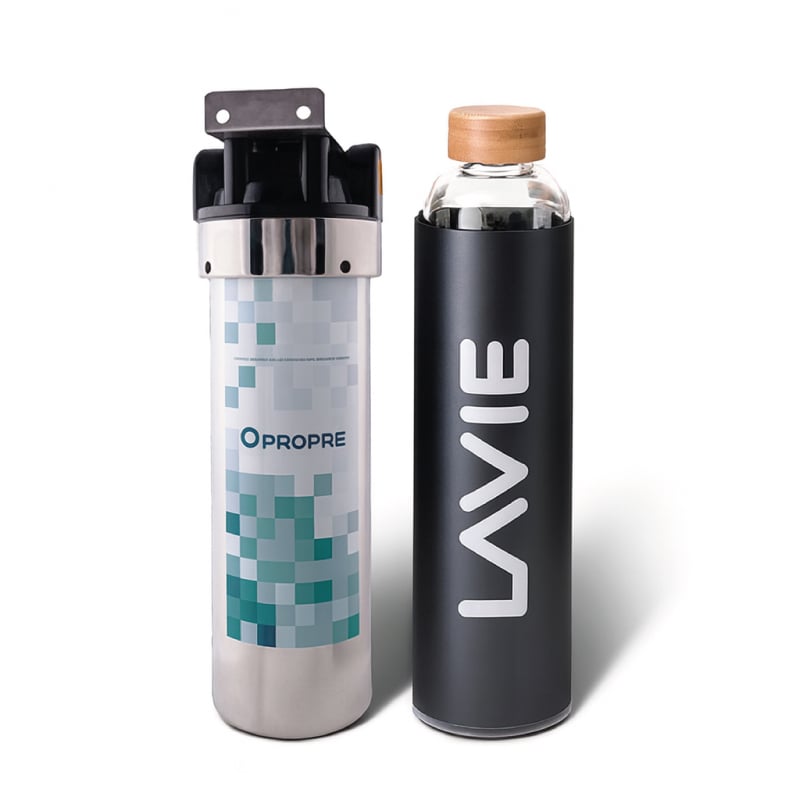
Serenity pack (Opropre + LAVIE PURE) |
| Chlorine | ✅ | ✅ | ✅ | ✅ | ✅ | ✅ |
| Sediments | ✅ | 🟠 | ✅ | ✅ | ❌ | ✅ |
| Bacteria | ❌ | ❌ | ❌ | ❌ | ✅ | ✅ |
| Viruses | ❌ | ❌ | ❌ | ❌ | ✅ | ✅ |
| Medicines | ❌ | ❌ | ✅ | ✅ | ✅ | ✅ |
| Pesticides | ❌ | ❌ | ✅ | ✅ | ✅ | ✅ |
| Heavy metals | 🟠 | 🟠 | ✅ | ✅ | ❌ | ✅ |
| PFAS | ❌ | ❌ | ✅ | ✅ | ❌ | ✅ |
| Microplastics | ❌ | ❌ | ✅ | ✅ | ❌ | ✅ |
| Preservation of beneficial minerals | ❌ | 🟠 | ❌ | ✅ | ✅ | ✅ |
| Discover | Discover | Discover |
LAVIE UV-A Carafe: pure water in 15 minutes
For healthy and beneficial water on a daily basis, the UV-A LAVIE carafe provides a simple, sustainable, and truly effective solution for treating your water.
Its patented technology is based on photolysis, a natural process that can degrade and neutralize contaminants. Specifically, when UV-A rays pass through the glass bottle, they transform chlorine into reactive compounds capable of removing pesticides, traces of medications, bacteria, and viruses.
In 15 minutes, the UV-A light treatment reduces these substances while preserving the essential elements for your body, such as calcium and magnesium.
The result: a more balanced and pleasant drinking water, without filters and without consumables.
A modern purification designed for today and for future generations.

Opropre Turquoise: the solution against persistent pollutants
For your drinking water, Opropre Turquoise intervenes where conventional treatments reach their limits.
Its system combines a high-performance coconut activated carbon with a specific resin capable of retaining the most stubborn pollutants: PFAS, heavy metals, nitrates, pharmaceutical residues, pesticides…
And unlike other under-sink filters, it allows essential minerals to pass through, which naturally arrive in your glass for beneficial hydration.
A second advantage: its returnable and rechargeable cartridge. Every six months, you send it back; LAVIE recharges it with new activated carbon and the old one is fully recycled. A circular, clean system without unnecessary waste.
Opropre Turquoise offers deep, sustainable filtration that complements the UV-A LAVIE carafe.

Classic filter carafe: practical, but ineffective
Classic filter carafes (from brands like Brita, Philips, Amazon…) give the impression of “doing the job.” But in reality, they fall far short of current challenges.
They mainly improve taste by reducing chlorine. In the process, they deplete the water and lower its pH, making it more acidic. This is not ideal for daily hydration, as it no longer meets the WHO’s drinking water standards.
As for persistent substances (heavy metals, pharmaceutical residues, viruses…), they pass through the cartridge and end up in your glass, then in your body.
And that’s not all: as soon as the filter is not changed on time, the carafe becomes a true bacterial breeding ground, as shown by several analyses.
The magazine Que Choisir even dedicated an article on the subject, titled: “Useless, or worse!”.
Add to that disposable, non-recyclable cartridges that need to be replaced every month. A treatment that is neither ecological, nor economical, nor reassuring.
Filter carafes are convenient, yes. But the effect is limited if the goal is to drink healthier drinking water.
Filtered tap water: the best choice today
In the face of pollution and scandalous revelations about mineral and spring waters, as well as the dubious composition of tap water, filtering the latter has become the simplest and safest solution for daily hydration.
Why?
With reliable and sustainable technologies like those offered by LAVIE, you eliminate contaminants while preserving the trace elements essential to your health in every liter.
And unlike branded waters, it is economical, ecological, and infinitely more practical. In other words, you are doing good for your body, your wallet, and the planet.
The best combination? Opropre Turquoise + the UV-A LAVIE carafe: purified drinking water that is more pleasant and truly beneficial for the whole family.