 French
 Spanish
 German
 Italian
 English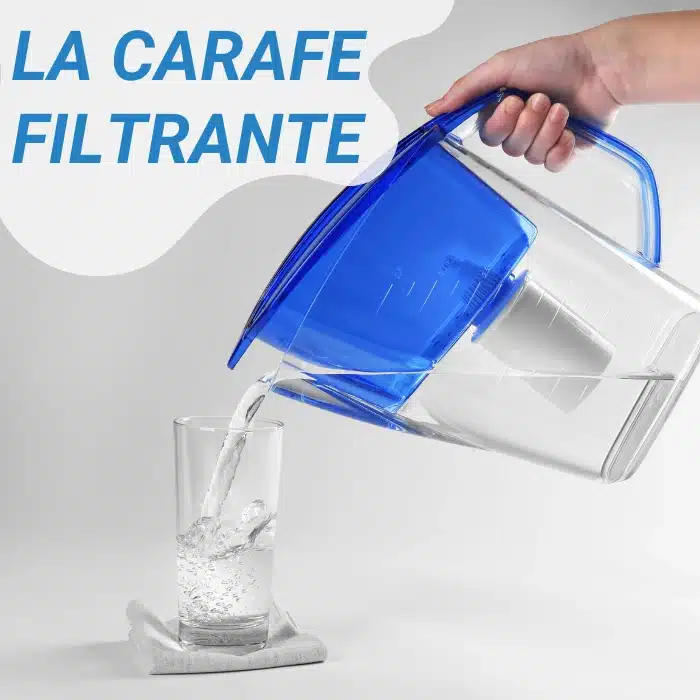
Are you considering purchasing a filtering carafe to improve the taste and quality of your tap water, but have questions about the effectiveness and operation of this type of product?
In recent years, several scientific studies, such as those from ANSES or the association “Que choisir”, have issued a more than reserved opinion on the health benefits of filtering pitchers (bacteria concentration in filters, water acidity, microplastics…).
Their ecological impact is also called into question: non-recyclable cartridges must be replaced every 3 to 4 weeks, generating a significant amount of plastic waste.
In this article, you will find our opinion (unfiltered!) on the usefulness of these carafes and their filters. We will also discuss the various disadvantages associated with their use. Finally, we will see that there are many healthier, more effective, and ecological alternatives such as the filtering carafe LaVie.
The functioning of a filtering carafe

A filtering carafe (some may call it a “filtering pitcher” or “filtering coffee maker”) is a means to improve the taste and quality of the tap water in your kitchen. It works by filtering certain impurities that can be found in your home’s tap water.
But beware, not all carafes are equal! To learn more, we compare the LaVie purifier to classic models like Brita in our article on the best filtering carafes.
A simple use
Using this type of filter allows you to have access to cleaner drinking water and better taste, without the additives or the additional cost of bottled water.
It is true that a carafe requires no complicated installation and is easy to use. You simply need to fill it with cold tap water and let it sit for a few minutes. You can then enjoy freshly filtered water of better quality.
The device consists of a double reservoir container. Its upper part is designed to receive the water to be filtered. The lower part stores the filtered water. Finally, the device is equipped with a cartridge containing the filter itself.
The composition of the carafe filter
The filter or the filtering cartridge of the carafe represents the nerve center of the device.
Inside, you will find white beads, ion exchange resins, and black beads, made of activated carbon. The activated carbon is a material obtained after the carbonization and activation of organic materials rich in carbon, such as coconut shells or wood. Its porous structure allows it to capture impurities, such as chlorine, pesticides, and organic residues, by adsorbing them onto its surface.
Finally, everything is wrapped in plastic and enriched with silver particles to prevent bacterial growth in the filter.
Thus, the water you pour into the top reservoir of the carafe will flow by gravity through these beads (this takes several minutes and must be done in several stages) into the bottom reservoir.
Filtering carafe or LaVie purifier? The video test
Before presenting the main disadvantages of classic filtering carafes and the alternatives to favor, a simple test conducted with methylene blue easily calls into question their filtration effectiveness.
Here, we compare a classic model with the LaVie carafe with UV-A technology (thus, without a filter!), which destroys bacteria, viruses, and other unwanted contaminants in just a few minutes.
The disadvantages of filtering carafes
An environmental impact
The filtering cartridges of carafes, like coffee pods, are very difficult to recycle. The process is specific and costly due to the mix of components and the low value of the materials.
The cartridges therefore produce numerous plastic waste, which have a significant environmental impact. Moreover, the pollutants concentrated in these filters that will never be recycled (at best burned in an incinerator, at worst thrown into an open landfill) will return to the environment, creating a vicious cycle!
So, no, the carafe and their filters made of ion exchange resins and activated carbon do not represent an ecological solution.
A low capacity
Furthermore, it must be understood that the usable capacity of carafes is not what is advertised, but only that of the lower reservoir!
Indeed, an advertised capacity of 2.4 liters for models from the most well-known brands actually contains only 1.4 liters of filtered water. Nevertheless, the device will occupy around 3 good liters of volume in your refrigerator, which generally does not have a dedicated space for this type of container.
Chlorine reduction? Yes, but…

So, yes, it is a fact, a filtering pitcher reduces chlorine. In fact, this is probably the primary reason for its use. Indeed, tap water free of chlorine (used primarily to disinfect the water) will have a much better taste.
However, according to ANSES, the process of reducing minerals in carafes will produce acidic water. Indeed, its pH will drop on average from 7.5 to 6, and will thus become corrosive to the metals of household appliances.
Thus, while water filtered by a carafe will protect your kettle from limescale and tartar, it will also damage it due to its acidity. The metal of your kettle will corrode and eventually puncture if you frequently boil acidic water!
Additionally, a tip for removing limescale if you use water balanced in trace elements in your kettle: a spoonful of citric acid effectively cleans limescale and costs only a few euros per kg. See here all our tips for descaling a kettle.
In conclusion, you will understand that it is not advisable to use water from a filtering carafe in household appliances that heat water in metal: kettle, coffee machine, etc.
What about bacteria?
The last point is of a bacteriological nature. UFC Que Choisir and ANSES warn after analyses about “bacteria nests” measured in the daily use of carafes.
Indeed, a report from the National Agency for Health Security (ANSES) published in March 2017 concludes that the effectiveness of filtering carafes is subject to debate.
Although these carafes promise healthier water than tap water at a lower cost than bottled water, the agency warns that inappropriate use can lead to the proliferation of bacteria.
The report thus warns against microbiological contaminations related to improper use of carafes at home. According to ANSES, when used at home, these carafes can become real nests for bacteria, compromising the quality of the water and presenting possible health hazards.
Source :
QUE CHOISIR: Filtering carafes Useless, or worse!
A water quality often degraded by the filtering carafe
The use of filtering carafes can release certain contaminants such as silver ions, sodium, potassium, and ammonium into drinking water.
Moreover, as mentioned earlier, some carafes can lower the pH of the water. According to Canadian and British studies, this lowering could promote the release of certain metals when heated in contact with metal or ceramic utensils. However, ANSES specifies that current data do not show any risk to consumer health.
Regarding water quality, ANSES estimates that most carafes meet standards for reducing odor, bad tastes, chlorine, lead, and copper. But performance varies significantly between models. ANSES also raises the question of the relevance of filtering calcium and copper, given that many people already have insufficient intakes of these minerals.
Finally, in 2010, analyses had already shown that all carafes tested at home had led to a degradation of water quality.
What alternatives to the filtering carafe?
If carafes indeed do not offer all the required effectiveness in filtering your tap water, it should not be concluded that the solution lies in purchasing packs of water!
Indeed, bottled plastic water represents an even worse alternative, both for the environment and your wallet! Did you know that bottled water costs at least up to 300 times more than tap water?
But do not worry, there are several alternatives to naturally purify tap water, including the LaVie carafe and its UV-A technology.
A filtering carafe… without a filter!
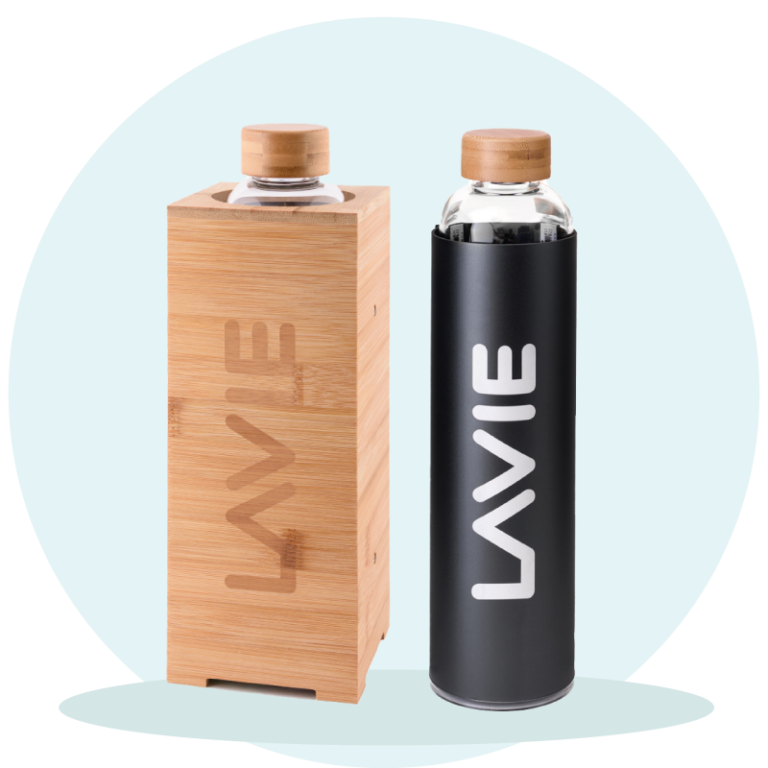
The tap water purifiers LaVie operate without filters or maintenance and allow you to purify your tap water in just 15 minutes.
They utilize innovative technology, different from the gravity filtration of the carafe, patented and exclusive to LaVie: the photolysis of chlorine by UV-A radiation.
This treatment, which has demonstrated its effectiveness (see here the scientific opinions), allows for the reduction of chlorine and its derivatives, as well as chemical compounds such as certain pesticides, herbicides, and pharmaceutical residues. Thus, the unpleasant tastes and odors that can be encountered in tap water are eliminated.
An economical AND ecological alternative
The results, which are of high quality, allow for a definitive end to the consumption of bottled plastic water and a return to a pleasant taste of water.
The carbon footprint associated with the production of the aluminum tube of the UV water purifier is neutralized within a few days of use compared to the equivalent consumption of bottled plastic water.
Finally, the savings made on the cost of plastic water bottles will quickly offset your purchase.
Discover the LaVie purifiers now and enjoy healthy and pure tap water for your family!
The filtered fountain for large families!
With its large 5L reservoir, LaFontaine is the ideal filtration system for families. Like the LaVie purifiers, this product uses UV-A technology to eliminate the taste and odor of chlorine, traces of pesticides, pharmaceutical residues, and bacteria.
Of course, all while preserving all the essential trace elements for our good health. Enjoying mineral quality water at home, without plastic bottles or polluting filters, is now child’s play with LaVie!