 French
 Spanish
 German
 Italian
 English
The lime is a bit like that unwanted roommate who moves in without warning and refuses to leave. It sneaks into your pipes, colonizes your appliances, and turns every shower into a battle against dry skin and rebellious hair. Your kettle struggling for its last breath, your washing machine in sabotage mode, and your energy bill climbing? You can thank our dear friend limescale, the solid form of lime.
But don’t panic, we have what you need! Whether you’re tired of your glasses covered in white marks or your hair staging a shine strike, it’s time to take matters into your own hands.
So, ready to make your home limescale-proof? Dive in with us in this article to discover the best anti-limescale solutions.

What exactly is limestone?
Before fighting your enemy, it is important to know it well!
Naturally present in water, it is primarily composed of calcium and magnesium, two essential minerals for health. So first of all, let’s reinforce this truth: hard water or limestone water is not dangerous for health! On the contrary, since this water is by definition rich in essential minerals for your body. It is just a drawback, sometimes really problematic, for your household appliances, your plumbing, and, in fine, your wallet!
So, when water is said to be “hard”, it means it contains a high concentration of these minerals, which gradually deposit on surfaces in contact with water, creating what is called limescale.
To learn everything about water hardness, we refer you to our article: Understanding water hardness: Definition and measurement of hard water
Unlike limestone, which dissolves in water, limescale forms when heated water causes crystallization of calcium and magnesium, thus sticking to the walls of pipes, water heaters, and household appliances. This hard and stubborn deposit reduces the efficiency of your equipment, increases their energy consumption, and can even lead to breakdowns.
In summary, limestone is the source of the problem, while limescale is the visible result that causes inconveniences, material damage, and increased energy bills. To prevent limescale, it is therefore necessary to treat hard water with suitable anti-limescale systems.

The benefits of installing a limescale prevention system at home: savings and comfort in daily life
Protect your appliances with a limescale prevention system
Installing an anti-limescale system (or rather, as we have seen, an anti-scale system) at home is an effective solution to extend the lifespan of your household appliances. Equipment such as the water heater, washing machine, or dishwasher are particularly vulnerable to scale deposits that accumulate on the heating elements and pipes.
This scale reduces their efficiency, increasing the risk of breakdowns and malfunctions. By eliminating or reducing limescale deposits, your appliances operate at full capacity, which saves you costly repairs and extends their lifespan.

Energy savings: reduce your bills by reducing limescale
Limestone in water is not only annoying for your appliances, it also directly impacts your energy consumption. Indeed, a deposit of just 1 mm of limescale on the heating element of a water heater can increase your energy consumption by 9% (make an image from this figure). This means that the more limescale accumulates, the higher your energy bills become, as your appliances have to work harder to reach the desired temperature. According to a study, a household of 4 can save up to €200 per year by reducing limescale in the water, whether through individual or collective solutions.
Improve the quality of your water and everyday comfort
But that’s not all. By protecting your pipes, a scale prevention system improves the quality of the water you use every day. No more tarnished faucets from limescale, skin that feels tight after a shower, and dull, dry hair. On top of that, you reduce the use of anti-limescale chemicals, further easing your maintenance budget while doing a favor for the environment.
In summary, installing a scale prevention system means saying goodbye to the hassles of limescale while making significant savings. You gain comfort, water quality, and peace of mind, all with an investment that quickly pays for itself.
Understanding the different types of anti-scale systems
Finding the right anti-scale system for your home can sometimes feel like a real puzzle: ionic, salt-free, electromagnetic, softener… It’s not always easy to navigate through all the options. To help you make the right choice, here’s an overview of the most popular solutions and what they can really bring to your daily life.
Water softeners: for completely softened water, but…

Water softeners are often presented as effective solutions for eliminating limescale by modifying the chemical composition of water. Through an ion exchange process, these devices replace calcium and magnesium ions – responsible for limescale deposits – with sodium ions. The result is soft water, free of limescale, which protects household appliances and plumbing from scale buildup.
However, this process is not without drawbacks. By replacing essential minerals with sodium, softened water can have an altered taste, sometimes unpleasant. Additionally, the addition of sodium in water is not recommended for regular consumption, especially for individuals suffering from hypertension or cardiovascular diseases. Beyond these health effects, the environmental impact is also concerning: softeners discharge large quantities of salty water during regeneration, contributing to pollution of groundwater and aquatic ecosystems.
Moreover, installing a water softener is not straightforward and requires regular maintenance and often a high budget.
Finally, if your water has become soft, this process also makes it acidic, thus potentially corrosive! You protect your household appliances from scale on one hand, only to expose them, on the other, to corrosive water for metals… Although it is a radical solution against limescale, these aspects must be carefully weighed before embarking on this costly investment.
Anti-limescale filter: passive protection
Anti-limescale filters are designed to reduce the adherence of limescale without changing the composition of the water. By using polyphosphate crystals, these filters form a protective film on pipes and surfaces in contact with water. This helps to limit the formation of scale without eliminating the existing limescale. Easy to install, they require little work. However, you will need to replace the filter cartridge every six months to a year. Be careful, though, as these filters add polyphosphates to the water, a substance to monitor, especially if consumed in large quantities.
Do you want to improve the quality of your household water? Discover in our article the best systems to filter tap water and enjoy healthier water to consume at home!
Magnetic anti-scale devices: the magnetic shield against limescale
Magnetic anti-scale devices use magnets to create a magnetic field around your pipes, which alters the behavior of minerals and prevents limescale from depositing as scale. This technology does not eliminate limescale, but it makes it less sticky, thus protecting your pipes and appliances. Easy to install and affordable, they require no major plumbing work. However, their effectiveness will vary depending on the strength of the magnets. Additionally, if the water contains high levels of iron oxide, this can disrupt the magnetic field created by these devices. Indeed, iron oxide, often present in water from old galvanized steel pipes, can interfere with the effectiveness of the anti-scale treatment. This interference reduces the system’s ability to prevent scale deposits.
Electronic anti-scale devices: the technological evolution of magnetism
Similar to magnetic systems, electronic anti-scale devices use a magnetic field generated by electrical pulses to prevent limescale from settling. This process is often more powerful than traditional magnets, providing increased protection against limescale. Easy to install, these systems still require a power source and may represent a slightly higher investment. Like magnetic models, they alter the way limescale behaves without actually removing it from the water. However, caution is advised, as their effectiveness may be limited in areas where the water is extremely hard, and their electrical consumption, although low, can represent an additional cost in the long term.
Ionic anti-scale systems: the silent and effective technology with ODOUCE
Among the most innovative systems, ODOUCE stands out as a cutting-edge ionic anti-limestone solution. Unlike traditional methods, ODOUCE uses neither chemicals nor electricity. Through a patented galvanic polarization process, this system modifies the structure of calcium ions present in the water, thus preventing limestone from clumping and depositing on your surfaces and household appliances.
The great advantage of ODOUCE lies in its ability to transform limestone into aragonite, a non-sticky powdery form that does not embed in pipes or on the heating elements of your appliances. This means you benefit from effective protection against limescale, without altering the mineral composition of the water, which retains its essential trace elements, such as calcium and magnesium. One could define ODOUCE as a salt-free water softener: as effective as a softener, without the addition of salt!

CO2 Anti-Limestone Systems
CO2 anti-limestone systems inject carbon dioxide into the water, lowering its pH to transform limestone into soluble calcium bicarbonate, thus preventing limescale deposits. Environmentally friendly, they preserve beneficial minerals while reducing energy and water consumption compared to traditional softeners.
However, this system requires regular CO2 refills, increasing long-term costs, and poor calibration could make the water too acidic, posing corrosion risks. The initial installation can also be costly.
Catalytic Systems
The catalytic systems transform limestone into non-incrusting crystals without salt or electricity, thus preventing limescale deposits on surfaces and appliances. Maintenance-free and autonomous, they provide long-term ecological protection for households.
However, their effectiveness is limited in areas where the water is extremely hard, and their initial cost is also higher than that of magnetic or electronic systems.
Comparative Table of Anti-Limestone Systems
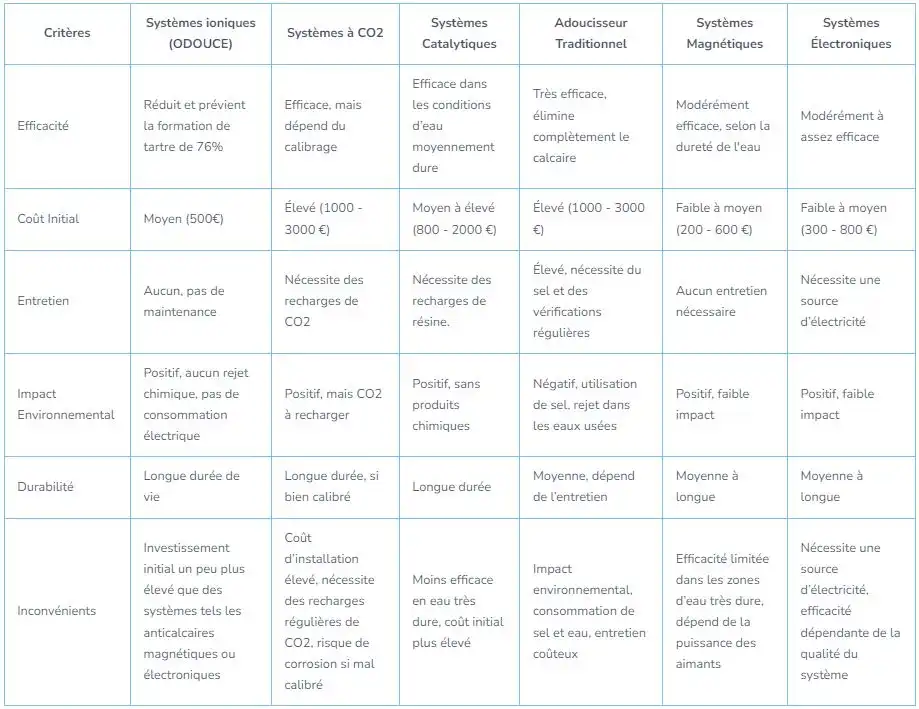
Comparative Table of Anti-Limestone Systems
| Ionic Systems (ODOUCE) | CO2 Systems | Catalytic Systems | Traditional Softener | Magnetic Systems | Electronic Systems | |
|---|---|---|---|---|---|---|
| Effectiveness | Reduces and prevents limescale formation by 76% | Effective, but depends on calibration | Effective in moderately hard water conditions | Very effective, completely eliminates limestone | Moderately effective, depending on water hardness | Moderately to fairly effective |
| Initial Cost | Medium (€500) | High (€1000 – €3000) | Medium to high (€800 – €2000) | High (€1000 – €3000) | Low to medium (€200 – €600) | Low to medium (€300 – €800) |
| Maintenance | None, no maintenance required | Requires CO2 refills | Requires resin refills. | High, requires salt and regular checks | No maintenance required | Requires a power source |
| Environmental Impact | Positive, no chemical discharge, no electricity consumption | Positive, but CO2 needs to be refilled | Positive, no chemicals | Negative, use of salt, discharge into wastewater | Positive, low impact | Positive, low impact |
| Durability | Long lifespan | Long-lasting, if well calibrated | Long-lasting | Average, depends on maintenance | Average to long | Average to long |
| Disadvantages | Initial investment slightly higher than systems such as magnetic or electronic anti-limescale systems | High installation cost, requires regular CO2 refills, risk of corrosion if poorly calibrated | Less effective in very hard water, higher initial cost | Environmental impact, salt and water consumption, costly maintenance | Limited effectiveness in very hard water areas, depends on the strength of the magnets | Requires a power source, effectiveness dependent on system quality |
Conclusion: Make the Right Choice for a Limestone-Free Home
There you have it, you now have all the cards in hand to choose the anti-limestone system for your home that best suits your residence and installations. Whether you are drawn to the ionic technology of ODOUCE, interested in CO2 solutions or catalytic systems, or curious about magnetic alternatives, the key is to make a decision that simplifies your life, protects your appliances, and respects the environment.
However, keep in mind that traditional water softeners, while effective, can pose health and environmental issues with the addition of sodium and the discharge of salty water. Furthermore, by choosing an anti-limescale solution that removes all essential minerals like calcium and magnesium from your water, you risk solving one problem only to create another! These minerals are not only beneficial for your health, but their absence can also alter the quality of the water you consume daily.
Thus, by opting for a suitable anti-limestone system, you can not only protect your household appliances and reduce your energy bills, but also preserve the quality of your water and contribute to environmental protection. Say goodbye to limescale and hello to a more comfortable daily life, with more durable appliances and welcome savings. The choice is yours!