 French
 Spanish
 German
 Italian
 English
Tap water is today at the heart of many questions. Behind its potability, traces of pollutants such as PFAS, pesticides, or microplastics are regularly detected. On paper, everything is compliant. In reality, the situation is less reassuring. Between health concerns and the proliferation of filtration solutions, it becomes difficult to know what to think and especially how to act.
Tap water is the most controlled food product in France. It complies with strict health standards and undergoes numerous analyses. So on paper, everything is fine.
But when you dig a little deeper, the reality is much less “clean.”
PFAS, pesticides, nitrates, microplastics… An increasing number of studies highlight the presence of pollutants in tap water. And this is true across the entire territory: no region of France is spared. Tools like dansmoneau.fr allow you to visualize, by municipality, the samples taken by the ARS.
So yes, the water is drinkable. But is it really safe for health?
In this article, we take stock: what are the risks, where do these contaminants come from, and above all, how to concretely reduce your exposure on a daily basis.
PFAS in tap water: contamination already everywhere
PFAS are chemical substances used for their non-stick, water-repellent, and heat-resistant properties. They can be found everywhere: in textiles, food packaging, certain industrial coatings, and even firefighting foams.
They are nicknamed “forever pollutants” because these molecules hardly degrade. They accumulate in the environment, particularly in soils, seep into groundwater, and end up in the water we drink through the distribution network.
Today, the presence of PFAS in water is nothing exceptional.
The samples taken by UFC-Que Choisir and Générations Futures clearly show: 96% of the tested municipalities have traces of forever pollutants in their drinking water. From large cities like Paris, Lyon, or Bordeaux to more rural areas, this contamination affects the entire French territory.
Unfortunately, this situation is not without consequences. Several studies mention links to certain cancers, hormonal disorders, decreased immunity, and even fertility problems.
The issue of PFAS in tap water is very real. A diffuse, lasting, and harmful pollution.
The good news is that this exposure is not inevitable. Solutions exist to limit these forever pollutants present in the waters.
Pesticides and nitrates: how agriculture impacts our water?
Pesticides: when agricultural treatments enter tap water
Pesticides are primarily used in agriculture. But these substances do not stop at the fields.
With rain and irrigation, they seep into the soils, contaminate the groundwater, then the rivers before ending up in our food and in our glass of water.
And today, their presence is massive. Analyses show that residues are detected in a large part of the water resources in France, sometimes even beyond the authorized thresholds.
In Europe, the limit is set at 0.1 µg/L per pesticide and 0.5 µg/L in total. On paper, everything is regulated. But in reality, compliant water does not mean safe water.
And that is the problem. Some pesticides are classified or suspected carcinogens. Others act as endocrine disruptors and can affect the hormonal or nervous system, even at very low doses.
The risk of pesticides in tap water can no longer be ignored.
Nitrates: a natural presence to monitor
Nitrates are naturally occurring compounds in the environment. They are notably found in many foods, such as leafy green vegetables.
In agriculture, nitrates are also used as fertilizers. And that’s when the problem begins. After spreading, they infiltrate the soils, reach the groundwater, and end up in drinking water.
A limit of 50 mg/L is set in France. But this does not necessarily mean “healthy” water. The risk is indeed present.
For adults, nitrates are not considered toxic at usual concentrations. However, in infants, they can convert to nitrites in the body and disrupt oxygen transport in the blood, leading to methemoglobinemia.
Therefore, nitrates in tap water are not an immediate danger, but a pollutant to monitor.
Heavy metals and chemical residues: molecules present in water
Heavy metals: these contaminants that circulate in the pipes
Heavy metals do not always come from afar. They can originate from old pipes, aging household installations, or industrial products. As a result, these substances can easily find their way into tap water through the distribution network.
Lead is the most well-known, but others like cadmium, nickel, or copper are also involved. And unfortunately, they pose risks.
In the long term, their accumulation in the body can be problematic. The cadmium present in tap water, for example, can cause kidney damage or weaken bones. It is even classified as a carcinogen. Others can also have effects on the nervous system or organs.
These residues therefore represent a significant public health issue.
Drug residues: our treatments end up in our glass
Antibiotics, painkillers, hormones… A portion of the medications we consume is not completely eliminated by the body. As a result, these residues settle in wastewater, and then pass through treatment plants.
The problem is that these facilities are not designed to completely remove this contamination. The result: traces of medications are found in our water.
These concentrations remain low, but the scientific community is questioning the risks. Some substances can act as endocrine disruptors or have long-term effects, especially in cases of repeated exposure.
A discreet pollution, but very real.
What are the effects of chlorine and limestone on health?
Is chlorine dangerous for humans?
Chlorine has been used for decades for drinking water disinfection. This treatment eliminates bacteria, viruses, and other microorganisms.
It is thanks to it that certain waterborne diseases, such as cholera and typhoid, have significantly decreased.
But this disinfection has a downside.
When in contact with organic matter, chlorine can transform into chemical by-products, some of which are suspected of having effects on human health. Not to mention its impact on the taste and smell of water. Water that smells like a swimming pool is never very pleasant, especially on a daily basis.
The subject of chlorine in tap water therefore remains nuanced. Essential for public health safety, but not always ideal to drink every day.
Limestone: a problem for the house, not for health
Limestone corresponds to the hardness of water, that is to say the amount of calcium and magnesium it contains. The more it is naturally rich in these minerals, the more it is said to be “hard.”
And contrary to popular belief, it is not a pollutant and it is not dangerous for humans. On the contrary, these minerals are essential for the body.
The problem actually arises at home. When water is heated, calcium and magnesium transform and deposit on surfaces. This solid deposit is what we call limescale.
Over time, this limescale accumulates in pipes, on heating elements, and in appliances. The result: less efficient equipment, higher energy consumption, and breakdowns.
Limestone is therefore not a problem for your health, but for your installations. This is why many households have an anti-limescale system.
How to improve the quality of your water daily?
Filtering your water at home: what solutions exist?
|
Filtered, reduced, or eliminated element |

Classic filter jug |
Tap filter |

Reverse osmosis system |

Under-sink Opropre filter |

LAVIE Purifier |
Serenity pack (Opropre + LAVIE PURE) |
| Chlorine | ✅ | ✅ | ✅ | ✅ | ✅ | ✅ |
| Sediments | ✅ | 🟠 | ✅ | ✅ | ❌ | ✅ |
| Bacteria | ❌ | ❌ | ❌ | ❌ | ✅ | ✅ |
| Viruses | ❌ | ❌ | ❌ | ❌ | ✅ | ✅ |
| Medicines | ❌ | ❌ | ✅ | ✅ | ✅ | ✅ |
| Pesticides | ❌ | ❌ | ✅ | ✅ | ✅ | ✅ |
| Heavy metals | 🟠 | 🟠 | ✅ | ✅ | ❌ | ✅ |
| PFAS | ❌ | ❌ | ✅ | ✅ | ❌ | ✅ |
| Microplastics | ❌ | ❌ | ✅ | ✅ | ❌ | ✅ |
| Preservation of beneficial minerals | ❌ | 🟠 | ❌ | ✅ | ✅ | ✅ |
| Discover | Discover | Discover |
As this comparison shows, not all filtration solutions are equal. Filter jugs and tap filters remain very limited, especially against the most persistent molecules. In contrast, the reverse osmosis system retains almost everything, including essential minerals. The result: water that is certainly “pure,” but not ideal for daily drinking.
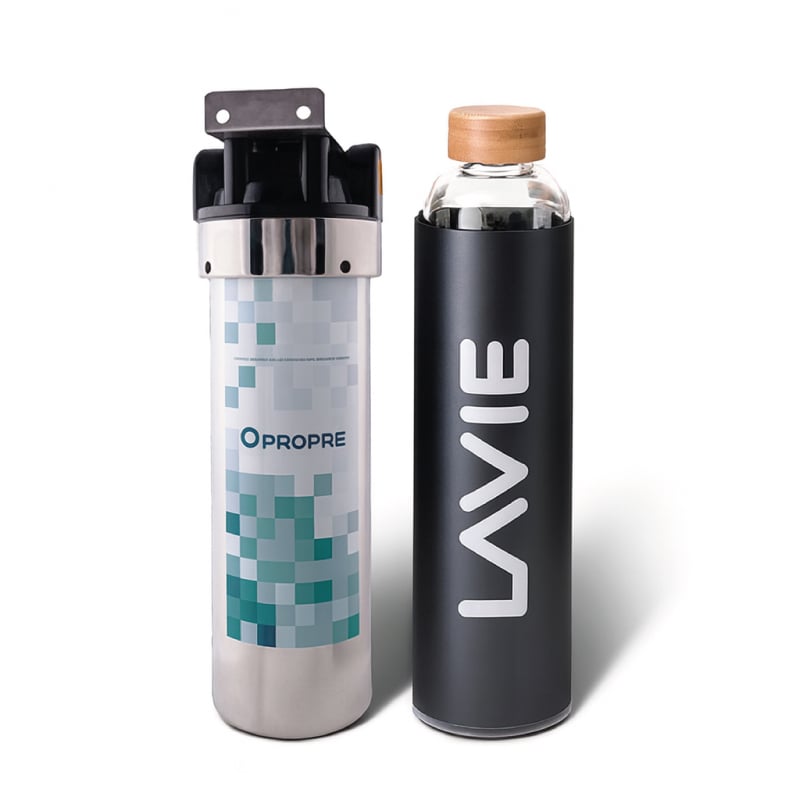
The Opropre under-sink filter from LAVIE works differently. It treats water directly at the source by capturing numerous contaminants, including eternal pollutants. And by combining it with the LAVIE purifier, which uses UV-A rays to neutralize bacteria and viruses at the time of consumption, we achieve a comprehensive and sustainable approach.
With a well-chosen tap water filter, it is possible to drink water of quality and greater safety.
Tap water or bottled water: which is better?
Bottled water may seem more reassuring. However, it is far from flawless. Studies have highlighted the presence of microplastics in samples of many bottled waters. These particles gradually accumulate in the body and impact our health.
Moreover, several scandals have called into question consumer trust in bottled water.
In addition, there are several drawbacks: high cost, bulky storage, transport of packs… And let’s not even mention the disastrous ecological impact, with tons of single-use plastic.
The danger of plastic water bottles is very real, both for the environment and for metabolism.
In light of this, filtered tap water appears as a much more balanced alternative. Cheaper, more ecological, and above all, more practical for daily use.
It allows for drinking higher quality water, directly at home.
Tap water: not perfect, but not without solution
So, is tap water really dangerous? It is drinkable, yes. But flawless, no.
PFAS, pesticides, sediments, toxic residues… Samples show that this pollution is present in a large part of the territory. And above all, their accumulation over the long term has an impact on human health.
But it is possible to take action.
Home filtration treatment allows for a significant reduction of these contaminants and improves the quality of water on a daily basis. The most effective approach is to intervene at two levels: treat at the source, then purify at the time of consumption.
This is exactly what the LAVIE Serenity Pack offers. The under-sink Opropre filter captures many substances such as PFAS, pesticides, and heavy metals before the water reaches the tap. Then, the LAVIE purifier uses UV-A rays to neutralize bacteria, viruses, and other unwanted elements, while preserving essential minerals.
Result: healthier, more pleasant drinking water, suitable for your daily life.