 French
 Spanish
 German
 Italian
 English
PFAS pollution in tap water is no longer a hypothesis. It is documented, measured, and mapped. Some municipalities have even had to ban its consumption. In the face of these eternal pollutants, many French citizens are questioning: is their water affected? Are the standards sufficient? And how can they effectively protect themselves?
PFAS are chemical substances used for their non-stick, waterproofing, and heat-resistant properties. They can be found in various products: textiles, food packaging, fire-fighting foams, industrial coatings, and pesticides.
The problem is that they persist in the environment, infiltrate soils, contaminate groundwater, and end up in tap water.
This pollution poses a real public health challenge. Several PFAS are already associated with cancers, hormonal disorders, and damage to the immune system.
And this water contamination is not limited to a few isolated areas. It is now widely spread in France. According to analyses conducted by UFC-Que Choisir and Générations Futures, 96% of the tested municipalities showed traces of PFAS in their drinking water. Is your region affected?
Research and monitoring continue. But in light of this reality, understanding the risks to human health and taking action becomes essential. Here’s how.
PFAS in tap water in France: a contamination that is spreading
PFAS in drinking water: analyses that raise concerns
The data is clear. The presence of PFAS in distributed drinking water is no longer exceptional.
Analyses conducted by UFC-Que Choisir and Générations Futures show detection of PFAS in 29 out of 30 samples taken in France. 96% of the tested municipalities therefore showed traces of PFAS in their tap water. This includes Paris, Lyon, Bordeaux, as well as Amiens, Orléans, Poitiers, Tours, and the surrounding areas of Rouen.
In other words, contamination is not limited to large metropolitan areas or isolated industrial zones. It clearly crosses every region. Yet monitoring and regulatory control by the Regional Health Agencies (ARS) are very strict in France.
Certain molecules, such as TFA (trifluoroacetic acid), have also been found in 24 out of 30 samples. In cities like Tours or near Rouen, analyses even revealed a true chemical cocktail; up to 11 different PFAS detected in a single sample.
These results on water quality can no longer be ignored. Taking action on our consumption habits is necessary.
PFAS in France: municipalities particularly affected
While contamination is widespread, some areas have already crossed a critical threshold.
In the Ardennes, the situation has changed. In July 2025, the consumption of tap water was banned for drinking and preparing baby bottles in 12 municipalities due to the excessive presence of PFAS. A month later, the same ban was extended to La Ferté-sur-Chiers. Unfortunately, these drastic measures are becoming increasingly common in France.
Some regions concentrate more sensitive points:
- The Grand Est, particularly around former industrial and military areas, where the massive use of these products has permanently affected groundwater.
- The Hauts-de-France, where the industrial legacy continues to influence water quality.
- Some municipalities in Île-de-France, particularly near industrial sites, where underground contaminations have been identified.
- The Provence-Alpes-Côte d’Azur region, around industrial and port areas.
To understand the extent of the phenomenon, you can view the national map, provided by the Ministry of Ecology, with various data and measurements on this water pollution. 39 sampling points exceed regulatory thresholds.
It should be noted that these controls only cover about twenty PFAS, while the family includes several thousand.
PFAS: what does French law provide?
Since January 2026, new measures have been taken. The search for 20 PFAS is officially mandatory as part of the health control of water, conducted by the Regional Health Agencies (ARS), in accordance with the European directive of 2020 (EDCH).
The regulatory limit set at 0.1 µg/L, or 100 ng/L, applies to the sum of these 20 substances in drinking water.
On paper, this is an advancement. In practice, these analyses are still too limited.
The decree n° 2025-1287, published on December 24, 2025, adds only two substances to the 20 PFAS required by European regulation: TFA and 6:2 FTSA. And these two molecules will only be included in health control starting in January 2027.
In other words, in 2026, official monitoring primarily focuses on 20 PFAS while the family includes several thousand.
Several scientific actors believe that the effort is insufficient. ANSES recommends including three additional PFAS in addition to TFA and 6:2 FTSA: 8:2 FTSA, MeFOSA, and EtFOSA.
ANSES also emphasizes the extent of TFA’s presence. Data shows that this molecule has been found at over 100 ng/L in 92.2% of the analyzed drinking water samples.
Meanwhile, the law n° 2025-188 of February 27, 2025, has initiated the gradual ban on certain products containing PFAS. Since January 1, 2026, cosmetics, ski wax, as well as certain clothing, shoes, and waterproofing agents can no longer be marketed when they contain these substances. The ban will be extended in 2030 to most textiles.
Monitoring is therefore advancing on two fronts: stricter control of water in each region and a reduction of pollution sources.
But in the face of persistent and massive substances, the results are still insufficient.
PFAS in tap water: what health risks?
PFAS are not mere chemical traces. They are substances designed to resist. That is why these eternal pollutants persist in the environment, particularly in drinking water. However, they also settle in our bodies.
This presence carries risks for human health. In 2023, the International Agency for Research on Cancer classified PFOA as carcinogenic and PFOS as possibly carcinogenic. Other scientific results associate prolonged exposure to PFAS with increased cholesterol, hormonal disorders, decreased fertility, and effects on the fetus. The immune system could also be weakened.
Children are particularly vulnerable. PFAS can affect growth, cognitive and behavioral development. Some studies have also observed a decrease in birth weight among exposed newborns.
In other words, the danger is progressive. These molecules remain in the blood. Each exposure adds to the previous one. And the body accumulates.
It is precisely this repeated consumption of PFAS that concerns health authorities.
Does the water in your region contain PFAS?
To find out if you are part of the affected municipalities and regions, the simplest way is to consult the independent platform 👉 https://dansmoneau.fr/
This interactive map compiles data and analyses from the health control of water conducted by the Regional Health Agencies (ARS). The results are presented by distribution network, allowing for local, precise, and updated information.
Two elements are distinguished:
- regulatory compliance (whether or not the quality limits set by law are respected)
- potential health risk.
Be aware that when you consult this map, the absence of exceedance does not mean the total absence of pollutants in your region. The measurements cover a limited number of substances, with thresholds defined by regulations.
However, this situation does not mean that the water is not drinkable. But it reminds us of a reality: pollution is diffuse, persistent, and difficult to eliminate through conventional treatments.
PFAS are not the only culprits. Agricultural pesticides, persistent metabolites, industrial residues, heavy metals… Almost everywhere in the country, the water distributed in municipalities contains traces of various chemical products. A contaminated tap water rarely contains a single pollutant, but rather a mixture of toxic elements.
What measures should be taken to protect one’s health?
How to reduce PFAS in your tap water?
Regulatory health control is improving, but drinking “compliant” water is no longer enough to reassure. In the face of these persistent pollutants, taking action at home becomes necessary.
For better water quality, solutions exist: filter jugs, under-sink filters, reverse osmosis…
But against PFAS, not all are equal. Some partially purify. Others waste liters of water. Some give an illusion of protection.
So, which water filter against PFAS is truly effective?
Opropre: a reinforced activated carbon filter against PFAS
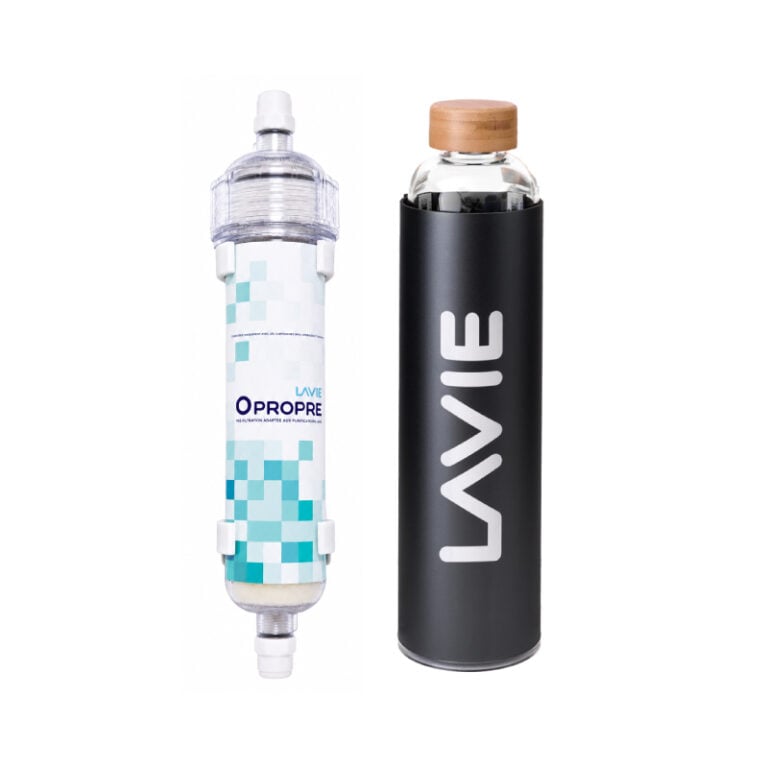
With Opropre, everything happens at the source. The system is installed under the sink and works continuously for effective tap water filtration on a daily basis. The water supplied is filtered and of high quality even before it comes out of the tap.
What makes it the most effective?
Its device combines high-performance activated carbon, derived from coconut shells, with an ion exchange resin specifically designed to capture PFAS.
Why is this combination important?
Activated carbon is known for its adsorption capacity. It retains many organic contaminants: chlorine, pesticides, industrial residues, microplastics. However, certain molecules, particularly PFAS, are more difficult to capture.
The specific resin enhances this action. It acts as a targeted trap for particularly persistent substances. In other words, complete filtration for healthy and beneficial water consumption.
The results of scientific analyses on Opropre are available here.
And unlike some solutions, Opropre does not demineralize the water. Essential minerals remain present. You filter out contaminants, not the elements necessary for your health.
Another key point in its use: sustainability.
The cartridge is replaced every six months. It is returned, recharged with new activated carbon, and reintegrated into a specialized industrial circuit. Less waste! Less plastic!
A technical and sustainable solution designed to provide you with quality and healthy water.

Filter jugs against PFAS: insufficient results
The use of filter jugs has become a reflex in many households. Simple, accessible, and compact, it improves the taste of water by reducing chlorine.
But against PFAS, the results are not satisfactory.
Most models rely on standard activated carbon capable of capturing certain organic contaminants. However, it was not designed to effectively retain the most persistent substances like PFAS.
And the limitations do not stop there.
- Ineffective against PFAS: depending on the models and replacement frequency, the reduction is almost nonexistent.
- Frequent cartridge replacement: on average every 3 to 4 weeks. Beyond that, their performance drops.
- Health risk in case of insufficient maintenance: a humid and stagnant environment can promote bacterial growth.
- Significant environmental impact: cartridges thrown away every month, not recycled, and an accumulation of plastic waste.
UFC-Que Choisir rightly relays in its article titled “Useless, or worse!” the data from ANSES analyses on the filtration capacity of these jugs. The title is more than telling.
Choosing a filter jug against PFAS may seem reassuring. But against molecules designed to resist for decades, the results remain largely insufficient.
💧Read also: Filter jug: Is it effective against PFAS?
Reverse osmosis: effective, but unsuitable for consumption
Reverse osmosis is often presented as the most effective solution for eliminating PFAS. Thanks to its ultra-fine membrane, it can retain up to 99% of contaminants, including eternal pollutants.
From a technical standpoint, it is effective. But in daily use, several limitations arise:
- Demineralized water
Calcium, magnesium, trace elements… Everything is eliminated. The result: impoverished and more acidic water, which requires remineralization.
- Costly and cumbersome system
Installation is often carried out by a professional. Regular replacement of filters, membranes, and cartridges. Technical management is essential to maintain performance. Over time, the budget increases rapidly!
- Water wastage and significant environmental impact
To produce one liter of filtered water, 2 to 4 liters may be discarded. The loss becomes catastrophic. Additionally, membranes and filters need to be periodically replaced, rarely recycled.
Choosing reverse osmosis against PFAS may provide reassurance due to its effectiveness. But its use is not suitable for daily consumption.
PFAS in tap water: the solution to better protect yourself
The presence of PFAS in tap water is now a reality in France. Regulation is progressing, but exposure remains daily. And PFAS are not the only pollutants. Pesticides, heavy metals, microplastics, pharmaceutical residues, bacteria… Water can contain several contaminants at once.
The solution is therefore simple: act on two levels.
At the source, with the Opropre under-sink filter. It retains PFAS, heavy metals, and microplastics even before the water reaches your glass.
Then at the moment of drinking, with LAVIE UV-A purifiers. They neutralize bacteria, viruses, and certain chemical residues without removing essential minerals.
The LAVIE Serenity Pack combines these two actions. Fewer pollutants. Less exposure. More control.
A concrete response to tap water contaminated by PFAS and other undesirable substances.