 French
 Spanish
 German
 Italian
 English
When it comes to hydrating your baby, every detail matters to protect their health. Should bottled water be prioritized? Can tap water really be trusted? These questions arise with every bottle preparation.
However, many misconceptions continue to circulate, whether regarding spring water or mineral water. Perceived as the safest, the latter is far from being the best water for babies.
In this article, we clarify the facts to help you distinguish between truth and falsehood. The goal: to assist you in making a calm and informed choice for the well-being of your infant.
Tap water, a safe and recommended solution
Contrary to popular belief, health authorities are clear: in France, tap water is perfectly suitable for babies. It undergoes rigorous daily testing across dozens of quality criteria, ensuring safe and potable water for consumption.
In fact, it is the most monitored food product in the country. The Ministry of Health recommends its use for preparing bottles, as long as potability is confirmed. This is the case in the vast majority of French territory.
To be completely assured, you can consult the results of the analyses from your municipality’s network, available at the town hall or directly on the government website: eaupotable.sante.gouv.fr
In addition to being healthy for your baby’s well-being, the water from your home is also more ecological (zero plastic waste, no emissions related to transport), more economical (up to 300 times cheaper than bottled water), and much more practical on a daily basis (no more packs to carry, store, and sort/dispose of).
When used properly (see our tips at the end of the article), this water is therefore an excellent option for hydrating your baby while simplifying family life.
💧Read also : Tap water: is it safe for your baby?
Mineral water for babies: 3 persistent myths
Many parents believe they are doing the right thing by choosing mineral water to prepare their baby’s bottles. It is often perceived as healthier, especially since some brands label their products as “suitable for infants.” But beware: this indication does not mean that the water is ideal for your child’s health. Why? Because natural mineral waters are not subject to the same potability criteria set by the WHO.
As pediatrician Emmanuel Delmas reminds us: “Mineral water is not at all necessary for children’s development or their nutritional needs.”
Let us revisit the 3 myths about this water to provide better hydration for your little one.
💧Read also : Mineral water for babies: is it really recommended?
A very low mineral water is needed for a baby
This is a widely held belief, but it is not scientifically founded. Many think that very low mineral water would be gentler, more digestible, and therefore necessarily better for infants.
In reality, no. Waters with minimal mineral content cannot be considered potable according to WHO criteria. They no longer meet physiological needs. For a growing baby, this is obviously far from ideal.
Just look at the composition of breast milk: the most suitable food for infants is naturally rich in minerals like calcium or magnesium.
Completely removing these elements from water makes no sense. Your baby is neither a car battery nor an iron that we reserve the use of distilled water without minerals.
Mineral water relieves colic and constipation in babies
When a baby seems uncomfortable, constipated, or prone to colic, many decide that they need to change water. As a result, parents opt for mineral water in the bottle, supposed to “promote transit”.
However, no scientific study confirms that this type of water alleviates and improves the digestion of infants. Pediatrician Emmanuel Delmas is very clear: “Often parents think their baby is constipated, but that is not the case. The first reflex in case of doubt is to consult a healthcare professional. But the second question is, is there any benefit to using these specific mineral waters in case of constipation? The answer is no.”
Changing water is therefore not the solution. It is better to seek advice from a professional rather than relying on misconceptions.
Bottled water is purer and pollutant-free
At first glance, it is reassuring: the water is sealed, sold by major brands, sometimes even labeled “special for infants.” So one thinks that bottled water is cleaner, better filtered, and therefore healthier.
But the reality regarding its quality is quite different. Numerous analyses have demonstrated the presence of microplastics, PFAS, and chemical substances in several packs. These elements are invisible to the naked eye but are well established and harmful.
And that’s not all. The Nestlé scandal revealed that some waters presented as “spring” or “mineral” actually came from the public network, filtered with unauthorized processes, and then sold at a high price.
Finally, it is difficult to ignore the environmental impact: single-use plastic, emissions related to transport, polluting waste…
Bottled water is therefore far from being a sustainable and quality solution.
The real danger for babies: bacteria in water
This is not what we think of first. Yet, bacterial contamination is one of the greatest risks for your baby. Much more than mineral content or the presence of chlorine or nitrates, it is the invisible bacteria and viruses that can cause the most serious damage to a newborn, whose immune defenses are still fragile.
This risk is much more common than one might think, particularly with traditional filtering pitchers, often perceived as safer. When poorly maintained, they become real breeding grounds for bacteria. UFC-Que Choisir does not mince its words and titles its article: “Useless, or worse!”. For its part, ANSES warns about microbiological contaminations related to their improper use. A paradoxical situation when the consumer pays a premium.
It is to avoid these pitfalls that LAVIE designed the UV-A filtering pitcher: a solution without filters, without chemicals and without waste, which eliminates bacteria, viruses, chlorine, pesticides, and pharmaceutical residues while preserving the essential minerals for your newborn’s growth.
Healthy, reliable water that is truly suitable for little ones.

How to prepare a bottle with safe water?
With the LAVIE UV-A pitcher
With the LAVIE UV-A filtering pitcher, purifying your water becomes simple and quick, perfect for your child’s health.
Here’s how to do it:
- Fill your LAVIE bottle with cold tap water.
- Plug the purifier into a power outlet, then place the bottle in the case.
- The UV-A technology comes into action: in 15 minutes, the light rays trigger a natural process called photolysis, which eliminates bacteria, viruses, chlorine, pesticides, and pharmaceutical residues.
Once the cycle is complete, the water is purified while retaining essential minerals. You can then prepare your baby’s bottle as usual, adding the infant formula.
Result: hydration and healthy water, free of pollutants and chemicals, suitable for the whole family and especially for little ones.
Without a purification system
If you are not using a purification system like the LAVIE UV-A pitcher, it is essential to adopt the right practices to limit risks associated with water quality.
- Always use cold water, never lukewarm or hot, as it may contain more contaminants.
- Let the water run for a few seconds before filling the bottle.
- Avoid any contact with the tap spout, which can transmit bacteria to the bottle.
- For infants under 6 months, it is recommended to boil the water for one minute, then let it cool before adding the infant formula.
These simple actions help reduce bacterial risk, but they require diligence and vigilance on a daily basis.
The best water for baby? What to remember
In daily life, tap water remains the most suitable for preparing your baby’s bottles. It is safer, more convenient, at a more than reasonable price, and environmentally friendly. Of course, provided that it is potable and used under good conditions.
But like mineral or spring water, it can contain invisible contaminants: chemical residues, microplastics, or harmful bacteria. And these risks are even more concerning for infants, whose immune systems are fragile.
To ensure truly healthy water, it is therefore recommended to purify it with effective and sustainable technology.
The solutions developed by LAVIE, such as the UV-A filter jug or the Opropre under-sink filter, help to eliminate pollutants while preserving the essential minerals for your baby’s growth.
Result: safe water, perfectly suited to the needs of your baby and the whole family.
|
Filtered, reduced, or eliminated element |

Under-sink Opropre filter |

LAVIE Purifier |
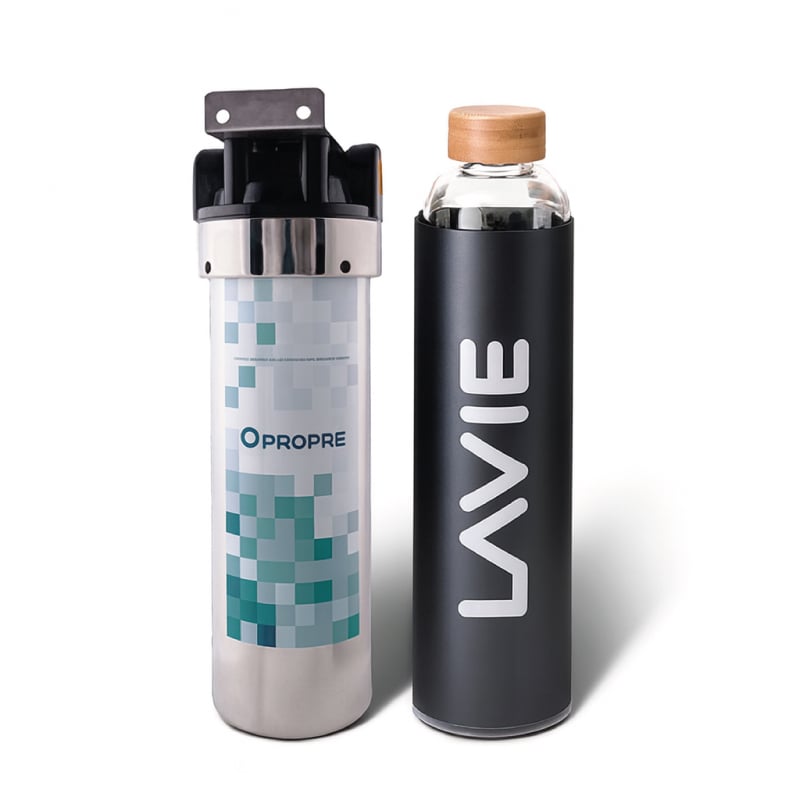
Serenity pack (Opropre + LAVIE PURE) |
| Chlorine | ✅ | ✅ | ✅ |
| Sediments | ✅ | ❌ | ✅ |
| Bacteria | ❌ | ✅ | ✅ |
| Viruses | ❌ | ✅ | ✅ |
| Medicines | ✅ | ✅ | ✅ |
| Pesticides | ✅ | ✅ | ✅ |
| Heavy metals | ✅ | ❌ | ✅ |
| PFAS | ✅ | ❌ | ✅ |
| Microplastics | ✅ | ❌ | ✅ |
| Preservation of beneficial minerals | ✅ | ✅ | ✅ |
| Discover | Discover | Discover |