 French
 Spanish
 German
 Italian
 English
When one becomes a parent, every choice related to their baby’s nutrition raises a thousand questions. And water is no exception to this rule!
While health authorities recommend tap water for preparing baby bottles, many parents instinctively think that bottled water is safer. However, mineral or spring water does not guarantee that it is free from pollutants such as PFAS, pesticides, or pharmaceutical residues!
As revealed by the Nestlé scandal, there are even instances where you are charged a premium for water supposedly “mineral,” when in reality… it is tap water, filtered.
So, is tap water suitable for a baby? Are there precautions to take? And above all, how can one permanently eliminate contaminants that may be present in the water?
The answers to all these questions in this article!
Why water quality is crucial for babies
If bottled water often inspires more confidence in young parents, it is mostly due to habit or recommendations from poorly informed pediatricians. However, tap water in France is perfectly suitable for infants.
In its early childhood guide, the Ministry of Health even explicitly recommends using this water for preparing baby bottles. And for good reason! In France, the quality of drinking water is subject to very strict monitoring, ensuring its safety.
Tap water is therefore safe, but also recommended for babies. Bottled mineral water does not provide any particular nutritional advantage.
Does tap water pose health risks for an infant?
As we have just mentioned, tap water is the most controlled food in France: its quality is continuously monitored by regional health agencies. Moreover, it has numerous advantages compared to bottled water.
An economic advantage, first of all: bottled water is 100 to 300 times more expensive than tap water! (Yes, you read that right!)
It is also much more practical for young parents: there is no need to transport packs of water from the supermarket, nor to find space to store them at home, not to mention the time spent dropping them off in the recycling bin.
Not to mention the ecological aspect: consuming tap water helps reduce plastic waste, while providing a comparable water quality for the baby.
The minerals contained in tap water
A widely held misconception suggests that one should prioritize a very low mineral water for young children. This is, in fact, the preferred marketing argument of certain bottled water brands.
However, most bottled waters marketed as “ideal” for infants are so low in calcium and magnesium that they do not meet the criteria for drinking water set by the WHO!
The contradiction is all the more striking when we know that breast milk naturally contains a lot of calcium and magnesium. Why then advise parents to use water low in minerals?
So far, no scientific study has demonstrated that an infant needs low mineral water, and no study has shown that tap water would not be suitable for babies!
The risk of bacterial contamination
The real danger associated with the water used for babies is microbiological contamination (bacteria, viruses). This is why it is recommended to take some precautions for preparing baby bottles, such as using cold water, letting it run for a few seconds, or boiling it before using it with infant formula.
However, to completely eliminate the bacterial risk, you can also use the LAVIE water purifier, which works in just 15 minutes to eliminate bacteria and viruses thanks to UV-A rays, while preserving all essential elements and minerals of the water (scientific tests to support this!).
Possible undesirable contaminants
Finally, like any water intended for human consumption (whether bottled or tap), water can contain undesirable contaminants that may be potentially dangerous to health:
- traces of pesticides,
- pharmaceutical residues,
- microplastics and nanoplastics,
- “forever chemicals” or PFAS…
Fortunately, there are effective and economical solutions to eliminate these pollutants, which improve the quality of tap water for the whole family.
How to improve the quality of tap water?
Even though tap water is heavily monitored in France, the current standards are based on thresholds that, while effective, do not cover all substances present in the water. For example, pharmaceutical residues and endocrine disruptors are not always systematically monitored, even though their presence may pose long-term risks.
Here are two complementary solutions that allow you to enjoy pure and healthy water at home, both for the baby and for the everyday use of the whole family.
The LAVIE UV-A Filter Jug
Unlike traditional filter jugs that can encourage bacterial proliferation when not used correctly (see here our complete review of the filter jug), the LAVIE jug uses UV-A purification technology that requires no filter or consumables.
This patented innovation, tested by independent laboratories, uses chlorine photolysis, a natural process that:
- destroys chlorine,
- eliminates bacteria and viruses,
- reduces traces of pesticides and pharmaceutical residues,
- improves the taste and quality of the water.
The LAVIE UV-A jug is therefore the perfect solution to purify tap water before using it for baby bottles!

The Opropre Turquoise under-sink filter
In addition to UV-A purification, the Opropre Turquoise filtration system is installed on the water supply under the sink to specifically target the most persistent pollutants:
- PFAS,
- heavy metals (lead, mercury, cadmium…),
- microplastics and nanoplastics,
- pesticides
- …
Its effectiveness relies on the combination of high-quality coconut activated carbon and a specific anti-PFAS resin. Unlike a conventional filter, Opropre Turquoise contains an amount of activated carbon approximately 15 times higher, allowing it to effectively block high levels of pollutants for several months.
The filtration cartridge should be replaced every 6 months and operates on a deposit and recharge system to avoid generating unnecessary waste. The carbon and resin are then recycled through specialized channels.

LAVIE and Opropre, two complementary products
By combining the Opropre Turquoise under-sink filter (pre-filtration) with the LAVIE UV-A jug, you enjoy perfectly healthy and safe water for your baby as well as for the whole family!
To go further and better understand the differences between the available solutions, you can also make a comparison of tap water filters thanks to our dedicated article! This comparison will help you identify the most suitable filtration technologies for your needs, depending on the contaminants to be treated and your daily water consumption.
|
Filtered, reduced, or eliminated element |

Under-sink Opropre filter |

LAVIE Purifier |
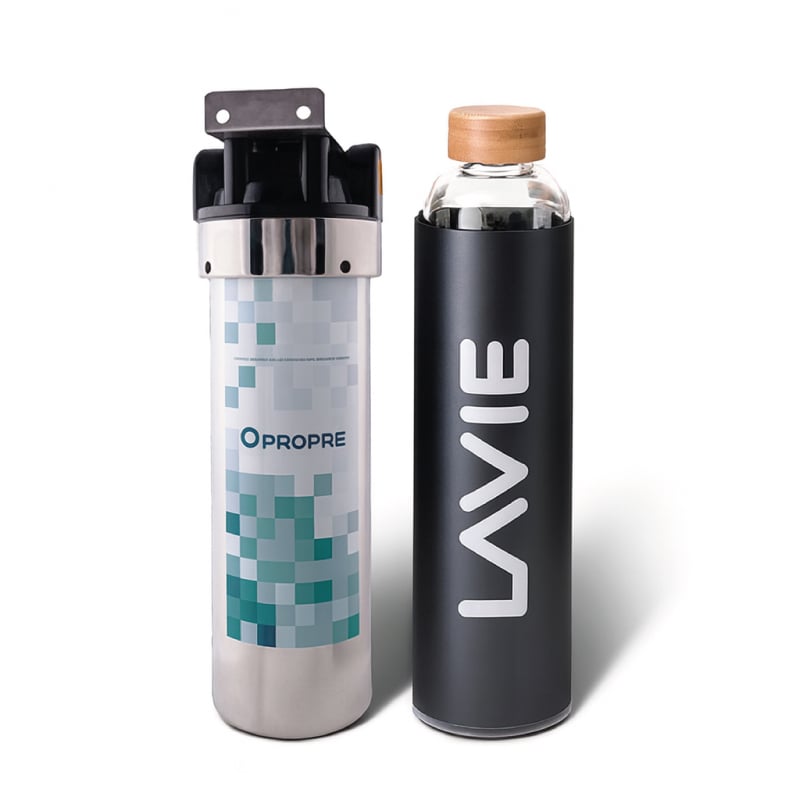
Serenity pack (Opropre + LAVIE PURE) |
| Chlorine | ✅ | ✅ | ✅ |
| Sediments | ✅ | ❌ | ✅ |
| Bacteria | ❌ | ✅ | ✅ |
| Viruses | ❌ | ✅ | ✅ |
| Medicines | ✅ | ✅ | ✅ |
| Pesticides | ✅ | ✅ | ✅ |
| Heavy metals | ✅ | ❌ | ✅ |
| PFAS | ✅ | ❌ | ✅ |
| Microplastics | ✅ | ❌ | ✅ |
| Preservation of beneficial minerals | ✅ | ✅ | ✅ |
| Discover | Discover | Discover |
How to prepare a baby bottle with tap water?
Tap water can indeed be used to prepare your baby’s bottles. Here are some simple precautions to follow to avoid bacteria:
With the LAVIE UV-A filter jug
- Fill your LAVIE bottle with tap water.
- Plug your purifier into a power outlet, and place the bottle in the case. The UV-A rays from the LEDs trigger the photolysis process that eliminates bacteria, viruses, traces of pesticides, pharmaceutical residues, and chlorine in just 15 minutes!
- After 15 minutes, the water is ready! Prepare your bottle as usual by adding the infant formula.
Without a purification system
- Always use cold water (hot water may contain more contaminants).
- Let the tap water run for a few seconds before collecting it.
- Avoid contact with the faucet spout which may transmit bacteria.
- Boil the water for one minute for infants under 6 months. Then, let it cool before diluting the infant formula. This helps eliminate any bacteria present in the water.
What precautions should you take if you use tap water for your baby?
Tap water is perfectly suitable for infants. It is also more economical, ecological, practical, and, contrary to popular belief, just as good as bottled water for the baby’s needs.
For safe use, avoid traditional filter jugs (with filters), which encourage bacterial proliferation and therefore pose a risk for the little ones (see the Que Choisir investigation on this subject).
For more peace of mind and to obtain the best possible quality water for the whole family, here are the LAVIE solutions we recommend:
- The LAVIE UV-A jug, which eliminates bacteria, viruses, chlorine, pesticides, and pharmaceutical residues.
- The Opropre Turquoise under-sink filter, which effectively retains persistent pollutants, heavy metals, and microplastics.
To choose the most suitable solution for your baby, it is important to thoroughly compare the available technologies and their performance against various contaminants. If you are wondering what to choose to filter tap water, it may be relevant to prioritize complementary systems that can address both persistent pollutants and improve the overall quality of the water, while remaining sustainable and environmentally friendly.
Discover our various products in our store now!