 French
 Spanish
 German
 Italian
 English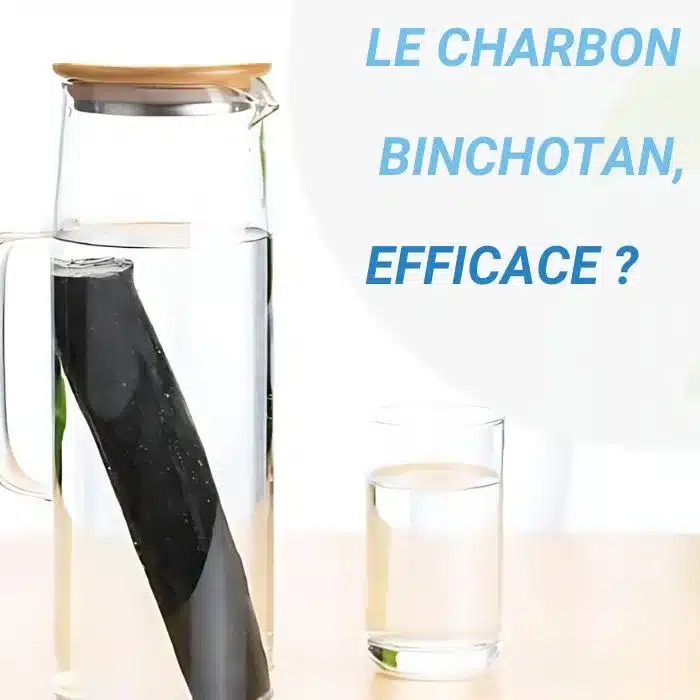
Do you want to purify your tap water with binchotan charcoal, or its Chinese version made from bamboo charcoal?
Marketed as natural, eco-friendly, and reusable, binchotan charcoal promises to filter contaminants from tap water and improve its taste. But what is the reality?
- What do scientific reviews say about binchotan charcoal?
- Are there dangers to using it daily?
- And above all, what is the best activated charcoal for purifying water?
In this article, we take stock of this natural purification method, to help you determine whether binchotan charcoal deserves a place in your carafe or if it is better to consider other alternatives.
What is binchotan?
For those who do not use it, it is first necessary to explain the exact nature of this particular type of charcoal.
Binchotan is an activated charcoal
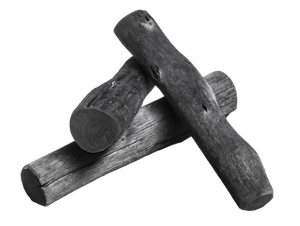
Binchotan charcoal is a type of activated charcoal made from organic materials such as wood, coconut shells, or sugar residues. It is produced by burning these materials at high temperatures, creating microscopic pores in the charcoal. These pores allow the activated charcoal to capture certain impurities from water or air (a phenomenon called “adsorption,” which is different from absorption).
Activated charcoal is therefore often used in the cartridges of your filtering carafes, for example (But is it effective? See our review of the filtering carafe).
Binchotan: a specific type of Japanese wood
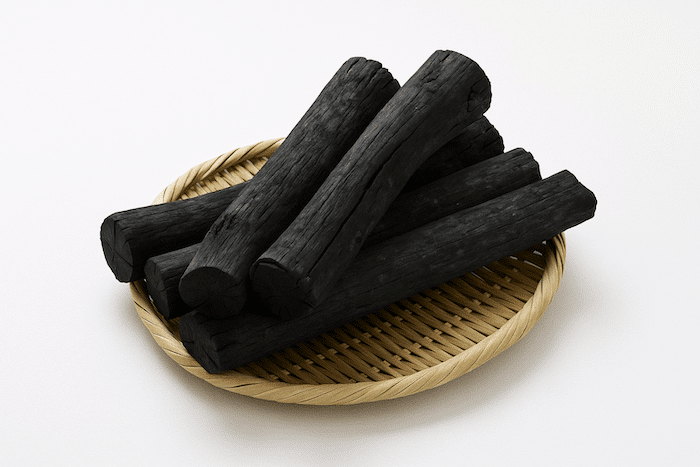
The white binchotan charcoal is a type of Japanese activated charcoal made from the green oak “ubamegashi” from Japan. This oak primarily grows in a region formerly known as the province of Kishu, specifically in the city of Wakayama (other cities and regions in Japan also produce it today).
It is made using a low-temperature combustion process in which the wood is burned in a clay oven for several days. This creates very dense and hard charcoal sticks with a relatively smaller specific surface area than that of conventional activated charcoals, but with a higher adsorption capacity.
Some therefore consider binchotan as effective for water and air purification due to their ability to adsorb impurities and odors.
The Kishu Binchotan charcoal is considered to be of the highest quality, thanks to the quality of the wood used and the craftsmanship and experience of local producers.
What do scientists say about the effectiveness of binchotan charcoal?
Binchotan charcoal may have an effect on the taste of water, which many users notice on a daily basis.
However, to date, there are very few independent scientific studies clearly demonstrating its effectiveness in eliminating certain pollutants present in tap water, such as heavy metals, pesticides, or pharmaceutical residues.
According to Yves Levi, a public health professor and water specialist: “The products sold online that claim to be ancestral magic charcoal from Japan or other countries are allegations that persons cannot verify anything.”
Available analyses remain limited to accurately assess its action on these various contaminants.
Several sources, including this article from L’Express, also highlight this lack of solid scientific results, particularly regarding the actual effectiveness of binchotan charcoal on chemical pollutants.
Binchotan charcoal: what dangers?
Authentic and properly used binchotan charcoal is not considered dangerous in itself.
However, as with many natural products, quality can vary depending on manufacturing methods and the origin of the charcoal. Not all products marketed under the name “binchotan” necessarily have the same characteristics.
It is therefore important for consumers to verify the origin, quality, and manufacturing conditions of the product to ensure its safe use.
Moreover, scientific data remains limited regarding its effectiveness on certain pollutants present in tap water, such as heavy metals, pesticides, pharmaceutical residues, or PFAS.
It is important to keep in mind that binchotan charcoal does not constitute a complete filtration solution, and its use alone does not guarantee a comprehensive elimination of contaminants.
💧 Read also: What is the best filter for tap water?
Is binchotan really eco-friendly?
Binchotan charcoal is often presented as a natural and eco-friendly solution for filtering tap water.
But in reality, its environmental impact is more nuanced than it appears.
Its production relies on the combustion of wood at very high temperatures for several hours, even days. An energy-intensive process that generates emissions, particularly CO₂ and particles.
Additionally, there are transportation stages, often over long distances, as well as the packaging necessary for its preservation, which also contribute to its overall carbon footprint.
In other words, even though it is a product of natural origin, binchotan charcoal is not as eco-friendly as one might think at first glance.
However, it does have an advantage at the end of its life: it is biodegradable and can be reused or recycled more easily than some traditional filters.
Is boiling binchotan enough to regenerate it?
Boiling binchotan charcoal allows for cleaning and limiting the development of bacteria.
However, this is not enough to restore its adsorption capabilities. To truly “reactivate” the charcoal, temperatures of around 1200°C are necessary! Far beyond what a domestic oven can provide.
Another point to keep in mind: there are few precise benchmarks regarding its duration of effectiveness. The recommended replacement frequency remains vague, as does the volume of water it can actually treat over time.
Some recommendations suggest boiling it once a week. While this may contribute to its maintenance, it also implies additional energy consumption that adds to its environmental impact.
In other words, maintaining binchotan is useful, but does not guarantee consistent effectiveness over time.
How much does binchotan charcoal cost?
Binchotan charcoal represents a certain budget over time.
For a Japanese model used in a 1-liter carafe, expect to spend about €40 per year. Over 5 years, that amounts to nearly €200. This is less than the regular purchase of plastic bottles, but it is not a free solution either.
There are also cheaper versions available on the market. However, depending on the products, quality can vary, particularly based on origin and manufacturing method.
It is therefore advisable to take the time to verify what you are purchasing to avoid unpleasant surprises.
What is the best charcoal for purifying water?
Between binchotan, more advanced activated charcoal filters, and complementary solutions such as UV-A purification, performance and uses can vary.
To clarify, here is a comparison between binchotan charcoal and the solutions offered by LAVIE, such as the Opropre Turquoise under-sink filter and the UV-A water purifier, which complements filtration at the time of drinking.
|
Criterion |
Binchotan charcoal |

Opropre under-sink filter |

LAVIE UV-A filtering carafe |
| Type of filtration | Activated charcoal stick | Coconut activated charcoal + targeted anti-PFAS resin | UV-A purification (photolysis of chlorine) |
| Water quality | 💧 | 💧💧💧 | 💧💧💧 |
| Filtered pollutants | Chlorine taste
Some odors |
Chlorine
Sediments Heavy metals Microplastics and nanoplastics Pesticides PFAS |
Chlorine
Sediments Bacteria Viruses Traces of medications Traces of pesticides |
| Effectiveness | ❌ Not proven (no scientific study) | ✅ Proven: See our independent lab tests | ✅ Proven: See our independent lab tests |
| Amount of water filterable per day |
❌ 2 to 3 L maximum (4 hours per liter) | ✅ Unlimited | ✅ Dozens of liters per day (15 min to filter 1 L) |
| Duration of effectiveness | A few weeks to a few months (variable, not measured) | 6 months per cartridge (15x longer than a filter jug) | Unlimited (No cartridge replacement!) |
| Ecological impact | ❌ High:
Burned oak at very high temperatures (CO2 and fine particles emissions), long-distance transport… |
✅ Low:
LAVIE cartridges are returned and recharged. Activated carbon and resin recycled in specialized circuits. |
✅ Low:
Operation without filters or consumables, low electricity consumption thanks to LEDs |
| Installation | ✅ None | 🟠 To be installed under the sink | ✅ None (plug-in connection) |
| Purchase price | € | €€ | €€ |
| Recurring price | € | € | None! |
| Discover | Discover |
Opropre, the under-sink coconut shell activated carbon filter
This under-sink filtration system uses high-quality coconut activated carbon and a specially developed resin to capture PFAS, these “forever chemicals” that escape the majority of consumer filters.
The advantages of the Opropre Turquoise filter:
💧 A scientifically proven efficiency: through tests conducted in an independent laboratory
💧 Purer and healthier water: the filters are capable of eliminating chlorine, heavy metals, microplastics, and nanoplastics as well as PFAS.
💧 An ecological and responsible solution: The cartridges of our filters have a lifespan of 6 months and are returned and refilled. The activated carbon and resin are then recycled in dedicated industrial circuits.
In short, Opropre Turquoise guarantees pure and quality water at home, without compromising your wallet or the environment!

LAVIE, the filterless water carafe!
What if purifying your tap water did not require a filter? This is exactly what the LAVIE water purifiers offer, thanks to an innovative and patented technology: the photolysis of chlorine by UV-A radiation.
How does it work?
In just 15 minutes, UV-A rays act on the water to eliminate chlorine and its derivatives, neutralize pesticides, pharmaceutical residues, bacteria, and microorganisms, while preserving essential trace elements and minerals!
Result: healthy water, without unpleasant taste or odor, and respectful of your health. As simple as a filter carafe, with fewer drawbacks!