 French
 Spanish
 German
 Italian
 English
Installing an under-sink water filter means saying goodbye to bulky and polluting plastic bottle packs, to doubts about the quality of tap water, and making a real gesture for your health and the planet. Discreet, practical, and efficient, this system is increasingly appealing to households seeking a sustainable, healthy, and ecological solution.
Indeed, the Opropre range from LAVIE ticks all the boxes: effectiveness, longevity, ease of use… In other words, it is a concentrate of benefits for you, your family, and the environment.
But among all the available options, which devices are truly reliable and adapted to your needs?
We help you see more clearly to choose the best under-sink water filter, with complete confidence.
The different under-sink filtration systems
When it comes to purifying tap water with an under-sink filter, several options are available to you: reverse osmosis, classic under-sink filter, the Opropre range… But not all are equal. We will detail the different systems in this comparison of water filters.
Indeed, between effectiveness, maintenance, ecological impact, and cost, the differences are significant and directly influence the quality of the water you drink every day. Each system has its advantages, disadvantages, and limitations, especially when it concerns your health or the environment.
Here is a clear and accessible comparison to help you make the best choice.
|
System |

Reverse Osmosis |

Classic Under-Sink Water Filter |

Opropre Turquoise LAVIE |
| Type of filtration | Reverse osmosis | Ceramic membrane + activated carbon | Activated carbon + anti-PFAS resin |
| Water quality | 💧 | 💧💧 | 💧💧💧 |
| Filtered elements | Chlorine Sediments Bacteria and viruses Heavy metals Pesticides Trace elements |
Chlorine Sediments Heavy metals |
Chlorine Sediments Heavy metals Microplastics and nanoplastics Pesticides PFAS |
| Installation difficulty | ❌ Complex (Professional recommended) |
✅ Easy | ✅ Easy |
| Ecological impact | ❌ Very high: Discharge of polluted water (3–4 L per liter purified) + disposable filters + disposable membrane |
❌ High: non-recyclable filter with concentration of pollutants. |
✅ Limited: LAVIE cartridges are returned and refilled. Recycled activated carbon. |
| Initial cost | €€€ | €€ | €€ |
| Recurring costs | €€ (Regular maintenance by a professional, cost of consumables) |
€ (Filter to be changed every 6 months) |
€ (Filter to be changed every 6 months) |
| Discover |
Focus on these under-sink filters: advantages and disadvantages
Each filtration system has its specificities, promises, and limitations. To make an informed choice, it is essential to understand what each truly offers in terms of performance, practicality, cost, and ecology.
Let us decode these under-sink filters together to select the one most suited to your lifestyle.
Not all filters are equal! The experiment conducted by M6 on microplastics
In the report Zone Interdite (“Our health in danger: revelations about this plastic that poisons us,” aired on March 8, 2026), independent researcher Jean-Baptiste Fini, a microplastics specialist, compared three filtration systems using deliberately contaminated water.
The results, analyzed by an independent laboratory, show significant differences in effectiveness:
- The gravity filters are the least effective: they filter only 30% of microplastics, allowing the majority of particles to pass through.
- The reverse osmosis systems retain about 60% of microplastics.
- While the Opropre activated carbon filter proved to be the most effective, eliminating 75% of the microplastics present in the contaminated water!
Conclusion: while filtration generally reduces the presence of microplastics, the choice of system makes a major difference in your actual daily exposure.

Water Reverse Osmosis
The water reverse osmosis is often presented as the ultimate in under-sink filtration. Thanks to its semi-permeable membrane, it has the ability to eliminate the vast majority of contaminants present in water: chlorine, heavy metals, pesticides, viruses, bacteria… But it also filters out beneficial minerals such as calcium and magnesium. The result: the water that comes out of the tap is depleted of trace elements, too acidic, and generally requires remineralization, possible only on high-end models, and still with low mineral levels, below the recommendations of the World Health Organization.
Moreover, by removing chlorine, your water becomes more vulnerable to bacteria. A proliferation can then quickly occur in the tanks or outlet pipes due to stagnation and the lack of disinfecting protection.
In addition, there are several constraints: a complex installation requiring professional intervention, regular maintenance (sediment filter, membrane, remineralization filter…), bulkiness, and a high overall cost.
But that’s not all! Its ecological impact is hard to ignore: to produce 1 liter of filtered water, the reverse osmosis system discharges between 2 and 4 liters of polluted water.
In summary: the reverse osmosis system offers very advanced filtration, but at the cost of many compromises, for you and for the planet. It also has a very high cost per liter.
Advantages
✅ Eliminates the vast majority of pollutants (chlorine, sediments, heavy metals, pesticides, viruses, bacteria)
✅ Very fine filtration
Disadvantages
❌ Bacterial proliferation in tanks and pipes
❌ Eliminates beneficial minerals (calcium, magnesium…)
❌ Acidic water output caused by the absence of mineral salts
❌ Discharges 2 to 4 liters of polluted water for 1 liter filtered
❌ Significant bulk under the sink
❌ High purchase and maintenance costs (membrane, filter, remineralization…)
❌ Non-ecological disposable consumables
❌ Very low flow rate, around 1l/min
❌ A noisy pump on some models
❌ An additional faucet to be installed on the countertop (drilling)
Classic Under-Sink Water Filter
Classic under-sink water filters consist of an activated carbon filter cartridge and/or a ceramic membrane. Their mission? To retain chlorine, sediments, and certain heavy metals while improving the taste of the water. Practical and easy to install, this filtration system represents a positive response to concerns about your tap water.
However, their effectiveness remains partial. These filters do not remove bacteria, viruses, or persistent pollutants like PFAS. Moreover, low-quality activated carbon, particularly that of fossil origin, can release compounds that are far more dangerous than the pollutants it is supposed to “adsorb.”
From an ecological standpoint, the assessment is also mixed: the filter cartridges, which are non-recyclable and concentrate pollutants, must be changed every six months. The result: additional waste in nature.
And if not well maintained, these filters can even become a bacterial breeding ground. Not ideal for healthy drinking water on a daily basis.
Advantages
✅ Easy and quick installation
✅ Improves the taste and odor of water
✅ Effective filtration of chlorine, sediments, and certain heavy metals
✅ Discreet solution, placed under the sink
Disadvantages
❌ Does not filter bacteria, viruses, and PFAS
❌ Non-recyclable cartridges to be changed every 6 months → production of plastic waste
❌ Can become a bacterial breeding ground if poorly maintained
❌ Reduced flow rate over time due to clogging
Opropre Turquoise LAVIE Under-Sink Filter
The Opropre Turquoise filters from LAVIE push the boundaries of filtration. Thanks to a high-quality coconut activated carbon, they have the ability to effectively eliminate chlorine, sediments, heavy metals, pesticides, microplastics, nanoplastics, and even PFAS (eternal pollutants, tests and results available) for the Turquoise model, while retaining essential minerals.
Their true strength? A deposit-return, rechargeable, and recyclable cartridge designed to last 6 months. Once used, you return it to LAVIE: it is recharged with new activated carbon, while the used one is recycled in specialized industrial circuits. For the Turquoise model, the resin targeting PFAS follows the same process.
This eco-friendly system drastically reduces waste while ensuring healthy and pleasant drinking water at home. Easy to install, the Opropre filters combine performance, eco-responsibility, and peace of mind.
Advantages
✅ Highly effective filtration: chlorine, heavy metals, pesticides, microplastics, PFAS (Turquoise)
✅ Retains essential minerals (calcium, magnesium)
✅ Deposit-return, recharged, and recycled cartridges: zero plastic waste
✅ Easy and discreet installation with provided kit
✅ Improves the taste and smell of water
Disadvantages
❌ Requires cartridge replacement every 6 months (but deposit-return and recycled)
How to choose the best under-sink water filter?
Choosing an under-sink water filter is not just about comparing prices or brands. Several criteria must be considered to find the best solution for your daily life, your budget, and your personal commitments. Here is a comprehensive buying guide to help you make an informed, sustainable, and truly effective choice.
The purchase price
The price of an under-sink water filter can vary from simple to triple depending on the technology used, the materials chosen, and the options offered. The most affordable models start around €50, while more comprehensive and durable systems can reach €200 to €250.
But beware: the purchase price is not everything! It is essential to think long-term. Indeed, one must also consider the cost of refills, their replacement frequency, and sometimes the intervention of a professional, especially in the case of reverse osmosis systems. It is worth noting that most filters need to be changed every 6 months. However, our Opropre range focuses on deposit-return and rechargeable filter cartridges to limit expenses as well as waste.
The best system is the one that combines efficiency, sustainability, and economy over several years.
The filtered contaminants
Not all filters are created equal, especially when it comes to protecting your body without depleting your water. Before purchasing your product, it is advisable to check what the device is actually capable of retaining. And what about invisible and persistent pollutants, such as PFAS or nanoplastics?
The Opropre range goes beyond the classic items on the market. Its filters effectively eliminate a wide spectrum of contaminants while preserving essential minerals for your body (calcium, magnesium). This performance is often overlooked, yet crucial for healthy and complete hydration.
A good under-sink filter is one that purifies water without depriving it of its natural benefits.
The installation of the under-sink water filter
Installing an under-sink water filter is a choice of discretion and efficiency. However, not all models require the same effort to set up.
The reverse osmosis system, for example, requires a complex installation. Space must be allocated for the tank, various filters, and plumbing. It is often preferable to call in a professional. Moreover, this type of device also requires regular maintenance, with component replacements.
In contrast, the under-sink filtration system from the Opropre range is much simpler to install. The kit is generally complete, with hoses and fittings included. You just need to connect the cold water supply to the filter, and then the filter’s output to the tap. The operation is easily done, without special skills.
If you are looking for a practical, reliable, and quick-to-install option, it is better to turn to solutions like Opropre.
The environmental impact
Not all filtration systems have the same ecological impact. The reverse osmosis system, for example, can waste up to 4 liters of polluted water for every liter filtered, in addition to requiring non-recyclable disposable cartridges. As for classic under-sink filters, they operate with single-use cartridges that need to be replaced every 6 months. The result: regular waste and a concentration of pollutants. A true ecological nonsense!
In contrast, the Opropre range from LAVIE has been designed to minimize its environmental footprint. The cartridges are deposit-based, then refilled with new activated carbon, and subsequently recycled through specialized channels. The resin in the Turquoise model benefits from a similar treatment circuit.
Thus, by choosing a responsible and sustainable system, you purify your water while reducing your waste.
Opropre filters: the most effective option
LAVIE’s Opropre filters are reliable and durable solutions for naturally purifying your tap water, day after day. This is the Opropre Turquoise model.
It relies on ultra-efficient coconut shell activated carbon, capable of retaining pollutants and impurities such as chlorine, pesticides, heavy metals, and microplastics, as well as chlorothalonil, volatile organic compounds (VOCs), metolachlor ESA and OXA, and endocrine disruptors. The Turquoise model goes even further by filtering PFAS, these eternal pollutants that raise serious health concerns.
The little extra we are proud of? The deposit-based cartridge system: once used, they are returned, refilled, and then put back into circulation. Zero waste, zero wastefulness.
Easy to install, discreet, and designed to last, Opropre solutions integrate naturally into your home.
With Opropre, you make a responsible, solid, and truly effective choice for your health.
|
Filtered, reduced, or eliminated element |

Classic filter jug |

Tap filter |
Reverse osmosis system |
Under-sink Opropre filter |
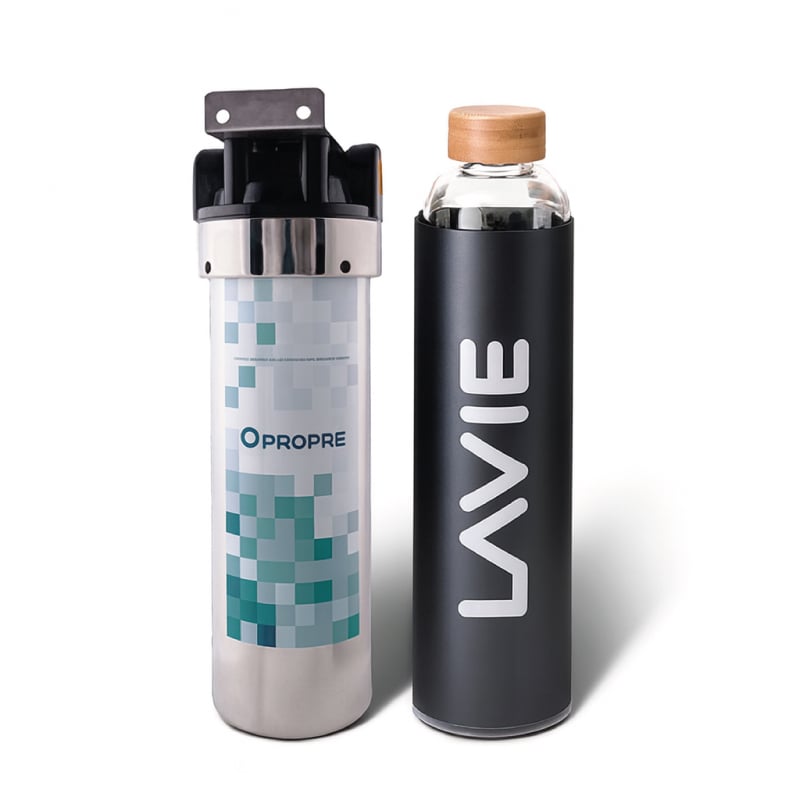
Serenity pack (Opropre + LAVIE PURE) |
| Chlorine | ✅ | ✅ | ✅ | ✅ | ✅ |
| Sediments | ✅ | 🟠 | ✅ | ✅ | ✅ |
| Bacteria | ❌ | ❌ | ❌ | ❌ | ✅ |
| Viruses | ❌ | ❌ | ❌ | ❌ | ✅ |
| Medicines | ❌ | ❌ | ✅ | ✅ | ✅ |
| Heavy metals | 🟠 | 🟠 | ✅ | ✅ | ✅ |
| Pesticides | ❌ | ❌ | ✅ | ✅ | ✅ |
| PFAS | ❌ | ❌ | ✅ | ✅ | ✅ |
| Microplastics | ❌ | ❌ | ✅ | ✅ | ✅ |
| Preservation of beneficial minerals | ❌ | 🟠 | ❌ | ✅ | ✅ |
| Discover | Discover |
Under-sink water filter: better than other filtration systems?
Today, there are many ways to filter the water in your home. Filter jugs, faucet-mounted filters, water softeners, or under-sink devices, each solution has its particularities, advantages, and limitations.
However, between performance, bulk, cost, and environmental impact, it is not always easy to know which option is best suited to one’s needs.
So, under-sink filter or another filtration system? Let’s clarify.
Under-sink filter or filter jug?
At first glance, filter jugs seem to be a simple and economical option for improving tap water quality. Their technology relies on a cartridge made of activated carbon and ion-exchange resins, enclosed in a plastic block enriched with silver particles. While this mixture eliminates chlorine, organic residues, and other pollutants, it also removes calcium and magnesium, which are essential for our balance.
In contrast, LAVIE’s Opropre filters use high-quality coconut shell activated carbon, and their stored quantity is about 15 times greater than that of a filter jug. They effectively retain chlorine, pesticides, heavy metals, microplastics, and even PFAS (for the Turquoise product), while preserving beneficial minerals.
But that’s not all. By removing chlorine, classic filter jugs also eliminate the natural protection against bacteria. Without regular cleaning and rigorous filter changes, water can become a true breeding ground for bacteria in less than 48 hours.
And from an ecological perspective, the assessment is far from ideal: unrecycled disposable cartridges, frequent replacements, and possible release of microplastics from the block.
For a comprehensive result, LAVIE offers a winning duo: combine the Opropre filter with the LAVIE UV-A purifier. Thanks to its UV-A light, the latter neutralizes viruses, bacteria, and chemical residues (viruses and bacteria are not eliminated by activated carbon), while preserving minerals.

Under-sink filter or faucet filter?
Faucet filters have their appeal: easy and quick to install, compact, effective against chlorine, odors, heavy metals, and microplastics, while preserving essential minerals. Moreover, some models, such as those made of stainless steel, are sturdy and durable.
However, their design remains limited. The flow rate is often reduced, cartridges need to be replaced frequently (every 30 days on average), and their placement can quickly become inconvenient for daily use.
In contrast, LAVIE’s Opropre filters offer a foundational solution: invisible and, above all, more efficient. Thanks to ultra-effective coconut shell activated carbon and a deposit-based recyclable cartridge, they ensure complete filtration while reducing your ecological impact. Opropre contains about six times the amount of activated carbon of a faucet filter.
In summary: filtering tap water is convenient. The Opropre filter is durable, comfortable, and designed for your health.
Under-sink filter or water softener?
A water softener is designed to reduce water hardness, that is, its calcium and magnesium content, which are responsible for limescale deposits in pipes and household appliances. However, this classic salt-based system raises several issues.
By replacing essential minerals with sodium, this method depletes drinking water of these benefits and can contribute to excessive salt consumption on a daily basis. Moreover, the softener discharges saline wastewater into the environment, polluting groundwater, while requiring heavy and costly maintenance.
LAVIE offers a much more respectful solution: ODOUCE. This salt-free ionic anti-limescale solution transforms limescale into aragonite, a harmless powder that does not settle. This method preserves beneficial minerals, requires neither electricity nor complex maintenance, and protects your installations while safeguarding your body and the planet.
An innovative, durable, and coherent filtration system for your well-being and your home.

Installing and maintaining an under-sink water filter: as simple as Opropre
Installing and maintaining your Opropre under-sink filter is as easy as pie. The starter kit contains everything you need: a stainless steel filter holder, a pre-filled cartridge, connection hoses, and a mounting tool.
➊ Turn off the cold water supply.
➋ Unscrew the existing pipe, then connect the filter’s inlet to the water supply, and the filter’s outlet to the tap using the hoses.
➌ Once the connections are in place, turn on the water supply and check for leaks.
➍ Let the water run for 3 to 5 minutes to rinse the filter before first use.
For maintenance, nothing could be easier: the cartridge needs to be replaced every 6 months. Once used, you return it to LAVIE, it is refilled and put back into circulation.
Zero waste and zero wastefulness.
Conclusion: What is the best under-sink water filter?
Among the under-sink water filters available on the market, the Opropre range from LAVIE stands out clearly. Thanks to its ultra-efficient coconut shell activated carbon, it eliminates the majority of pollutants and impurities while preserving beneficial minerals. And the benefits do not stop there: easy to install, durable, and eco-friendly, the Opropre Turquoise filters ensure thorough filtration and zero waste with the deposit-based cartridge system.
In other words, it is a filter that combines efficiency, comfort, economy, ecology, and takes care of you.