 French
 Spanish
 German
 Italian
 English
PFAS, also known as forever pollutants, are increasingly finding their way into our glasses. Indeed, these chemical substances, used for decades in industry, are now found in many French municipalities.
And just recently, a warning signal was issued in France. In July 2025, their concentration in water led 12 cities in the Ardennes to temporarily ban the consumption of tap water. Why? Because these toxic compounds are suspected of having serious effects on the body.
In light of this alarming observation, more and more households are seeking a reliable way to protect their health. Among the most accessible options, the filtered carafe is often highlighted (see our comparison of the best filtered carafes).
But are they really effective against these pollutants? Can they truly hold their own against these invisible elements?
Let us take stock together of what these filtered carafes can (or cannot) do, and the alternatives to consider for purifying your drinking water.
PFAS: why do these forever pollutants threaten your health?
PFAS (per- and polyfluoroalkyl substances) form a group of chemical elements used since the 1950s in industry and in many everyday products: non-stick coatings, waterproof textiles, firefighting foams, food packaging…
What is their particularity? These compounds are extremely stable, to the point of almost never degrading. This is what earns them the nickname of forever pollutants. As a result: they are found everywhere, even traces of substances that have been banned for years, in the environment, including in tap water.
And their effects on health are increasingly concerning.
In 2023, the International Agency for Research on Cancer (IARC) classified some of these substances as carcinogenic or potentially carcinogenic. For example, PFOA is now classified as “carcinogenic to humans”, and PFOS “possibly carcinogenic”.
But that’s not all: prolonged exposure can also lead to increased cholesterol levels, hormonal disorders, decreased fertility, or even impacts on fetal development.
That is why it is necessary to monitor their presence and choose a filtration solution that is truly capable of eliminating them, for optimal hydration, without compromise.
Filtered carafe: a response against PFAS or a false promise?
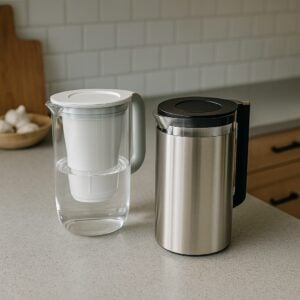
Traditional filtered carafes (Brita, Philips, Aarke, Amazon…) have become popular in many households in recent years. Easy to use, practical, and compact, they improve taste by reducing chlorine and certain impurities. But in the face of such a serious problem as the contamination of drinking water with PFAS, are they really up to the task?
The answer is unfortunately no.
Indeed, they generally consist of cartridges based on activated carbon, sometimes accompanied by ion-exchange resins, to remove chlorine, certain organic residues, pesticides, and correct taste. However, they are neither designed nor validated to effectively and sustainably remove forever pollutants. As a result: they remain present in your glass, even after filtration.
Worse still, these carafes have other limitations:
- In case of poor maintenance, they can become real breeding grounds for bacteria, compromising water quality.
- The materials of traditional models can release microplastics, silver ions, and other substances into drinking water.
- Frequent filter replacements (every 3 to 4 weeks) generate a significant amount of unrecyclable plastic waste.
In summary: although they may improve taste, these carafes are not suitable for removing PFAS. They even raise various health and ecological concerns.
So, what system should be adopted to eliminate these resistant pollutants?
Truly effective filtration solutions
In the face of the invisible threat of PFAS, not all filtration systems are created equal. While some carafes improve the taste of water, they are not designed to block these persistent elements. So, which reliable alternatives should you turn to in order to truly protect your health and that of your family? Let us take stock of the most effective technologies available today.
Under-sink filter Opropre: tested and approved
If you are looking for an effective and validated response against PFAS, the under-sink filter Opropre deserves your full attention. Developed by LaVie, this model goes well beyond traditional filtered carafes.
Thanks to high-quality coconut activated carbon, combined with a targeted resin, the Opropre under-sink filter has the capacity to eliminate pesticides, heavy metals, microplastics, nanoplastics, chlorine, sediments, and of course, forever pollutants. All this, without removing essential minerals from your tap water.
And its effectiveness is proven. A study conducted by the Environmental Chemistry Laboratory of Aix-Marseille University demonstrated that the filter can retain up to 27.4 mg of PFOA (used in non-stick coatings) and 23.8 mg of PFBA (found in some household products) per gram of resin. A top-level performance for domestic use.
But that’s not all. This method is also distinguished by its controlled environmental impact. The cartridge is deposit-returnable, rechargeable, and recyclable. Every six months, you send it back: LaVie recharges it with new activated carbon, while the old one is recycled in specialized industrial circuits. The resin follows the same process. A sustainable, reliable technology perfectly suited for daily use.
With Opropre, you choose healthy water, an eco-responsible system, and a solution without compromise.
Filtered carafe LaVie: an innovative alternative
At first glance, all filtered carafes look alike. Yet, LaVie shakes things up with a unique technology: purification by UV-A.
Unlike traditional models, the LaVie carafe relies on a process inspired by nature. When water passes through its glass bottle, it is exposed to UV-A light for 15 minutes. These rays trigger a photolysis phenomenon, which transforms chlorine into reactive radicals capable of neutralizing pollutants. Once their action is complete, these radicals disappear. The result: soft and perfectly healthy water.
And unlike traditional models (Brita, Philips, Amazon…), LaVie does not remove calcium or magnesium, essential minerals for your body. Moreover, it does not release any undesirable elements, it does not alter the pH, and it does not generate any filter to throw away each month. It is therefore a filtered carafe alternative that is both healthier, more ecological, and economical.
However, to go further, especially against PFAS, LaVie provides a complementary approach. Because while UV-A technology neutralizes many substances, it does not eliminate forever pollutants. For optimal purification, it is then used with the Opropre under-sink filter. Together, they form a reliable, durable duo perfectly suited to current health challenges.
Reverse osmosis: proven effectiveness, but not without compromise
Reverse osmosis is often presented as the most advanced method for filtering tap water. And for good reason: with its semi-permeable membrane, it removes up to 99% of contaminants, including PFAS. A performance that, on paper, makes it a particularly reassuring system.
But in practice, this technology raises several limitations:
- Water that is too pure, depleted of minerals:
Reverse osmosis does not distinguish between good and bad elements: it also filters out essential minerals such as calcium and magnesium. The result: water that is too acidic, requiring remineralization, which is rarely optimal.
- A complex and costly maintenance method:
Installation often requires the intervention of a professional. And to maintain water quality, several products must be replaced regularly (sediment filter, membrane, remineralization cartridge…), which increases the price and maintenance burden.
- A significant ecological impact:
For every liter of filtered water, the osmosis system rejects between 2 and 4 liters of polluted water. In addition, there are non-recyclable consumables and waste generated.
- A limited system against microplastics:
It seems that the effectiveness of the osmosis system against microplastics is not so evident. Indeed, the Zone Interdite broadcast experienced this, in comparison with the product LaVie. The result: 60% of microplastics filtered, against 99% claimed.
In other words, reverse osmosis is effective, but it impacts the composition of water, your budget, and the environment.
For a simpler, more sustainable, and planet-friendly alternative, the Opropre under-sink filter remains today the most effective solution against forever pollutants, while preserving healthy, balanced, and pleasant drinking water.
And bottled water in all this? A choice far from ideal
When trust in tap water diminishes, many turn to bottled water, perceived as a safer option. However, this choice raises several issues.
First, from a health perspective: studies have revealed the presence of microplastics in many bottles, including those from major brands. Moreover, these waters are not automatically free from PFAS, some having been detected in tested samples.
Next, the cost: drinking exclusively bottled water is significantly more expensive in the long term than a home filtration system. Additionally, there are the impracticalities of transport and storage on a daily basis.
Finally, the ecological impact is substantial. Every year, billions of plastic bottles are produced and discarded, with a recycling rate that remains too low. The result: tons of waste accumulate and pollute our planet.
As you can see, bottled water is neither a sustainable solution nor a guarantee of purity. For healthy, economical, and environmentally friendly hydration, it is better to invest in a suitable and safe home filtration method.
To compare technologies and choose the solution that meets your needs, discover our guide to choosing a filtering carafe.
Can PFAS be eliminated with a filtering carafe?
Unfortunately, the answer is no, at least not with a standard filtering carafe. While these solutions improve taste and reduce certain harmful substances, they are not designed to reliably eliminate PFAS.
For effective protection against these pollutants, it is better to turn to a tested and validated technique, such as the Opropre under-sink filter. Furthermore, when combined with Opropre, the carafe LaVie offers even healthier purification, for balanced water and optimal hydration on a daily basis.
The Serenity Pack combines filtration and purification to provide complete water protection. After passing through the Opropre filter, the UV-A technology LaVie eliminates bacteria present in the water, as well as those that could be introduced during the filling of the bottle or carafe. This absence of bacterial contamination allows the water to be stored at room temperature without the need for refrigeration.
Together, they form a safe, sustainable, and reassuring response to current water quality challenges.