 French
 Spanish
 German
 Italian
 English
What water for athletes: mineral, spring, or tap?

We witnessed the magnificent Olympic Games in Paris where athletes from around the world gave their best. Whether on the track, in the pool, or on the field, one thing is certain: hydration is essential for athletes to perform at their highest level. Water is the magic fuel that allows athletes to stay at the top of their game and sport.
But which water to choose to maximize performance? Spring water, mineral water, or tap water? In this article, we will explore the specific needs of athletes and compare the different types of water to help you make the best choice. Hydrate wisely, follow the advice of Olympic champions, and your body will thank you!
How much water to drink per day
Ah, the eternal question! While the advice to drink between 1.5 and 2 liters of water per day is very common, we wouldn’t mind a bit more individualized advice!
So it’s actually easy: you need to adjust your water intake based on your weight, age, and activity level.
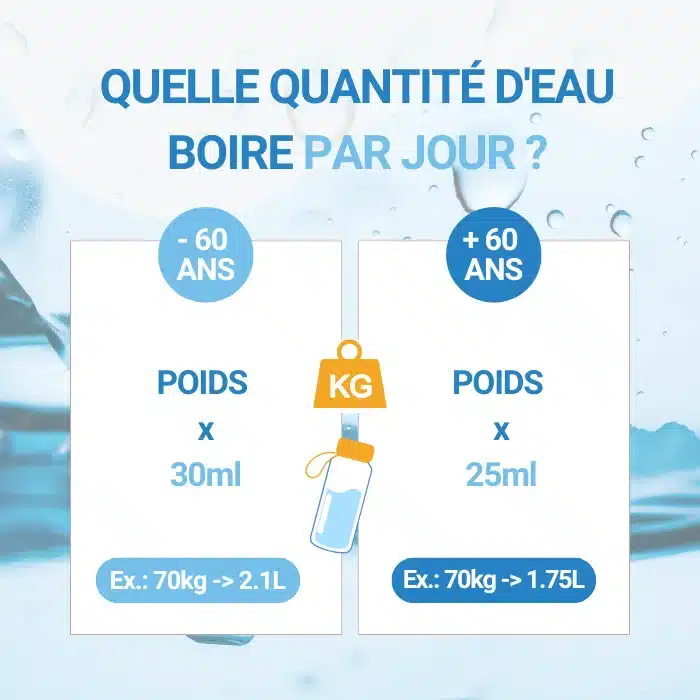
A simple rule? For your daily water needs (excluding exercise) multiply your weight in kilograms by 30 milliliters (ml) if you are under 60 years old. For example, a person weighing 70 kg should aim for about 2.1 liters of water per day. You will also need to compensate for losses related to exercise.
But if you are over 60, multiply your weight in kilos by 25 ml. It’s simple: you need to consider that you have less muscle, which itself retains a lot of water.
Finally, remember to eat water-rich foods, such as fruits and vegetables, which can account for 20-30% of your hydration needs. Beverages like juice, tea, and milk also count! But remember: Prefer pure water and herbal teas over sugary drinks loaded with additives.
Specific needs of athletes
Practical recommendations
Of course, if we are exercising, we must compensate for the dehydration caused by physical activity by adding even more water to our daily intake.
Because during exercise, we sweat, and with that precious sweat, we lose not only water, but also essential electrolytes. To avoid becoming as dried out as a sponge in the sun, it is crucial to drink sufficiently and regularly.
But that’s not all: water also helps to regulate body temperature, prevent injuries, and accelerate muscle recovery. In short, hydration is key to staying fit and performing well.
So, how much water should an athlete drink before, during, and after physical exertion?
- Before sports:
- Drink about 500 ml of water 2 to 3 hours before starting.
- Add another 200 to 300 ml about 20 to 30 minutes before exercise.
- During sports:
- Don’t forget to drink 150 to 300 ml every 20 minutes to stay at your best.
- After training:
- For every kilogram lost during exercise, drink 1.5 liters of water to properly rehydrate.

- Constant hydration: Drink regularly throughout the day, even outside of training sessions, to avoid dehydration and its harmful effects such as headaches.
- Weather conditions: If you are training in scorching heat, remember to drink more to compensate for sweating.
In general, adjust your water intake according to your weight, physical activity, and the weather to stay at the top of your performance and avoid dehydration.
Bottled water: spring or mineral?
Yes, but which water should you drink? Before making a choice, it is good to know the differences between the two.
Spring water and mineral water, although both are bottled waters and both come from natural underground sources, have their own particularities.
Spring water is like nature in a bottle: it comes from protected natural springs and offers a variable mineral composition.
Mineral water, on the other hand, is the diva of waters! It must have a stable and well-defined mineral composition, bottled directly at the source. Often praised for its specific benefits, such as being rich in mineral salts like calcium or magnesium. It must undergo no treatment (see our article on the scandal regarding mineral water).
In summary, spring water is your everyday ally, while mineral water is the choice of athletes seeking performance.
And tap water?
Tap water is the most accessible and economical of the options. However, even though in France, we are indeed talking about drinking water that is extremely controlled, its quality can vary depending on the region and the local treatment system.
Advantages:
- Accessibility: Available almost everywhere at a negligible cost.
- Ecological: Reduces the carbon footprint associated with the production and transportation of bottled water.
(See our article on the environmental impacts of plastic water bottles)
Disadvantages:
- Variable quality: May contain contaminants such as chlorine, pesticides, and heavy metals.
- Taste: The taste may be affected by the chemicals used in water treatment.
Solution
All you need to do is filter or purify it to remove contaminants while keeping its minerals and trace elements intact! ”Yes, but how?” you may ask! A little patience dear reader, we will get to that very quickly.
Final comparison
Factors to consider when choosing water for an athlete:
- Minerals: Athletes benefit from minerals such as calcium and magnesium, essential for performance and recovery.
- Taste: Pleasant-tasting water encourages regular hydration.
- Accessibility: Tap water is always available, but may require purification.
- Cost: Spring water and mineral water can be expensive, especially for regular consumption.
Final choice
- Spring water: Purity and natural taste, but high cost and variability of minerals.
- Mineral water: Rich in minerals, ideal for recovery. It should be noted that different mineral waters are still significantly more expensive. Indeed, we are talking about a cost that is 100 to 300 times higher!
- Tap water: Economical and accessible, but requires purification for optimal quality.
The importance of water purification for athletes
Why purify tap water?
- Improved quality: Provides clean and pure water, essential for performance and recovery.
- Optimized taste: A pleasant drink encourages regular consumption.
Tailored purification solutions:
- Filter jugs: Convenient and easy to use at home, but with questionable effectiveness.
- Home purifiers such as reverse osmosis systems: They provide continuous purification for the whole family. However, they have the drawback of removing necessary electrolytes for athletes. Be aware, these devices are expensive, energy-consuming, and polluting.
- Bottles with integrated filters: For outdoor hydration, such as hiking. The quality of the filtered water will vary greatly depending on the filters.
- LaVie water purifiers:
- UV-A technology: Eliminates contaminants without chemicals.
- Benefits: They improve taste, eliminate chlorine and 99.9% of bacteria, retain minerals and trace elements, and are simple to use.
- LaVie water purifiers:
For athletes, tap water can therefore be an excellent option if properly purified. Using a water purifier, such as those offered by LAVIE, eliminates contaminants and improves taste, making tap water as good as bottled water.
LAVIE thus offers athletes a practical, effective, and economical solution for optimal hydration.
To learn more, discover in our article how to filter tap water.

There you go, you now have all the keys to choose the best water for athletes!
Whether you prefer spring water, mineral water, or purified tap water for your training session, you now know what to expect regarding the characteristics of each.
Spring water, with its natural purity, mineral water, rich in electrolytes, and tap water (just as enriched in electrolytes as the average mineral waters), which can become excellent with a good purifier.
Indeed, investing in a water purifier can transform your tap water into a high-quality resource, ideal for athletes. LAVIE purifiers, with their UV-A technology, guarantee pure, healthy, and tasty water, perfect for hydrating you before, during, and after exercise.
So, hydrate smartly during sports activities and choose the water that best meets your needs and the proper functioning of your body. Your performance and recovery will only improve. For uncompromising hydration, trust LAVIE water purifiers. Ready to boost your hydration? Grab your bottles, ready, drink!
Google Reviews
Use of LAVIE in video

Article written on 06/08/2024 by Pascal Nuti – CIO Solable – Passionate about energy, I am constantly seeking new targets for improvement, exploring cross-disciplinary paths using innovative methods.

You may also be interested in these articles:

Do you want to stay updated on our articles about water?
Sign up below for our Newsletter
and receive -5% on your first order!