 French
 Spanish
 German
 Italian
 English
In the market for carafes, options abound: glass, stainless steel, plastic… However, not all are created equal. The material used influences much more than just the design: it directly affects the quality of the water, the durability of the product, and even your health.
So, which model is truly the healthiest, the most eco-friendly, and the most economical?
In this comparison of filtering carafes, we review the advantages and limitations of each material to help you make the best choice.
Glass or stainless steel filtering carafe? Discover which device best suits your lifestyle and needs.
Glass or stainless steel: what are the differences between these two materials?
The choice between glass and stainless steel is not solely aesthetic. These two materials have very different characteristics in terms of health, comfort, and durability. This directly impacts the quality of your hydration.
Glass is favored for its neutrality. It releases no chemical substances, retains neither taste nor odor, and is easy to clean. Its transparency also allows for a quick visual check of the clarity of the water and the cleanliness of the device. However, it is more sensitive to shocks and temperature variations.
Stainless steel, on the other hand, emphasizes robustness. Solid, durable, and modern, it withstands repeated handling and thermal fluctuations. But it has its limits! It can alter the taste of the water, and some people find the contact of metal with the mouth unpleasant. Its opacity also prevents visualizing the water level and the cleanliness of the interior.
This is where borosilicate glass stands out. Used in filtering carafes LaVie, this high-end material combines durability and purity. It withstands scratches, impacts, and high temperatures, while remaining perfectly neutral.
The result: healthy filtered water, with sustainable and safe technology.
Plastic carafe: a danger to your health and the environment
While plastic carafes are appealing due to their price and lightness (Brita, Philips, Amazon…), they remain one of the worst choices for filtering tap water.
From a health perspective, several studies have shown that these carafes leach microplastics and endocrine disruptors such as bisphenol A (BPA) or phthalates. These substances migrate into your glass and eventually into your body. The result: contaminated water and a long-term danger to your metabolism.
ANSES and UFC-Que Choisir also warn about bacterial risks. Without regular maintenance, filters and cartridges made of activated carbon and ion-exchange resins become real breeding grounds for microbes. By removing chlorine, these devices also eliminate the barrier against bacteria. A true nonsense in terms of purity!
But that’s not all! Some carafes also release undesirable substances (silver, sodium, ammonium…) and deplete the levels of essential minerals, rendering filtered tap water non-potable according to World Health Organization standards.
And from an ecological standpoint? The situation is catastrophic. Non-recyclable disposable filters, which need to be replaced every three to five weeks, generate enormous pollution, in addition to the carafes themselves being non-recyclable.
In summary, these models are neither healthy nor eco-responsible.
What are the essential criteria for choosing your device?
Before making your choice, it is necessary to understand what differentiates an effective model from a disappointing one. Here are the criteria to closely examine before your purchase.
- The effectiveness of the filtration system
This is criterion number 1. A good carafe eliminates pollutants without depleting the water. Chlorine, pesticides, heavy metals, and pharmaceutical residues must disappear while retaining essential minerals like calcium and magnesium. This is what distinguishes simply filtered water from truly healthy water.
- The ecological aspect
Your choice has a direct impact on the environment. Disposable filter carafes generate considerable waste and require regular replacements. Favor a sustainable technology, without consumables, made from recyclable materials.
- The long-term cost
Some carafes may seem economical at purchase, but their filters that need replacing every month quickly increase the bill. Look at the actual maintenance cost. A model without a filter or with a long-lasting system will be more cost-effective and practical on a daily basis.
- The material
Glass and stainless steel are the most reliable: healthy, durable, and easy to maintain. The former remains neutral and elegant; the latter is sturdier and more modern. Plastic should be avoided: it contaminates the water and poses a risk to your health.
The best option: borosilicate glass, which combines purity and resistance for optimal filtration.
- The capacity and practicality
A 1-liter filtered water carafe is sufficient for a single person, but a family would prefer a model with a capacity of 1.5 to 2 liters. Also consider the handling, weight, and ease of maintenance: a carafe that is pleasant to use will become a daily reflex.
In summary, for water that respects your body, your budget, and the planet, it is better to turn to an alternative to the classic filtering carafe, such as the bottle LaVie.
To compare technologies and choose the solution suited to your needs, discover our guide to choosing a filtering carafe.
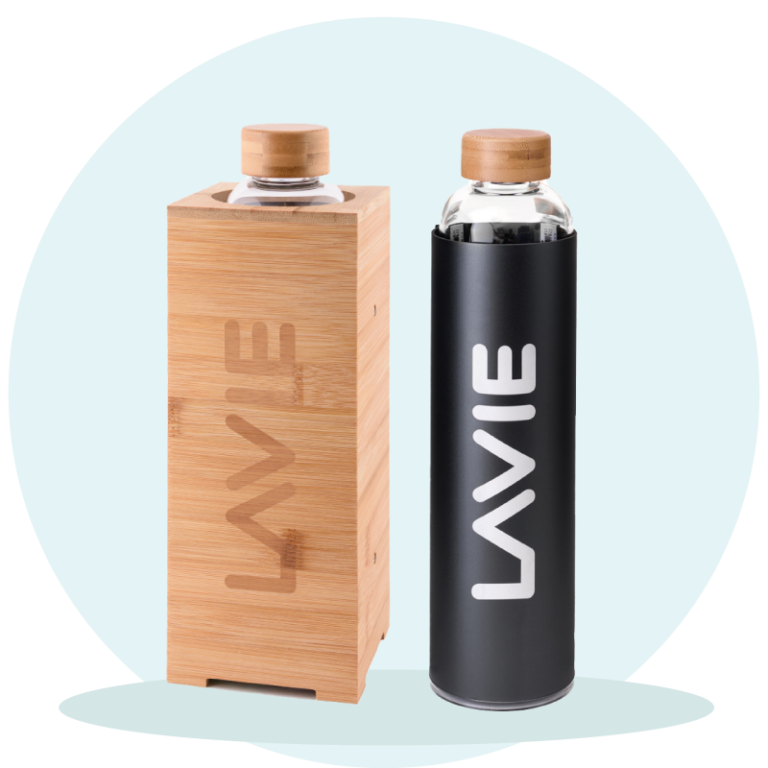
UV-A LaVie borosilicate glass carafe: the best domestic filtration
| Élément filtré, réduit ou éliminé | Carafe filtrante classique | Carafe UV-A LAVIE | Carafe LAVIE + Filtre Opropre |
|---|---|---|---|
| Chlore | ✅ | ✅ | ✅ |
| Sédiments | ✅ | ❌ | ✅ |
| Bactéries | ❌ | ✅ | ✅ |
| Virus | ❌ | ✅ | ✅ |
| Médicaments | ❌ | ✅ | ✅ |
| Métaux lourds | 🟠 | ❌ | ✅ |
| Pesticides | ❌ | ✅ | ✅ |
| PFAS | ❌ | ❌ | ✅ |
| Microplastiques | ❌ | ❌ | ✅ |
| Conservation des minéraux bénéfiques | ❌ | ✅ | ✅ |
| Découvrir | Découvrir |
In light of the limitations of traditional filtering carafes (cartridge replacement, loss of trace elements, impurities…), LaVie has developed a sustainable and remarkably effective alternative.
Its technology relies on UV-A rays, which trigger a natural phenomenon called photolysis of chlorine.
In other words, when light passes through the water, it transforms chlorine into reactive radicals capable of neutralizing pesticides, bacteria, viruses, and pharmaceutical residues, while preserving 100% of essential minerals like calcium and magnesium.
In fifteen minutes, your tap water becomes healthy, balanced, and pleasant to drink.
The tests and reviews are unequivocal: 100% of bacteria eliminated, over 50% reduction of glyphosate, and up to 49% reduction of chlordécone.
Far from simple mechanical filtration, LaVie offers complete, stable purification, without contamination or leaching.
And its material makes it a first-class system. Designed in borosilicate glass, the UV-A LaVie bottle combines performance, durability, and neutrality. This high-end and practical material, ubiquitous in laboratories, withstands shocks, high temperatures, and releases no substances.
Without a filter and without recurring costs, it is an ecological, economical, and safe choice.
The answer is clear: using the UV-A LaVie device in borosilicate glass is the best option for domestic filtration.