 French
 Spanish
 German
 Italian
 English
In light of the presence of microplastics in drinking water, more and more consumers are seeking a solution to protect their health. Filter jugs are among the most popular options. But are they really capable of retaining these invisible particles? Before making a choice, it is essential to understand their limitations and identify truly suitable solutions to reduce exposure to microplastics.
We ingest between 39,000 and 52,000 microplastics per year. And for those who primarily consume bottled water, this figure rises to 90,000 particles.
Water, air, food: these contaminants have infiltrated everywhere, even into tap water. A diffuse and silent pollution that raises serious health concerns.
But the real problem lies in their recognition. A study by CNRS reveals that 98% of microplastics in drinking water measure less than 20 micrometers. Particles so fine that they escape current detection methods in France, leading to the belief that their actual presence and effects on health are largely underestimated.
In the face of this contamination, more and more consumers are therefore turning to filter jugs to purify their tap water.
But are these filter jugs really capable of retaining microplastics, or is it a false good idea? And above all, what is the best and most effective filter jug?
What are the dangers of microplastics for our health?
Microplastics are tiny plastic fragments, less than 5 millimeters, invisible to the naked eye. They originate from the degradation of packaging, bottles, synthetic textiles, and certain industrial processes, and they are everywhere in the environment.
Present in rivers, groundwater, and distribution networks, they massively contaminate tap water.
And even though there is very strict control in France, the water’s journey exacerbates this pollution. Reservoirs, pipes, and certain stages of treatment and filtration release additional chemical particles.
The problem arises once they enter our bodies! Ingested or inhaled, the contaminants are not eliminated. On the contrary, research shows that they gradually accumulate in the body, passing through the bloodstream to settle in organs such as the liver, kidneys, and even the brain.
Unfortunately, this is not without effect. The presence of microplastics is associated with chronic inflammatory reactions, oxidative stress, and disruptions of the immune and hormonal systems.
Some scientific data also indicate that microplastics and nanoplastics (smaller than one micron) cross the blood-brain barrier, which is supposed to protect the brain from toxic substances. A study published in Molecular and Cellular Biochemistry highlights possible links between exposure to these particles and the development of neurodegenerative diseases such as Alzheimer’s or Parkinson’s.
Research remains cautious, but the facts are there: consuming microplastics is not trivial. In the face of such pollution, limiting their ingestion becomes a major health issue.
But by what process?
Filter jugs: a real solution against microplastics?
Classic filter jugs, mostly made of plastic (Brita, Philips, Aarke, Amazon…), appeal due to their ease of use and affordable price. Their promise: a process that improves the taste and smell of tap water while reducing chlorine and certain pollutants.
How? Their operation relies on cartridges made of activated carbon and ion exchange resins, through which the water flows.
But this system quickly shows its limitations. The filtration fineness is insufficient to sustainably retain microplastics and nanoplastics.
That’s not all! In addition to this lack of effectiveness, classic filter jugs have other drawbacks:
- Release of plastic fragments and undesirable products, linked to the wear of materials and cartridges.
- Risk of bacterial breeding ground: without chlorine, the water becomes more vulnerable to the development of microbes.
- Alteration of water quality, with a depletion of essential minerals. The filtered water no longer meets WHO recommendations.
- Significant ecological impact, due to the frequent replacement of cartridges and disposable filters every 3 to 5 weeks.
While filter jugs have the ability to improve taste and odor, they are not a reliable solution for purifying water from microplastics and other pollutants. Their use can even alter water quality.
Are there then truly effective systems to limit the presence of these microparticles in tap water?
💧 Read also: Glass or stainless steel filter jug? The complete comparison
Water filtration: what solutions against microplastics?
In the face of drinking water contamination by these plastic pollutants, not all filtration solutions are equal.
To choose a water filter against microplastics, one criterion matters more than promises: what the system can truly eliminate from tap water.
Here is a comparison of filtration technologies to obtain, at home, truly purified quality water.
|
Filtered, reduced, or eliminated element |

Classic filter jug |
Tap filter |

Reverse osmosis system |

Under-sink Opropre filter |

LAVIE Purifier |
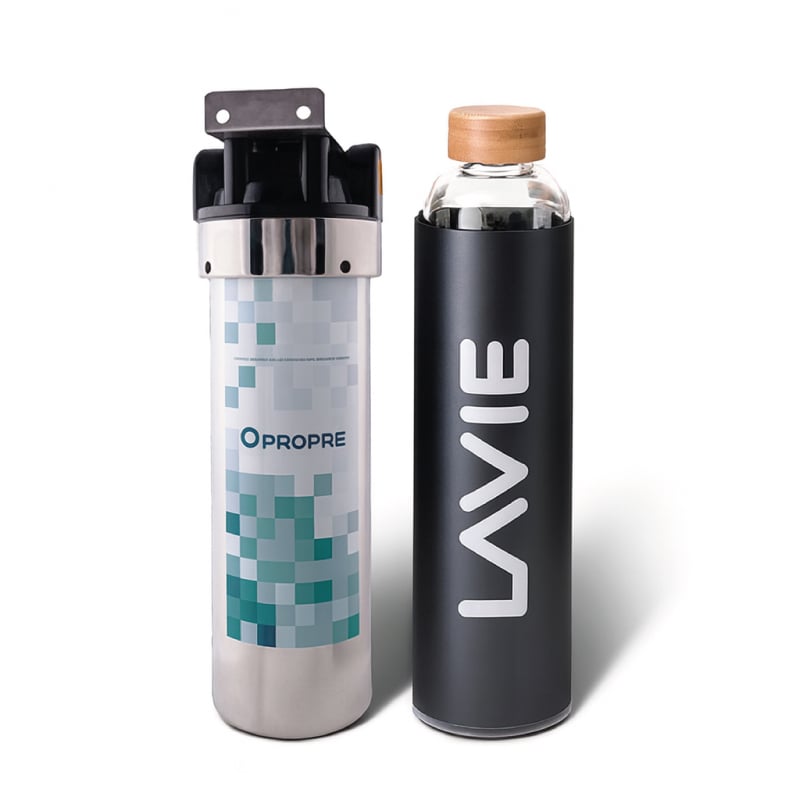
Serenity pack (Opropre + LAVIE PURE) |
| Chlorine | ✅ | ✅ | ✅ | ✅ | ✅ | ✅ |
| Sediments | ✅ | 🟠 | ✅ | ✅ | ❌ | ✅ |
| Bacteria | ❌ | ❌ | ❌ | ❌ | ✅ | ✅ |
| Viruses | ❌ | ❌ | ❌ | ❌ | ✅ | ✅ |
| Medicines | ❌ | ❌ | ✅ | ✅ | ✅ | ✅ |
| Pesticides | ❌ | ❌ | ✅ | ✅ | ✅ | ✅ |
| Heavy metals | 🟠 | 🟠 | ✅ | ✅ | ❌ | ✅ |
| PFAS | ❌ | ❌ | ✅ | ✅ | ❌ | ✅ |
| Microplastics | ❌ | ❌ | ✅ | ✅ | ❌ | ✅ |
| Preservation of beneficial minerals | ❌ | 🟠 | ❌ | ✅ | ✅ | ✅ |
| Discover | Discover | Discover |
Not all filters are equal! The experience conducted by Zone Interdite
In the report Zone Interdite (“Our health in danger: revelations about this plastic that poisons us,” aired on March 8, 2026), independent researcher Jean-Baptiste Fini, a microplastics specialist, compared three filtration systems using deliberately contaminated water.
The results, analyzed by an independent laboratory, show significant differences in effectiveness:
- The gravity filters are the least effective: they filter only 30% of microplastics, allowing the majority of particles to pass through.
- The reverse osmosis systems retain about 60% of microplastics.
- While the Opropre activated carbon filter proved to be the most effective, eliminating 75% of the microplastics present in the contaminated water!
Conclusion: while filtration generally reduces the presence of microplastics, the choice of system makes a major difference in your actual daily exposure.
Opropre: advanced filtration against microplastics
With the Opropre under-sink filter, LAVIE has chosen demanding filtration designed to retain particles as fine as microplastics. This effectiveness relies on the combination of a very high-performance activated carbon and a specific resin, capable of capturing extremely small elements.
Scientific studies show that activated carbon constitutes a powerful barrier against micro- and nanoplastics. Under conditions close to those of natural water, the observed elimination rates can reach up to 90%, particularly when nanoplastics aggregate, facilitating their capture.
Opropre also retains other pollutants present in tap water, such as PFAS, pesticides, and certain heavy metals like lead. Tests conducted by the laboratory of the University of Aix-Marseille confirm this capability, with up to 27.4 mg of PFOA and 23.8 mg of PFBA captured per gram of resin, while preserving essential minerals.
Finally, Opropre is part of an environmentally friendly approach thanks to its returnable, rechargeable, and recyclable cartridge, limiting plastic waste.
Result: a scientifically proven and effective solution to reduce daily exposure to microplastics.

The LAVIE jug: the choice of healthier water, every day
With the LAVIE jug, there is no cartridge to replace or filter to throw away, but a patented UV-A technology, inspired by a natural phenomenon called photolysis.
Specifically, when UV-A rays pass through the glass jug, they transform the chlorine present in the water into reactive compounds. These compounds then have the ability to neutralize pollutants such as pesticides, traces of medications, as well as bacteria and viruses. This process allows for purifying the water in just 15 minutes, without the addition of chemicals and without altering essential minerals.
Once treated, tap water can be consumed with peace of mind throughout the day. And as a bonus: the LAVIE UV-A jug massively reduces the use of plastic bottles while maintaining a high level of demand for health and taste pleasure.
Used in conjunction with the Opropre filtration, which eliminates persistent pollutants such as microplastics, PFAS, and heavy metals, the LAVIE filter jug allows for an even healthier and more balanced water, directly at home.

Reverse osmosis: a high-performance solution, but at what cost?
Reverse osmosis, in addition to allowing more than 40% of microplastic particles to pass through the water according to the experience presented above, comes with many constraints:
- High cost: purchase of the device, installation, maintenance, and regular replacement of filters and membranes.
- Water waste: up to 4 liters rejected to produce 1 liter of filtered water.
- Ecological impact: disposable cartridges, energy consumption, and discharges of concentrated water with pollutants.
- Demineralized water: loss of essential minerals (calcium, magnesium), with a more acidic pH.
- Risk of bacterial breeding ground in case of insufficient maintenance.
Water bottle: an even higher risk for health
For a long time, bottled water was perceived as safer. Today, this idea no longer holds.
The scientific data is clear: individuals consuming bottled water ingest up to 90,000 microplastics per year, compared to about 4,000 for those who primarily drink tap water.
Over time, transportation and temperature variations cause the material to degrade. Tiny fragments then migrate from the bottle directly into the water.
And glass is not a safer solution either. A study conducted by ANSES and reported by Que Choisir revealed a surprising result: microplastics are more numerous in glass bottles than in plastic ones.
Hard to believe, but it is indeed the truth. Analyses reveal up to 5 to 50 times more pollutants per liter, primarily due to the degradation of caps and coatings.
In other words: bottled water, whether plastic or glass, increases exposure to these contaminants, unlike filtered water with quality technology.
Can microplastics be eliminated with a filtering carafe?
Classic filter jugs do not eliminate microplastics. The extremely fine size of these fragments exceeds their filtration capabilities. Worse still, some release plastic particles and contribute to a decline in water quality.
As for bottles, whether plastic or glass, they present a higher level of contamination, as demonstrated by several scientific studies.
To truly limit exposure to these harmful pollutants, a combined approach is necessary. The Opropre under-sink filter, with its very high-performance activated carbon and specific resin, acts at the source by retaining microplastics, as well as PFAS and heavy metals, even before the water reaches the tap.
The UV-A LAVIE carafe then completes this protection by purifying the water, neutralizing pesticides, pharmaceutical residues, bacteria, and viruses, without altering essential minerals.
At home, enjoy quality filtered water, free from unpleasant taste or odor!
With the LAVIE Serenity Pack, you are choosing a reliable and sustainable solution to effectively reduce your exposure to microplastics.
Pre-filtration + Purifier