 French
 Spanish
 German
 Italian
 English
Yes, tap water in France is drinkable. But no, it is not completely free of pollutants.
PFAS, nitrates, pharmaceutical residues, microplastics… These substances are detected in the water we have at home.
And depending on where you live in France, the analyses yield very different results. In some areas, the level of water contamination is higher than in others. Understanding the pollution of tap water by region then becomes essential to know what you are actually drinking.
The real problem? These molecules are invisible and not all filtration systems eliminate them.
What elements are therefore present in your water? What are the health risks?
And above all, how can you limit your exposure for healthier and safer hydration on a daily basis?
What pollutants are hiding in your glass of water?
The distributed water does not contain just one type of pollutant, but a combination of substances from different sources. Contaminants are regularly detected in drinking water samples, with levels varying according to the environment.
Before continuing to drink tap water, it is therefore essential to understand what it contains and the origin of these compounds.
Pesticides: these agricultural residues that end up in your glass
Pesticides are used extensively in agriculture. But they do not stay in the fields. With rain and irrigation, they seep into the soils, contaminate groundwater and then rivers, before ending up in our glass.
Today, their presence is well documented in France thanks to water analyses. Residues are regularly detected even after treatment to make the water drinkable. And inevitably, they are more present in agricultural areas.
A situation still too underestimated.
Heavy metals: contamination linked to pipes and the environment
Heavy metals can contaminate water at different stages. Some are naturally present in soils, others come from industrial production or the aging of pipes. As it passes through the distribution network, water can thus become loaded with these substances before reaching your home.
Cadmium, for example, is a metal found in the Earth’s crust. But its levels have increased due to human activities, particularly because of fertilizers.
As a result: cadmium is now found in drinking water, with higher levels in certain areas.
PFAS: these “forever pollutants” already present in your water
PFAS, also known as “forever pollutants,” are chemical substances used for decades in industry and in many everyday products (packaging, textiles, non-stick coatings…). Their particularity? They do not degrade easily in the environment.
The issue of PFAS in tap water is now being raised everywhere across the entire French territory.
A phenomenon that can no longer be ignored, as it is not without risk.
Pharmaceutical residues in tap water: where do they come from?
Pharmaceutical residues in water come directly from our consumption. Antibiotics, painkillers, hormones… A portion of these substances is not eliminated by the body and therefore returns to wastewater.
This water then passes through treatment plants, which are not designed to remove these compounds.
As a result: traces persist and are found in the water we drink.
Microplastics: these invisible fragments circulating in your water
Microplastics are omnipresent. We cannot see them, but they are all around us: in the air, the soils, and therefore in the drinking water we consume every day.
Derived from the gradual degradation of plastics, these microscopic fragments continuously circulate in the environment. And despite treatments, a portion of them still escapes conventional filtration systems.
And no, bottled water is not an alternative. On the contrary! The plastic in bottles itself releases microplastics.
Where does the pollution of tap water really come from?
The pollution of the water in your home does not come from a single source. It is the result of several human activities that directly impact water resources.
Agriculture is one of the main causes. The use of fertilizers and pesticides leads to soil contamination, then groundwater and rivers.
Industry also plays an important role, particularly with the discharge of persistent chemical substances like PFAS, now present in many environments.
Finally, the situation of the urban environment also contributes to this contamination. Wastewater carries fragments of pipes, residues of medications, household products, or even microplastics, which are not completely eliminated.
The real problem? Some pollutants, like PFAS, hardly disappear. Once present, they remain and accumulate durably, with no current factory or network able to completely eliminate them.
Tap water pollution: what risks for your health?
Drinking polluted water does not necessarily lead to immediate health effects. But repeated exposure, even at low levels and compliant with regulations, raises many concerns today.
The dangers associated with tap water are therefore the subject of increasing analysis.
Depending on the pollutants present, different consequences can be observed:
- hormonal dysfunction related to endocrine disruptors (PFAS, pesticides, pharmaceutical residues)
- increased risk of certain pathologies, including some cancers, in case of prolonged exposure (PFAS, heavy metals…)
- damage to certain organs such as the kidneys, nervous system, or bones (cadmium, lead…)
- decreased immunity or fertility issues mentioned in several studies on PFAS
- effects in infants, particularly with nitrates that can disrupt oxygen transport in the blood
- possible links to certain neurodegenerative diseases (microplastics), via inflammation and oxidative stress
Some people are more sensitive than others to polluted water. This is particularly true for infants and young children, whose bodies are still developing and therefore more fragile.
Pregnant women are also affected, as some contaminants can be transmitted to the baby during pregnancy.
Finally, elderly individuals are more vulnerable to prolonged exposure, as their bodies eliminate certain substances less easily.
How to check the quality of your municipality’s tap water?
The quality of water depends on where you live. From one municipality to another, the level of contamination can change drastically. Agricultural and industrial areas are often the most affected.
Recent examples show this. In Hauts-de-France, hundreds of households have been exposed to water contaminated by a pesticide, with data up to 5 times above regulatory thresholds. In Ardennes, some municipalities even had to temporarily ban tap water due to PFAS.
And these are not isolated cases. Today, pollutants are detected over a large part of French territory, despite the mandatory treatment of plants, whether you live in the city or the countryside.
To know concretely what your water contains, the simplest way is to consult tools like the interactive map “Dans mon eau”. In just a few clicks, you access the analyses from the ARS (Regional Health Agencies) of your municipality, network by network.
But be careful: “compliant” drinking water meets the standard without being completely free of pollutants. And there is another point to know.
Today, only a small percentage of the substances actually present in water are monitored. Since 2026, only 20 PFAS are officially monitored, while this family includes several thousand molecules. The ANSES recommends further expanding the list. In practice, the vast majority of residues still go undetected.
The real question is therefore no longer whether the water is contaminated, but how to limit your exposure on a daily basis to protect your health.
How to reduce tap water pollution at home?
Not all solutions are equal for filtering drinking water. Activated carbon filter, filtering carafe, reverse osmosis, under-sink filter…
Each system relies on a different treatment of tap water, with a very variable level of effectiveness.
Some even increase the risk of contamination and reduce the quality of your water.
To help you see more clearly, here is a comparative table of the main solutions and their actual performance.
|
Filtered, reduced or eliminated element |

Classic filtering pitcher |
Tap filter |

Osmosis system |

Under-sink Opropre filter |

LAVIE purifier |
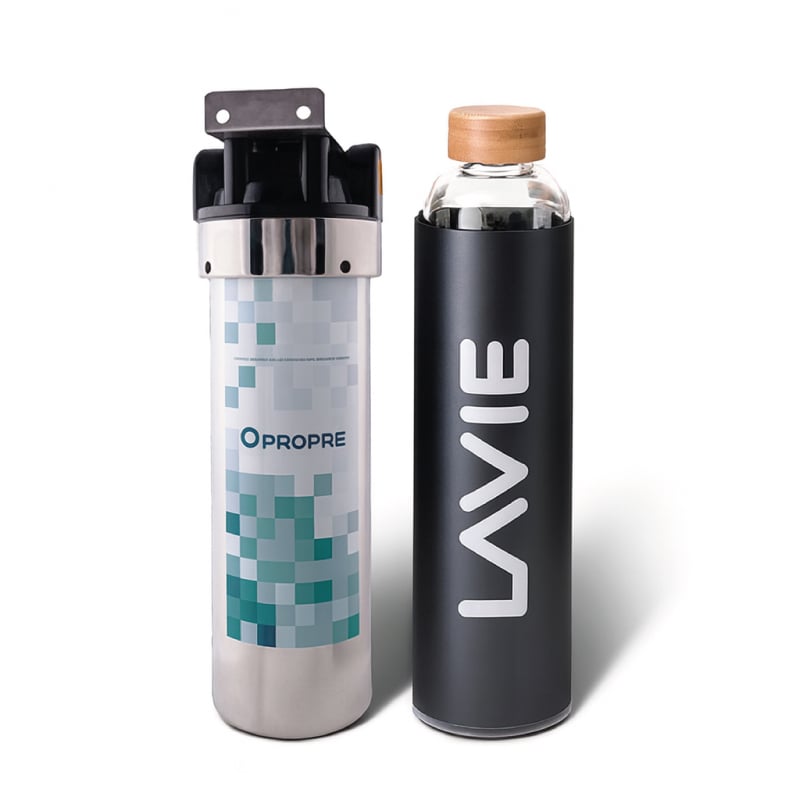
Serenity pack (Opropre + LAVIE PURE) |
| Chlorine | ✅ | ✅ | ✅ | ✅ | ✅ | ✅ |
| sediments | ✅ | 🟠 | ✅ | ✅ | ❌ | ✅ |
| Bacteria | ❌ | ❌ | ❌ | ❌ | ✅ | ✅ |
| Viruses | ❌ | ❌ | ❌ | ❌ | ✅ | ✅ |
| Medications | ❌ | ❌ | ✅ | ✅ | ✅ | ✅ |
| Pesticides | ❌ | ❌ | ✅ | ✅ | ✅ | ✅ |
| Heavy metals | 🟠 | 🟠 | ✅ | ✅ | ❌ | ✅ |
| PFAS | ❌ | ❌ | ✅ | ✅ | ❌ | ✅ |
| Microplastics | ❌ | ❌ | ✅ | ✅ | ❌ | ✅ |
| Conservation of beneficial minerals | ❌ | 🟠 | ❌ | ✅ | ✅ | ✅ |
| Discover | Discover | Discover |
The results of this table are clear: not all solutions are equal. The filtered carafe remains very limited. It improves the taste but is not very effective against most pollutants, especially the most problematic ones. The under-sink filter goes much further, though it does not cover everything. And reverse osmosis eliminates a lot, even too much, as it also removes essential minerals from drinking water.
In other words, no single solution ticks all the boxes.
That is precisely why LAVIE has designed a combination of filtration and purification with the Serenity Pack.
As shown in the comparison table, this approach allows for the treatment of a maximum of harmful substances while preserving the essential minerals needed for metabolism.
Let’s now take a closer look at how these LAVIE solutions work.
The LAVIE UV-A Carafe: a filterless, simple, and effective purification
With the LAVIE UV-A carafe, there are no filters to change or cartridges to throw away. This treatment relies on a patented technology inspired by a natural phenomenon: photolysis.
Specifically, UV-A light passes through drinking water and activates the chlorine naturally present. This then becomes a agent capable of neutralizing pollutants such as pharmaceutical residues, as well as bacteria and viruses.
In just 15 minutes, the water is purified, without the addition of chemicals and without altering essential minerals. Once treated, it can be consumed throughout the day, with an improved taste.
The data from the tests conducted by the laboratory of the University of Aix-Marseille confirm this capability.
And as a bonus: fewer plastic bottles, for a more ecological solution, without compromising on water quality.

Opropre: complete filtration directly at the source
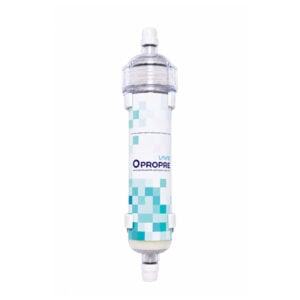
With Opropre, filtration occurs directly at the source, under the sink. Water is treated continuously, even before it reaches your glass.
The system combines high-performance activated carbon with a specific resin, capable of capturing particularly resistant compounds such as PFAS, pesticides, nitrates, heavy metals, and microplastics. And unlike some solutions, it retains essential minerals.
Its effectiveness has notably been highlighted in the show Zone Interdite, with a test conducted that demonstrates Opropre’s power to retain microplastics, where technologies like reverse osmosis can allow up to 40% to pass through and gravity-filtering stainless steel carafes can let through up to 70%.
And for environmental protection, the Opropre cartridge is returnable: every six months, it is sent back, recharged, and then put back into circulation.
Result: less waste, less plastic, and a more sustainable daily solution. Pollutants are truly destroyed after their concentration.
The Serenity Pack: the most complete solution for healthy water
In the face of tap water pollution, a single solution is not enough. PFAS, microplastics, heavy metals… These pollutants are different and cannot be treated the same way.
To truly improve the quality of drinking water, action must be taken on two levels:
- At the source, with the under-sink filter Opropre, which captures the most problematic contaminants.
- At the time of consumption, with the LAVIE UV-A carafe, which purifies the water by neutralizing microorganisms and certain residues, without affecting essential minerals.
By combining the two, the Serenity Pack provides a complete and effective response for your home.
Today, choosing the best filter for tap water involves this combined approach, capable of treating a wide spectrum of pollutants.
Result: fewer pollutants, and above all a healthy and beneficial water for your health.