 French
 Spanish
 German
 Italian
 English
In France, chlorine is used in tap water to disinfect it. But what is its effect on your health? Moreover, depending on its chlorine concentration, water, although potable, is sometimes unpleasant in taste and smell. Are there simple ways to address this? We will tell you everything!

What is chlorine?
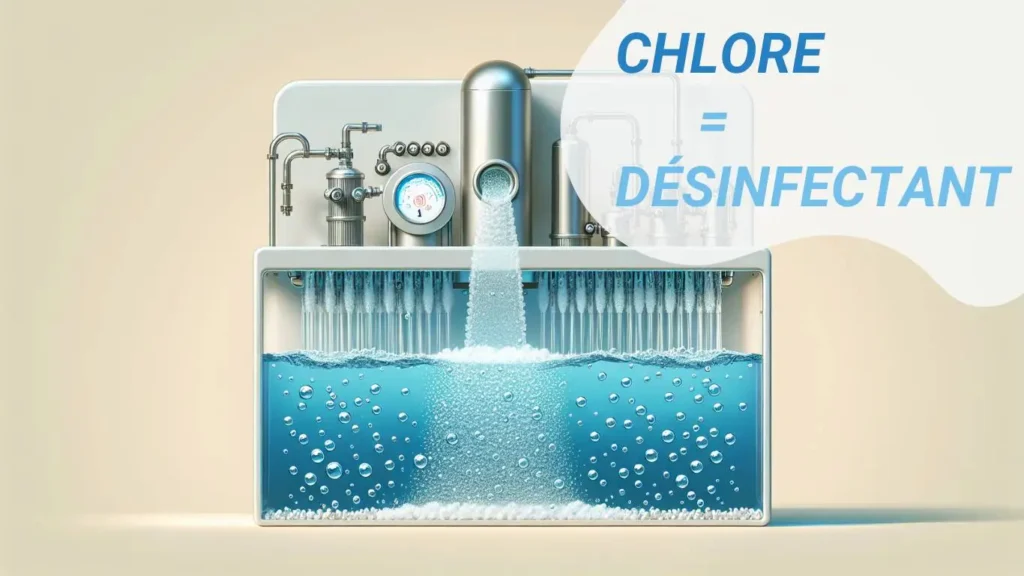
First, let us get acquainted with our subject! Chlorine is a chemical element (symbol Cl) that, in its natural state, appears as a yellow-green gas at ambient temperature and pressure, characterized by its sharp odor and highly reactive nature. This reactivity makes it particularly effective as a disinfectant and bleaching agent.
Note that a derivative of chlorine is very familiar to you in your daily life: sodium chloride. Yes, the good old table salt!
Why is chlorine found in tap water?
Since the 19th century, chlorine has been used in France (mainly in diluted form) as a major disinfectant in drinking water treatment. It eliminates viruses, bacteria, parasites, and other harmful microorganisms present in raw water, in a persistent manner. This is also why it is used in public swimming pools.
The use of chlorine has played a major role in the fight against waterborne diseases, such as cholera and typhoid.
The chlorine in water is therefore an essential element to ensure the safety of the water we consume during its transport.
However, despite these advantages, there are concerns about the long-term effects of consuming chlorinated water. We will discuss this further later in this article.
Standards and regulations regarding chlorine in drinking water
In France, the residual level throughout the water distribution network must not exceed 0.1 mg/L of free chlorine, in accordance with the standards established by health authorities.
It is essential to be aware of these standards and to regularly check the quality of tap water using the information provided by municipalities.
Check the quality of tap water in my municipality
To check the quality of tap water, and thus its chlorine level, there are several publicly accessible methods in France. Data on water quality is public and can be consulted in various ways:
- Consult the results online: You can access the tap water quality results for each city by visiting the Ministry of Health website. These results are regularly updated, providing a reliable source for assessing water quality in your locality.
- Contact your town hall: Another option is to contact your town hall directly. Municipalities have the results of the latest drinking water health checks and can provide you with this information upon request.
- Annual summary note: In France, a summary note on the quality of tap water is also attached annually to your water bill. If you live in a condominium, this information can be obtained from the property manager.
The effects of chlorine on human health

Chlorine, despite its advantages in terms of water safety, is not entirely safe for our health.
Chlorine “mutates” every time it oxidizes (encounters) a bacterium, an algae, a biofilm, a dead leaf… (in fact, any organic matter). It thus transforms into 500 by-products, many of which are hazardous, such as trihalomethanes (THM), and even carcinogenic.
Trihalomethanes can have long-term health effects. They are suspected, among other things, of increasing the risks of bladder and rectal cancer. This finding raises concerns and interests in alternative water purification methods.
Moreover, chlorination of drinking water can lead to digestive disorders, skin irritations with itching and tightness, as well as making hair brittle and dry.
It should be noted that exposure to chlorine and its health effects vary significantly from person to person. For example, children, the elderly, and those with pre-existing medical conditions may be more sensitive to chlorine.
Nevertheless, the benefits of using chlorine to prevent waterborne diseases are considered to be greater than the risks, provided that chlorine and by-product levels remain within regulated limits.
The influence of chlorine on the taste and odor of tap water
In addition to its possible long-term health effects, chlorine also has an impact on the taste and odor of tap water.
Many people indeed complain of a strong pool or bleach taste in their tap water! This unfortunately drives them to purchase plastic bottled water, which creates disastrous effects on the environment and whose health safety is highly questionable.
Fortunately, there are several techniques to neutralize the bleach taste of chlorine.
Domestic solutions to eliminate or reduce the presence of chlorine in tap water
We finally arrive at the heart of the matter! While the benefits of chlorine for human health far outweigh its potential risks, the question of unpleasant tastes and odors it causes remains. So, how can we get rid of it once it has fulfilled its role as a disinfectant?
Grandmother’s methods!
First of all, simple methods can be used, such as:
- Letting the water sit in a carafe in the open air for at least 1 hour. This helps to remove chlorine mainly through the degassing process. By leaving the water exposed in a carafe, chlorine, which is volatile, naturally evaporates into the air.
- Keeping it in the refrigerator for a few hours, as cold decreases the solubility of chlorine in water, thus promoting its transformation into gas and its quicker escape into the air.
Unfortunately, evaporation only concerns “free” chlorine (that is, pure and non-mutated) which is almost harmless, but not the famous 500 more dangerous by-products, which are counted in what is called “total chlorine”, that is, the addition of pure free chlorine and that which has been transformed.
- Boiling water can also serve as both a disinfection method and a chlorine reduction method.
It is also possible to improve the taste of water by adding a little lemon or other natural ingredients like herbs or orange slices. - Carbonating tap water using a sparkling water fountain can also enhance its taste by breaking down the chlorine molecules.
Note that these methods have a non-guaranteed and sometimes random effectiveness! For better results, you may then turn to water filtration methods.
Activated carbon water filtration

Activated carbon filters are very commonly used to remove chlorine from water. They work through the process of adsorption, which allows chlorine particles to be retained.
These filters can be used in water fountains, filtering carafes, or directly fitted onto your tap. See our article on charcoal for more details: https://lavie.bio/charbon-actif-eau-robinet/
However, using an activated carbon system, such as a filtering carafe for example, requires regular filter changes to prevent contamination by microbes and ensure continuous removal of chlorine. It is therefore important to maintain a routine for replacing filters to guarantee water quality. Additionally, used filters are very difficult to recycle, making them not environmentally friendly.
Another drawback is that to prevent the formation of bacterial colonies, manufacturers add products like silver oxide that you will consume with the filtered water.
There are other systems to purify tap water, such as reverse osmosis, which we describe in detail in our article.
Goodbye to chlorine with LaVie water purifiers

Yes, you see us coming from afar! But if we are addressing this important topic for many French people, it is because we believe we have the best solution to simply eliminate chlorine from your tap water with LaVie water purifiers!
Forget about old filtration systems and endless waits or even recurring expenses for replacement filters. With LaVie, a whole new era of water purification opens up before you, combining efficiency, savings, and ecology.
- The magic happens without consumables: No filters, no cartridges, just cutting-edge UV-A technology that replicates the effects of solar radiation, taking care of everything. LaVie purifiers offer a sustainable and hassle-free solution to say goodbye to chlorine and hello to pure and delicious water.
- How does it work? Thanks to its innovative UV-A technology, the LaVie water purifier neutralizes chlorine (and its derivatives) and purifies water without the use of filters, simply by exposing the water to UV-A light that breaks down chlorine, eliminates bacteria and viruses, while preserving the quality and natural taste of the water.
- Goodbye chlorine, hello purity: In just 15 minutes, LaVie transforms chlorinated tap water into pure and refreshing tasting water. It’s as if your tap becomes a source of mountain water, without you having to move and without polluting the planet with plastic bottles.
- Simplicity at its finest: Using LaVie purifiers is child’s play. Fill, place, wait a little… and there you go! The water is ready to be enjoyed. No more need to plan your water filtration hours in advance or worry about replacing filters. LaVie takes care of everything, quickly and efficiently.
- A striking design: Not only do LaVie carafes work wonders for your water, but they also beautify your kitchen with their elegant and modern design.
- A gesture for the planet: By choosing LaVie, you opt for a zero-waste solution that helps reduce plastic bottles. It is an ecological and responsible choice, perfect for those who wish to combine daily comfort with environmental preservation.
If you would like to learn more about how LAVIE water purifiers work, visit here: https://lavie.bio/fr/technologies-brevetees-lavie/
Google Reviews

Using LaVie in video
In summary
While chlorine remains an essential player in the production of drinking water, safeguarding our public health like a vigilant guardian, it is true that its impact on the aroma and flavor of our daily water can sometimes leave us with a sense of incompleteness.
Moreover, beyond these taste considerations, questions arise regarding its long-term repercussions on our well-being, particularly concerning its derivatives produced during the water’s journey through the pipes.
Fortunately, we have a range of solutions to reduce its omnipresence in our tap water. However, these tap water filtration methods (e.g., activated carbon filter) can sometimes fall short in terms of their effectiveness or their ecological footprint.
But the good news is that a new solution exists with the innovative purification method of LaVie, which opens the doors to purified water, where taste (and thus the pleasure of drinking!) and health go hand in hand.