 French
 Spanish
 German
 Italian
 English
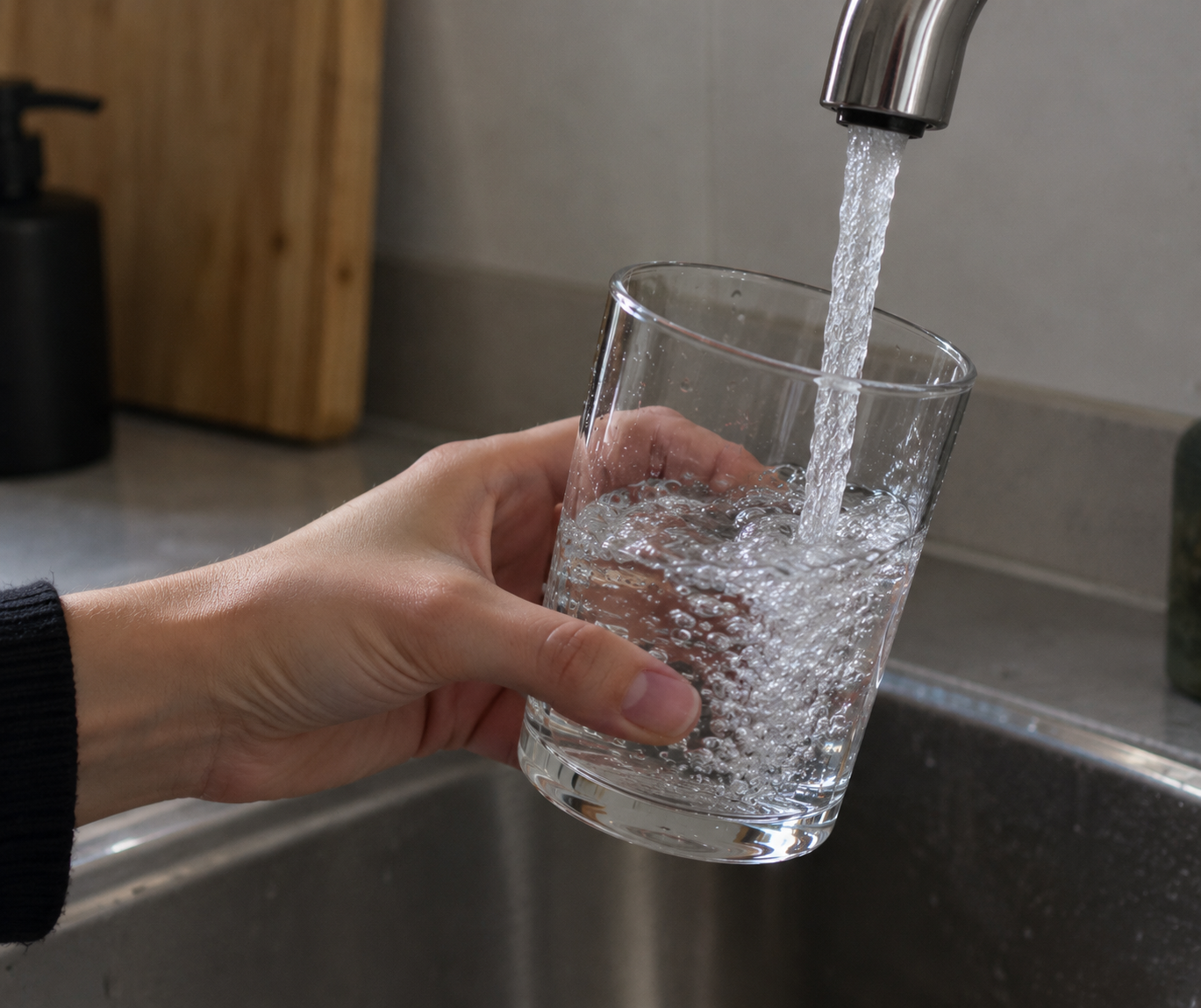
You turn on your tap and, at the moment of drinking, you notice a slight smell or taste reminiscent of chlorine from the pool.
Rest assured, its presence in tap water is not abnormal. Chlorine is intentionally used to disinfect water and protect it from microorganisms until it reaches your home.
However, this exposure inevitably raises some questions. Why is chlorine used in drinking water? What amount is found in the water? Is it dangerous to health? And above all, how can one reduce chlorine in tap water when its taste or smell becomes unpleasant?
We explain everything to you.
Why is there chlorine in tap water?
Chlorine is added to drinking water to disinfect it and prevent the proliferation of microorganisms that may pose risks to human health. Bacteria, viruses… Its role is to destroy or neutralize them before the water reaches our glass.
Since the late 19th century, this method of disinfecting water networks has played a major role in combating waterborne diseases. It has notably significantly reduced the risk of cholera and typhoid fever.
But why do we still find chlorine once the water arrives at our homes? Simply because the water must remain protected throughout its journey to our tap. A small amount of chlorine is therefore maintained in the water to continue its action as it flows through the pipes. This is what the Anses calls the residual effect of chlorine.
In other words, the presence of chlorine in water is not contamination. On the contrary. It is primarily a necessary public health safety measure, which contributes among other things to limiting bacteria in tap water.
What is the allowed chlorine level in drinking water?
There is no maximum chlorine level allowed in tap water in France, at least for free residual and total chlorine.
It is important to distinguish between these two measurements. Free chlorine refers to the chlorine that remains available in the water to continue acting against microorganisms. Total chlorine includes this free chlorine, but also the chlorine that has reacted with certain substances present in the water.
For these parameters, the decree of January 11, 2007 does not set a general maximum value. The regulation instead establishes a reference related to the organoleptic quality of the water, that is to say, its taste and smell. The distributed water must therefore not have an unpleasant odor or taste nor show any abnormal change.
On the other hand, standards are set for certain by-products of water chlorination. These are compounds that can form when chlorine reacts with organic matter present in the water. Among them, we find trihalomethanes (THM), including chloroform. Their total concentration must not exceed 100 µg/L in drinking water.
In short, France does not set a unique maximum chlorine level in tap water. It regulates the quality of the distributed water and certain by-products formed during chlorination.
Is chlorine in tap water dangerous?
At the concentrations used to treat drinking water, the chlorine present in tap water is not considered dangerous to health when sanitary requirements are met.
Its use, on the contrary, helps limit risks associated with bacteria, viruses, and waterborne diseases.
However, this disinfection is not without consequences. Chlorine can react with organic matter present in the water, such as fragments of dead leaves, plants, algae, or biofilms. These reactions can form numerous compounds: more than 600 chlorination by-products have been identified.
Among the most monitored are trihalomethanes (THM), including chloroform. In a report published in 2025, the High Council of Public Health (HCSP) reports an association between exposure to THM and certain cancers, particularly bladder cancer. Reproductive effects have also been observed in toxicological studies at high consumption levels.
In short, when questioning the dangers of tap water, chlorine itself is not the main point of concern. It is primarily the substances that can form when it reacts with organic matter.
How to remove chlorine from tap water?
Letting the water sit is not enough to eliminate chlorine
It is often said that simply letting tap water sit for an hour is enough to make chlorine disappear. In reality, this time frame is too short to completely get rid of it.
At room temperature, some of the chlorine present in the water can gradually dissipate into the air. But this evaporation does not happen instantly: it takes time and varies with temperature. After an hour, there is still some left in your water.
And putting your carafe in the refrigerator does not change the situation. The cold actually slows down its degassing. If the cold water seems to taste better, it is mainly because the cold makes certain flavors and odors less perceptible.
Letting chlorinated water sit may then reduce this characteristic taste, but it does not completely eliminate chlorine or all chlorination by-products.
Remove chlorine naturally using UV-A technology
LaVie has developed a patented technology that uses UV-A light to naturally purify tap water.
Its principle is based on the photolysis of chlorine. Specifically, UV-A rays act on the chlorine present in the water and transform it into reactive compounds capable of neutralizing certain undesirables.
In just 15 minutes, this technology allows for:
- Eliminate more than 90% of chlorine
- Eliminate up to 99.99% of bacteria and viruses
- Reduce pesticides and pharmaceutical residues
- Preserve essential minerals for our metabolism
Water treatment without filter, without cartridge, and without the addition of chemicals.
And without chlorine, what about preservation? A bottle of water treated with LaVie and kept closed can be preserved for 6 months or more, at room temperature or in the refrigerator. Once opened, however, it is recommended to consume the water within 48 hours.