 French
 Spanish
 German
 Italian
 English
Between faucet filters, under-sink filters, and filtered carafes, it can be difficult to navigate! All promise to improve the quality of tap water. However, they do not offer the same results.
Their effectiveness depends on the technology used, the amount of filtering materials, and the contact time with the water. Significant differences to choose the best faucet water filter.
So, faucet filter or under-sink filter? Let’s compare their advantages, limitations, and performances to help you make the right choice.
What are the differences between a faucet filter and an under-sink filter?
A faucet filter and an under-sink filter have the same goal: to improve the quality of drinking water. But their operation and filtration capabilities are quite different.
- The faucet filter: attached directly to the faucet, it generally uses a small activated carbon cartridge to reduce certain contaminants and residues.
- The under-sink filter: connected to the water supply, it contains more filtering materials and can process larger quantities of water.
- The countertop systems: the classic filtered carafe and the LaVie purifier operate without plumbing connection. The former has cartridges, while LaVie purifies water using UV-A, without filters or consumables.
But be careful, the size of the product is not everything. Effectiveness mainly depends on the technology used. Let’s see what each system can do.
What are the advantages and constraints of an under-sink filter?
The advantages of an under-sink filter
The under-sink filter offers effective water treatment and genuine daily comfort.
Its main advantages are:
- Effective filtration: it reduces many pollutants and residues such as chlorine, pesticides, PFAS, heavy metals, sediments and microplastics.
- A large capacity: its large filter cartridges treat more liters of water and provide better autonomy.
- Discreet installation: hidden under the sink, it frees up the countertop and does not obstruct the faucet.
- Comfortable flow rate: some models maintain the flow rate to quickly fill glasses, pots, and carafes.
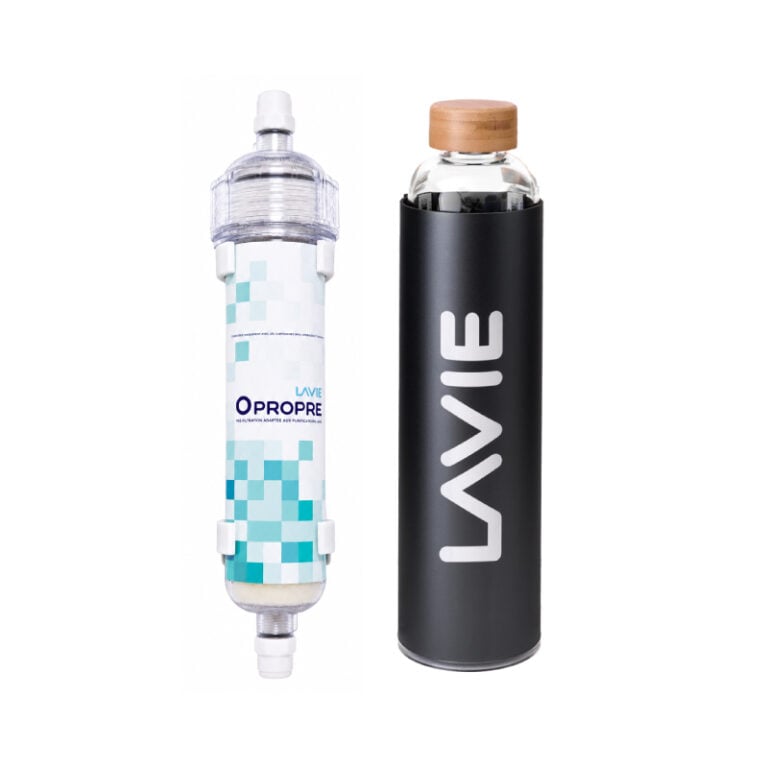
With the Opropre under-sink filter, LaVie combines coconut activated carbon and specific resin to eliminate up to 99.9% of certain pollutants, including PFAS. And to combine efficiency and ecology, its cartridge is replaced every 6 months and is rechargeable to limit waste.
To go further, find the various solutions in our comparison of under-sink filters.
The disadvantages of an under-sink filter
The under-sink water filter also has some constraints:
- Higher purchase price: the investment is greater than with a faucet filter. But the cartridges last longer and need to be replaced less often.
- Necessary connection: the system must be connected to the water supply. However, installation remains simple and does not require major work.
- Space under the sink to consider: some filtration systems, like reverse osmosis units, are bulky. Others, like Opropre, remain compact and easy to integrate.
What are the strengths and limitations of a faucet filter?
The advantages of faucet filters
The faucet filter appeals due to its affordable price and ease of use.
Its main advantages:
- Affordable price: cheaper to purchase than an under-sink filter, it attracts those on a budget.
- Quick installation: it attaches directly to the faucet, without any work or plumbing modifications.
- Improvement of water taste: some models reduce chlorine, unpleasant odors, and certain contaminants.
An accessible and practical solution, therefore. But in terms of treatment efficiency, the results on filtered water are not always satisfactory.
The limitations of a faucet filter
Behind their low price, faucet filters have several limitations:
- Variable effectiveness: according to UFC-Que Choisir, some water filters retain pollutants, but none of the tested products eliminate TFA. Therefore, water filtration remains incomplete.
- Low capacity: small cartridges must be replaced regularly. Otherwise, they can promote bacterial growth.
- Reduced flow rate: the passage of water through the membrane or cartridge can slow its flow.
- Cluttered faucet: the device can obstruct certain daily tasks, particularly for washing dishes.
An attractive price, certainly. But incomplete filtration and demanding maintenance.
What is the best water filtration system for the home?
The best water filtration system for the home remains the under-sink filter. Thanks to its larger cartridges, it processes more water, reduces many pollutants and residues, and requires fewer replacements than a faucet filter.
A real advantage for water quality and comfort at home.
But the choice also depends on your needs:
- To improve the taste and odor of water: faucet filters may suffice to reduce chlorine and certain particles, but their action remains limited.
- To reduce PFAS, heavy metals, and microplastics: prioritize a high-performance under-sink filter, like Opropre, which combines activated carbon and specific resin.
- To avoid regular cartridge purchases: UV-A purifiers LaVie operate without filters or consumables. Less spending and waste!
- For a simple solution, without installation: LaVie PURE purifies water in just 15 minutes. Thanks to UV-A, it eliminates up to 99.9% of bacteria and viruses and reduces chlorine, pesticides, and pharmaceutical residues.
And to combine filtration and purification? The Serenity Pack combines Opropre, which retains pollutants under the sink, and LaVie PURE, which complements its action through UV-A.
Two complementary technologies to naturally purify drinking water and drink quality water at home.