 French
 Spanish
 German
 Italian
 English
It is known that filtering tap water improves its quality and reduces exposure to certain pollutants. But perhaps the system used at home presents certain dangers?
In France, more and more households are choosing to filter their drinking water to reduce the presence of chlorine, PFAS, pesticides, or even microplastics in their glass.
A rather reassuring approach, at least at first glance. Studies have highlighted the limitations of certain devices, such as filter jugs and reverse osmosis systems.
Should we then be wary of filtered water?
No, on the contrary. It is enough to opt for a reliable solution tailored to your needs. We will guide you.
Is it good to drink filtered water?
To protect one’s health, drinking filtered water is a very good habit. Why? Because filtration improves the composition of tap water by retaining the contaminants present in it. But this is provided that the appropriate treatment is chosen.
For example, a poorly maintained filter jug can become a favorable environment for the development of bacteria. As for some reverse osmosis systems, they eliminate elements that are naturally present in water, yet essential to the body. And of course, if the filters or cartridges are ineffective, they will not reduce the impurities you are trying to avoid, which today raise many questions within the scientific community.
The problem is therefore not the purified water itself, but the filtration method used at home.
Can bacteria develop in water filters?
That is the big question! And the answer may not please you. Yes, bacteria do develop in filter jugs, especially when they are not properly maintained.
ANSES and UFC-Que Choisir warn about this health risk with this striking title: « Useless, or worse! ». In other words, without regular replacement of filters and cartridges, these devices become real nests for these organisms.
Why? Because by reducing the chlorine present in the water, they also eliminate its natural disinfecting action. Add to that stagnant water and a used filter, and these microorganisms find an ideal environment to proliferate. A real nonsense when trying to improve the quality of one’s water.
The same observation applies to reverse osmosis systems. By eliminating chlorine, bacteria colonize the storage tank, the outlet of the membrane, or even the distribution tap.
In light of the limitations of these systems, the filter jug without cartridge LaVie adopts a radically different approach.
Thanks to its UV-A technology, the purifier LaVie eliminates 100% of bacteria without a filter to replace. In fifteen minutes, it safely purifies drinking water.
Moreover, sterilization occurs with the bottle closed and sealed, so the water can be stored for many months, even at room temperature.
A sustainable, effective, and secure use through this “closed bottle” sterilization.

Is filtered water always rich in essential minerals?
Some solutions also pose problems regarding what they filter. Because yes, eliminating pollutants and improving taste is good, but if it means removing essential minerals for our body, that is more debatable.
Among others, calcium and magnesium, which contribute to bone health as well as the proper functioning of muscles and the nervous system.
This is particularly the case with certain filter jugs. Their small white beads, made of ion-exchange resins, not only reduce certain contaminants, but also decrease the amount of calcium and magnesium present in tap water.
As for reverse osmosis systems, they go even further. Their extreme filtration eliminates 95% of these minerals necessary for our health.
The result? Very low mineralized water, more acidic, even in the case of remineralization. Indeed, the quick passage through a mineral cartridge only allows for the recovery of a tiny dose of calcium/magnesium.
In other words, it is not recommended to consume osmosis water daily in the long term.
The aim of this treatment is, however, simple: to provide healthier drinking water at home, not water impoverished below the WHO’s “drinking water” standards.
Is filtered water really free from pollutants?
Not all filtration solutions provide the same level of protection. Filtering tap water does not necessarily mean eliminating all dangerous substances.
Here are their main limitations:
- Filter jugs: they mainly improve taste and odor, but remain ineffective against contaminants such as forever chemicals, microplastics, or heavy metals. A practical solution, but insufficient.
- Reverse osmosis systems: presented as extreme filtration systems, they are far from flawless. In the report Zone Interdite (« Our health in danger: revelations about this plastic that poisons us »), tests showed that they only retained about 60% of microplastics. Quite disappointing for a technology supposed to eliminate everything.
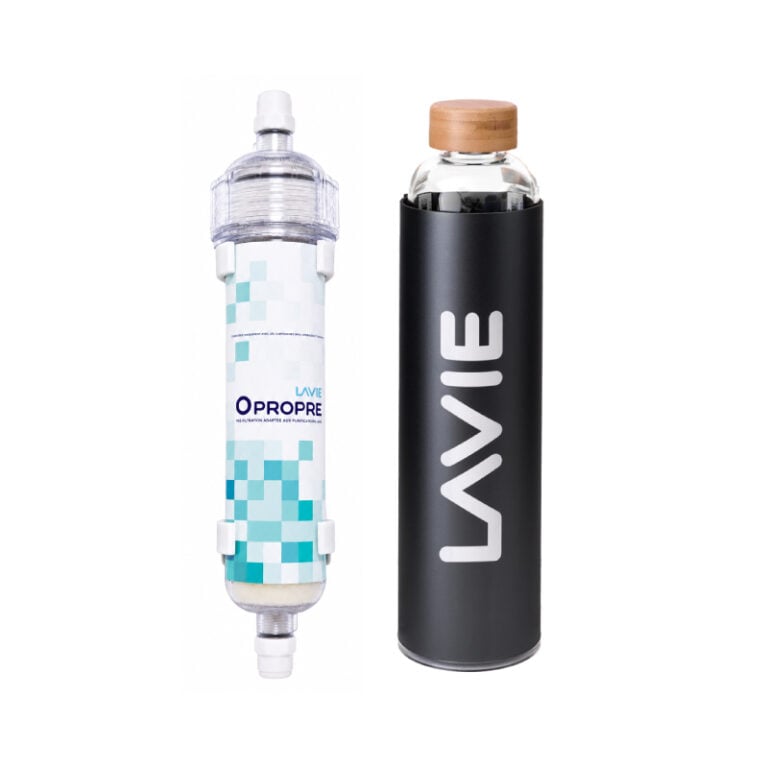
In light of these limitations, the under-sink filter Opropre from LaVie offers a more demanding approach. Its effectiveness relies on high-performance activated carbon combined with a specific resin capable of blocking particularly resistant substances, such as PFAS, pharmaceutical residues, microplastics and nanoplastics.
The result? Healthier and more pleasant drinking water.
Can filtered water become your everyday water?
Filtered water can indeed become your everyday water, provided you choose a reliable and properly maintained device.
Its main benefit? Reducing the presence of harmful pollutants found in tap water.
Some precautions remain necessary. Filters and cartridges must be replaced regularly to avoid any loss of effectiveness and any possibility of bacterial proliferation. It is also important to follow the usage and storage recommendations.
Infants also require special attention, as their immune systems are still fragile. Before giving tap water to a baby, it is better to check that the chosen solution is truly suitable, which is the case for LaVie products.
Thanks to its UV-A technology, the purifier LaVie eliminates 100% of bacteria present in drinking water, without a filter or cartridge to replace. True peace of mind for parents.
A simple way to take care of your health and that of your family. Proven effectiveness here.
What is the best method to filter water safely?
One thing is certain: not all filtration solutions are equal.
Filter jugs promote bacterial growth when poorly maintained and quickly show their limitations against impurities. They also introduce microplastics through the contact of acidified water with their plastic body.
Reverse osmosis systems, on the other hand, eliminate some of the essential minerals naturally present in water, without offering flawless protection against certain contaminants like microplastics.
So, how can one enjoy safe tap water? By combining multiple levels of filtration.
This is precisely the promise of our Serenity Pack:
- The under-sink filter Opropre*, thanks to its high-performance activated carbon and a specific resin, acts directly at the source to retain forever chemicals, sediments, pharmaceutical residues, as well as microplastics and nanoplastics, while preserving the essential elements present in the water.
- The UV-A purifier LaVie intervenes at the time of consumption to eliminate the last undesirable elements, without a filter or cartridge to replace, which limits the microbiological risk.
Healthier water, more pleasant to drink, and designed to take care of the whole family.
*Our Opropre filter is deposit-returned and recycled so that pollutants do not return to the environment.