 French
 Spanish
 German
 Italian
 English
The good quality of water that one uses at home, for hydration, washing, or cooking is one of the major concerns of consumers, and this is quite normal! In France, tap water is perfectly drinkable and its quality is closely monitored by regional health agencies. Nevertheless, depending on your region, department, or municipality, its mineral content, taste, or even its hardness may vary.
What is hard water?
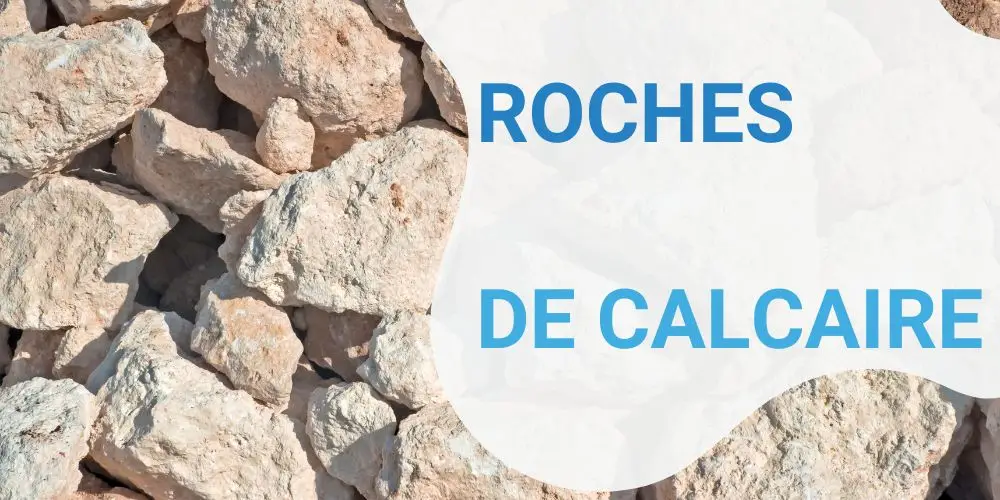
The hardness of water is a parameter that measures the amount of minerals, primarily calcium and magnesium, present in the water. This indicator is expressed by a hydrotimetric title (TH), which is a number expressed in French degrees (°F).
Each French degree corresponds to a concentration of 4 mg/l of calcium or 2.43 mg/l of magnesium, or to a concentration of 10 mg of limestone per liter of water. Limestone is a form of calcium carbonate (CaCO3) that forms when the minerals present in the water combine with carbon dioxide from the air.
Thus, for example, if the water has a hardness of 20 °F, it means that it contains 80 mg/l of calcium (20 x 4) or 48.6 mg/l of magnesium (20 x 2.43), or 200 mg/l of limestone (20 x 10).
The different degrees of water hardness and their correspondences in terms of calcium and magnesium concentration
| Degree of hardness | Hydrotimetric title (°F) | Calcium concentration (mg/l) | Magnesium concentration (mg/l) |
|---|---|---|---|
| Very soft | <8 | <32 | <20 |
| Soft | 8 – 15 | 32 – 60 | 20 – 36 |
| Moderately hard | 15 – 25 | 60 – 100 | 36 – 61 |
| Hard | 25 – 40 | 100 – 160 | 61 – 97 |
| Very hard | >40 | >160 | >97 |
The values presented in the table and the graph above are general indications and may vary from one region to another.
Indeed, it is important to note that the hardness of water can vary depending on the geographical location and the geological characteristics of the region, as well as the water source used. In fact, regions where water is in contact with limestone rocks tend to have harder water, while regions with acidic soils have softer water.
Water hardness by municipality
Overall, there are 3 simple ways to know this information.
Visit the Ministry of Health’s website
First of all, it should be noted that the Ministry of Health provides information on water quality for each region and each city. It is possible to find information on the hardness of water for your region by visiting the Ministry of Health’s website and consulting the section related to water quality. This option can be useful if you wish to obtain an estimate of the hardness of the water in your region without conducting a test.
On the water bill
Next, the hardness of the water may also be indicated on your water bill. However, this is not always the case. Nevertheless, if the hardness of the water is not indicated on your bill, you can contact your local water company to obtain this information.
Also read: What is the price of m3 of water in France and in my municipality?
Perform a water hardness test TH
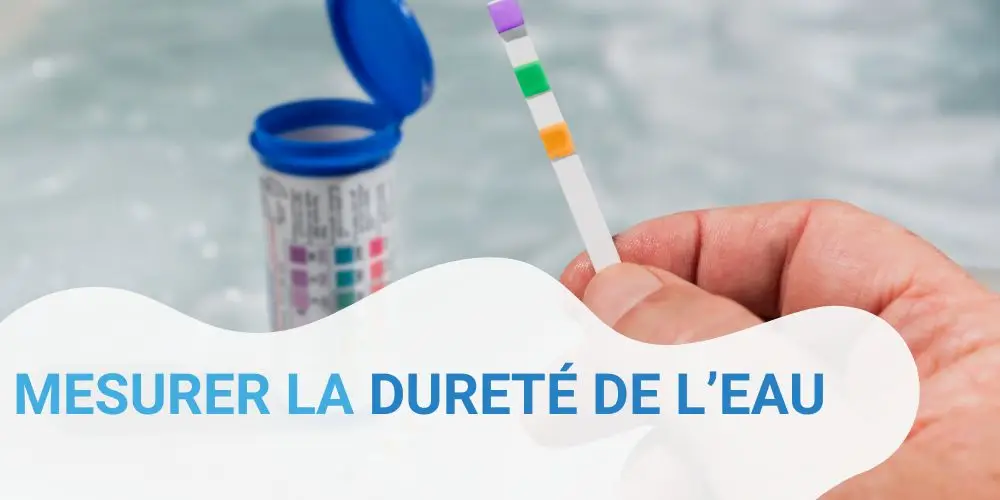
Finally, the most reliable way to know the hardness of water is to perform a water hardness test TH. These tests are available in most DIY and gardening stores. You can also find them online for an average cost of about 10 euros.
Water hardness tests TH use strips or test kits to measure the mineral content in the water. These kits contain chemicals that react with the minerals in the water to produce a color. The color produced is then compared to a color scale to determine the hardness of the water in French degrees.
Is hard water harmful to health?
NO! It must be said and repeated, hard or calcareous water is not harmful to health. On the contrary, it has the advantage of providing essential minerals such as calcium and magnesium that are important for human health. Calcium and magnesium are essential elements provided by nature that help strengthen bones, maintain healthy blood pressure, and support the nervous and muscular systems.
Moreover, the minerals present in calcareous water are beneficial for cardiovascular health by helping to reduce the risks of heart disease. Studies have also shown that calcareous water can help reduce the risks of certain chronic diseases, such as kidney disease, dental cavities, and osteoporosis.
Also read: Limestone / calcium ion in drinking water, the whole truth!
What are the drawbacks of hard water?
If there are water softeners for sale, you may ask us: “what are the drawbacks of this hard water?”
In fact, when hard water is heated, the minerals deposit as scale. This scale can accumulate in pipes, water heaters, washing machines, and dishwashers, thereby reducing the efficiency and proper functioning of household appliances.
The perfect example of the disadvantages that can be caused by excessively hard water remains the scaling of your kettle!
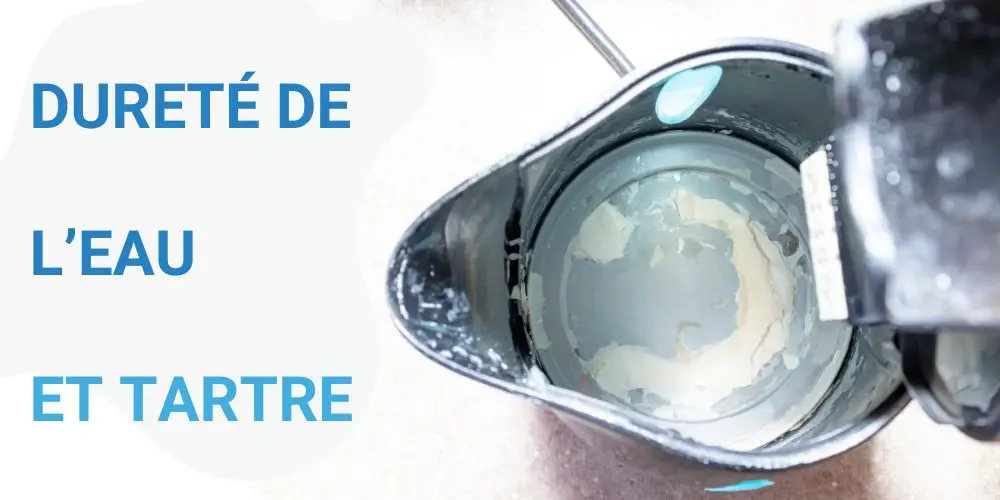
Scale can not only reduce the efficiency of the kettle by increasing the heating time of the water, but it can also alter the taste of boiled water. Additionally, deposits can cause premature wear of the kettle’s heating element, which may require costly repairs or premature replacement of the appliance.
In this regard, we recommend reading our article on How to descale a kettle and extend its lifespan.
Do I need a water softener?
There are several solutions for treating hard water. One of the most common options is to use a water softener. This device uses an ion exchange resin to replace calcium and magnesium ions with sodium ions (yes, salt!), thereby reducing the amount of minerals in the water.
To get a more comprehensive overview of the best anti-limestone systems for the home, we discuss it in detail in our dedicated article.
Negative environmental impact
It is first useful to note that a water softener can be harmful to the environment for several reasons.
First, water softeners use salt to remove hard water minerals such as calcium and magnesium. When the water softener is regenerated, a large amount of salty water is discharged into the sewers, which eventually ends up in the surrounding waterways. This salty water can be toxic to plants and animals.
Next, a water softener is of course energy-intensive and requires additional water for its operation. Finally, the manufacturing of a water softener requires the production of materials that are often non-recyclable.
And my appliances?
Yes, this is the main argument for selling you a softener! The device will protect your appliances from the negative consequences of scale that we discussed earlier. Really?
Nothing is less certain! Indeed, the softener that will remove calcium from your water will also make it acidic in addition to making it corrosive by adding salt! Is it really better than calcareous water for your appliances?
So what to do? There are alternative solutions that we describe in our article Which anti-limestone system to choose for the home? that will not turn your tap water into seawater, while being environmentally friendly!
Also read: A water softener, why do it?
Here, we hope that you now know everything there is to know about water hardness and its measurement. We also hope to have convinced you that the concept of water hardness is primarily promoted by manufacturers of water softeners who try to persuade you that hard water would be bad for your health, which is completely false.
Alternatives to traditional water softeners
If water hardness can cause problems for your household appliances, it is not necessary to resort to traditional salt-based softeners, which are often expensive and, as we have seen, not very environmentally friendly.
In fact, there are alternative solutions such as ionic anti-scale systems. For example, the ODOUCE anti-scale system from LaVie presents itself as an innovative and salt-free alternative. Thanks to its patented technology, it prevents scale formation by transforming hard water into a non-sticky powder that is easy to remove. Easy to install, maintenance-free, ODOUCE effectively protects your equipment while preserving the quality of your water, without the drawbacks of traditional softeners.

 We talked about