 French
 Spanish
 German
 Italian
 English
Before discussing a UV filter for treating tap water in particular, let us start with some scientific information.

What is ultraviolet radiation?
Ultraviolet rays are a form of electromagnetic radiation emitted by the sun and other sources. They are classified into three main types based on their wavelengths. UV-A, UV-B, and UV-C are all joyful photons of the light spectrum. They are electromagnetic waves, but our eyes cannot see them. They are at the very bottom of the spectrum, opposite to infrared.
UV-A
First of all, let us start with the most abundant, by far: UV-A! UV-A rays have the longest wavelengths among UV, ranging from about 320 to 400 nanometers (nm). They represent 5% of solar radiation. Harmless, they can help combat skin diseases.
Moreover, they are generally essential for our balance, and only cause a slight tan after a few hours of exposure. However, exposure exceeding a few hours per day is not recommended, even though we do not clearly know its long-term harmfulness.
They are widely found in industrial products: polymerization of adhesives, drying in printing and screen printing, drying and polymerization of nail varnishes, fluorescent light in nightclubs, etc.
UV-B
Next, UV-B rays have wavelengths ranging from approximately 280 to 320 nm. UV-B rays are clearly carcinogenic at high doses, hence the increasingly strict regulations on tanning booths due to cases of skin cancer, in particular.
They are responsible for “sunburns”, which can occur after only 30 minutes of exposure for fragile skin. UV-B rays also have the ability to damage cellular DNA, which can increase the risk of skin cancers.
The atmosphere filters out a large part of them, allowing us to face the midday sun with minimal risks.
They are very rarely present in commercial products, except for some reptiles (for reptiles kept in captivity, it is essential to provide appropriate UV-B lighting to replicate their natural environment) and tanning booths.
UV-C
Finally, UV-C rays have the shortest wavelength, ranging from about 100 to 280 nm. UV-C is lethal to humans and nearly everything that lives on the planet. There are none on Earth, as the ozone layer blocks them (let us hope it stays there, otherwise we will have to live underground…).
Humans can produce them with the power of mercury lamps or LEDs, mainly for their effects on bacterial DNA.
Learn more about UV: https://fr.wikipedia.org/wiki/Ultraviolet
Effects of UV water treatment on microorganisms
So, in commerce, when you hear about UV water treatment, it will almost always imply sterilizers that use a UV-C lamp.
With this prerequisite established, let us focus on water and the undesirable living microorganisms within it.
We use UV-C for sterilization, as they can affect bacterial DNA and cause mutations. This blocks bacterial division.
If you drink water loaded with bacteria that has been flashed with UV-C, you will indeed drink these bacteria, mostly alive, but with the guarantee that these creatures will not reproduce during digestion.
Thus, you will be “saved”, but you will not improve the taste, odor, or the physico-chemical aspects of the water. That is why we talk about sterilization and not filtration (and even then, to kill bacteria using a UV sterilizer, you need to triple the dose, and for certain viruses, multiply it by 10.)
It should also be noted that the effect of UV-C on bacteria is uneven, as it generates mutations: the vast majority can no longer reproduce, but a small minority becomes “supercharged”, either more active and dangerous, retaining the ability to divide, or to multiply.
You can therefore acquire a UV-C bottle (or UV sterilizer) if you wish to consume water from a lake or a river. Provided it is not loaded with chemicals, pesticides, traces of medications, etc.
Some brands document them as water purifiers, which is entirely false.

Effects of UV treatment on bad tastes and odors in tap water
UV-B and UV-C
As for the bad taste and bad odor of tap water at home, they are due to chlorine and its 500 by-products. But did you know that some of these chlorine by-products are proven carcinogens? And the “flashes” of UV-C will not affect them at all!
In this regard, even a “common” filter jug with a activated carbon filter performs much better!
Moreover, while the major players in drinking water treatment in France use UV-C for its rapid action, they only do so at the end of treatment, just before chlorination for transport in the public network.
However, when I see French companies equipping themselves with UV-C treatment under the sink for €1300, I cry scandal: there are no bacteria in tap water in France, there is no point in trying to eliminate them…
It is as distressing as buying a water softener (€1000, very polluting) to improve the taste of water: who prefers to drink salty water passed through resins and plastic to avoid absorbing calcium? Calcium ions have no taste…
So, one last reminder: UV-C rays cannot “purify” water, unless one believes that purifying means killing a bacterium to drink it dead? I leave you to conclude.
It should be noted that UV-B is hardly used for water treatment, as plastics and glass are opaque to it.
Also read: What are the environmental impacts of plastic water bottles and how to avoid them
UV-A light for real water treatment
UV-A is utilized for its bactericidal property in various applications such as the SODIS process (solar disinfection) developed by EAWAG and widely used in developing countries.
It is a method to disinfect water using only solar rays and polyethylene terephthalate (PET) bottles.
Thus, this solar disinfection of water works by exposing plastic bottles to sunlight for several hours to eliminate pathogenic germs. In such a way that it significantly reduces cases of dysentery, for example.

What do LaVie water purifiers offer?
Now that we have thoroughly covered the topic of UV water treatment, let us look together at what the solution proposed by LaVie has that is innovative.
First of all, let us be clear, using UV-A for its bactericidal properties is not patentable, as it has been known to practitioners for decades. Therefore, we have patented something entirely different.
So, fasten your seatbelts, we are diving into this magnificent innovation. However, we will need to quickly explain what an advanced oxidation process is, a family to which LaVie belongs.
Advanced Oxidation Processes (AOP)
First of all, it is important to know that advanced oxidation processes (AOP) refer to a series of techniques (Ozonation, Peroxidation, UV Radiation, and Electro-oxidation) used to treat water and wastewater. Their main objective is to destroy or transform organic pollutants and certain inorganic pollutants present in the water.
In fact, water companies use these very expensive processes to eliminate persistent substances in wastewater: female hormone (beta-estradiol from contraceptive pills), endocrine disruptors, pesticides, traces of medications, etc.
The system proposed by LaVie
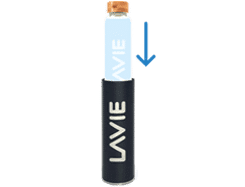
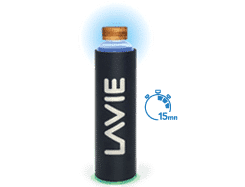
LaVie water purifiers indeed use an advanced oxidation process, with the radiation of water by UV radiation. But, as you will have understood: a UV-A radiation!
In fact, the novelty consists in flashing the chlorine contained in tap water with UV-A radiation, which transforms it into oxidizing radicals (O, O3, H2O2, H-, CL-). This UV-A bombardment of chlorine generates radicals, which by rebound will decompose everything that is not water into simple and harmless elements. And, all while also eliminating chlorine: one had to think of that 🙂
Moreover, let us note that living bodies (bacteria, viruses, etc.) are riddled with holes created by these violent exchanges and cannot emerge alive or in one piece from this treatment.

A UV water treatment for individuals
To be honest, no one had thought of using this type of treatment for tap water, let alone with UV-A instead of UV-C. And even less so with chlorine contained in tap water as the active ingredient!
Thus, we have created the first domestic advanced oxidation process. It is safe and this time as effective as its predecessors.
Conclusion on UVs for treating tap water
The treatment of water by UV radiation is a vast field with a diversity of effects and applications. The UV-A, UV-B, and UV-C all play distinct roles, but it is essential to fully understand their specifics for appropriate and effective use.
While UV-C has traditionally been associated with water sterilization, LaVie brilliantly demonstrates the effectiveness of UV-A in an advanced oxidation process. This is a first for domestic water treatment.
In summary, thanks to this innovation, it is now possible to effectively eliminate pollutants and improve tap water quality without health risks. In a world where drinking water is a precious resource, it is imperative to turn to innovative and sustainable solutions like the one proposed by LaVie.
But some may argue that protecting oneself from micro-pollutants can undoubtedly be interpreted as a precautionary principle. But would you consider drinking medications or pesticides, even in very small quantities?
Similarly, do you think that drinking the chlorine from your favorite beverage, a biocide found in tap water, has no effect on the bacteria in your trachea?
And once again: Therefore, avoid UV-C based products. You do not need them if you are not a fan of camping in a camper or wild camping or a resident of a country where drinking water is not treated! You are “consumactivists,” it is up to you to judge.