 French
 Spanish
 German
 Italian
 English
In France, tap water is strictly controlled. But is that enough to make it completely safe? Unfortunately, not always. Its quality depends on many factors: region, condition of the pipes, treatments applied… As a result, it sometimes contains pesticides, pharmaceutical residues, bacteria, and the notoriously famous PFAS.
In July 2025, 12 towns in the Ardennes even banned its consumption due to a too high level of PFAS. Can we still trust tap water?
In light of these concerns, some households are turning to reverse osmosis, a radical filtration method capable of removing up to 99% of contaminants present in drinking water. An appealing solution, but not without consequences: minerals removed, acidity, microbial risk, water wastage…
So, is this technology really suitable for daily use? What are its dangers and what safer alternatives can we consider? Let’s take stock.
How does reverse osmosis water filtration work?
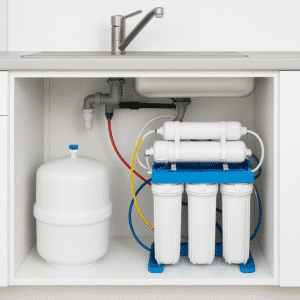
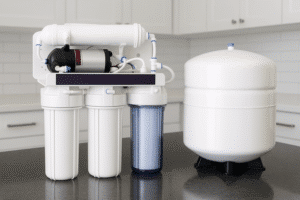
A reverse osmosis unit is a water treatment device based on the principle of reverse osmosis. It operates using a semi-permeable membrane that removes the majority of pollutants present in the water, blocking dissolved impurities: heavy metals, bacteria, pesticides, organic contaminants, and even PFAS.
This process occurs in three steps:
- Pre-filtration: removal of solid particles such as sand, sediments, and reduction of certain chemical components, particularly chlorine.
- Filtration: water is pressurized to pass through a very fine membrane, which retains undesirable substances and ions.
- Post-filtration: a final filter adjusts the taste of the water and removes any residual odors.
This process allows for very pure water to be obtained at the tap.
Osmosed water: ultra-pure filtration
Reverse osmosis is considered one of the most effective treatment devices on the market. Thanks to its semi-permeable membrane, this system retains up to 99% of contaminants present in the water: heavy metals, nitrates, pharmaceutical residues, pesticides, PFAS (eternal pollutants), viruses, bacteria…
The result? Water of great purity, almost free of undesirable substances. It is clearer, odorless, has no unpleasant taste, and is visually clear. This is why many households opt for this solution when seeking maximum filtration.
However, this extreme purity is not without complications. The reverse osmosis unit has several drawbacks, both for your health and for the environment.
The reverse osmosis unit: effective… but not against microplastics?
In the report Zone Interdite (“Our health in danger: revelations about this plastic that poisons us,” aired on March 8, 2026), independent researcher Jean-Baptiste Fini, a microplastics specialist, compared three filtration systems using deliberately contaminated water.
The results, analyzed by an independent laboratory, show significant differences in effectiveness:
- The gravity filters are the least effective: they filter only 30% of microplastics, allowing the majority of particles to pass through.
- The reverse osmosis systems retain about 60% of microplastics.
- While the Opropre activated carbon filter proved to be the most effective, eliminating 75% of the microplastics present in the contaminated water!
Conclusion: while filtration generally reduces the presence of microplastics, the choice of system makes a major difference in your actual daily exposure.

Reverse osmosis: the dangers of overly filtered water
While reverse osmosis impresses with its effectiveness, its extreme result is not without risk. By removing almost everything, it also deprives water of certain necessary elements, with possible harmful effects on your body and the environment.
Drinking osmosed water: a health risk
In the quest for perfectly pure water, we risk losing its essential benefits. Indeed, the reverse osmosis treatment removes almost all contaminants present in the water, but also essential minerals like calcium, magnesium, and potassium. These elements play a key role in the functioning of the body. Their absence can therefore, in the long term, lead to deficiencies and alter the quality of hydration.
Another consequence: excessive acidity. Without these alkaline minerals to regulate pH, treated water becomes more acidic. Daily consumption can then disrupt the body, disturb digestion, and weaken certain metabolic functions.
And that’s not all! By removing the chlorine naturally present in water, reverse osmosis units also eliminate its disinfecting power. As a result, without regular cleaning of the device, this system becomes a favorable ground for bacterial growth.
The magazine 60 Millions de consommateurs warns about the harmful effects of this process and states that “the consumption of osmosed water is not recommended”, even going so far as to headline: “Osmosed water: a scam and danger”.
The catastrophic environmental impact of the reverse osmosis unit
Behind its promise of purity, water treatment by reverse osmosis hides a high ecological cost. For every liter of filtered water, it discharges up to 4 liters of water into the pipes. The most problematic? This rejected water, called brine, is concentrated with pollutants (heavy metals, pesticides, PFAS…) and goes directly back into the environment. An ecological nonsense!
Unfortunately, it doesn’t stop there. To compensate for extreme demineralization, some devices incorporate a remineralization system. The result: cartridges to buy, replace, and throw away. All of these energy-consuming consumables and waste add to the high cost of the product, installation, and maintenance.
Despite all this, the water remains well below the mineral levels recommended by the WHO, which tap water complies with in France.
In light of this observation, one question arises: is it really necessary to filter water that is already potable so much? The reverse osmosis unit for the tap ultimately appears to be a costly, unsustainable, and ecologically disastrous solution. It essentially amounts to producing ultra-processed water that has lost most of its original qualities.
Read also: Water reverse osmosis unit: why this device is not so essential?
Better than reverse osmosis? Sustainable and effective devices
When considering what to choose to filter tap water, it is important to compare the different technologies available and their impacts on health as well as on the environment. Some solutions favor a gentler and more sustainable approach, allowing for improved water quality while preserving its essential minerals and limiting waste associated with traditional filtration systems.
While reverse osmosis is appealing due to its performance, it remains restrictive, expensive, and disastrous for the environment. Fortunately, LAVIE offers innovative devices that are healthier and more respectful of both your body and the planet.
UV-A filter carafe, under-sink Opropre filter… Each need has its responsible solution.
|
Filtered, reduced, or eliminated element |

Classic filter jug |
Tap filter |

Reverse osmosis system |

Under-sink Opropre filter |

LAVIE Purifier |
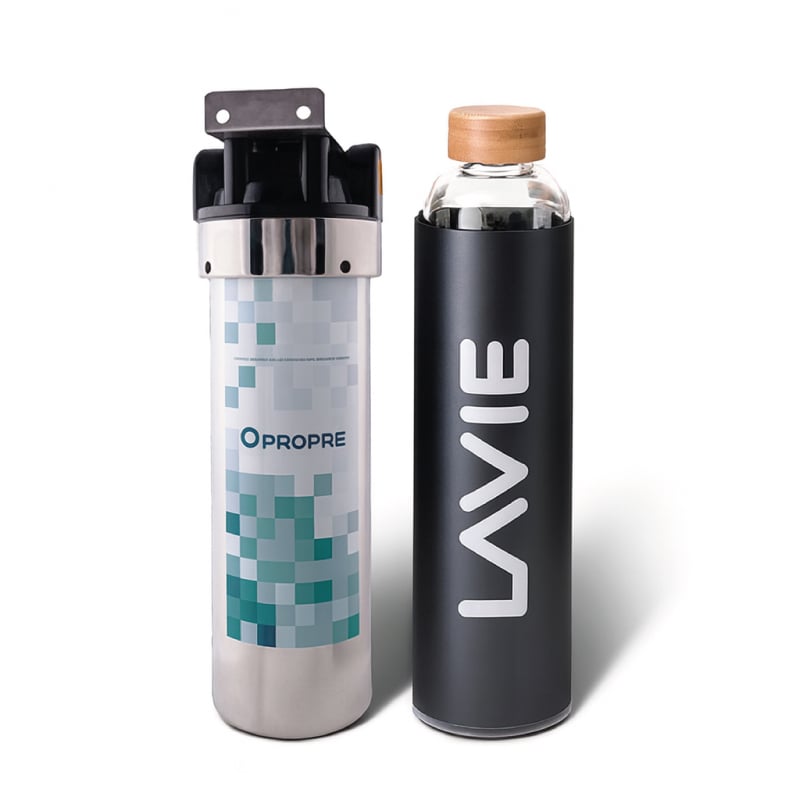
Serenity pack (Opropre + LAVIE PURE) |
| Chlorine | ✅ | ✅ | ✅ | ✅ | ✅ | ✅ |
| Sediments | ✅ | 🟠 | ✅ | ✅ | ❌ | ✅ |
| Bacteria | ❌ | ❌ | ❌ | ❌ | ✅ | ✅ |
| Viruses | ❌ | ❌ | ❌ | ❌ | ✅ | ✅ |
| Medicines | ❌ | ❌ | ✅ | ✅ | ✅ | ✅ |
| Pesticides | ❌ | ❌ | ✅ | ✅ | ✅ | ✅ |
| Heavy metals | 🟠 | 🟠 | ✅ | ✅ | ❌ | ✅ |
| PFAS | ❌ | ❌ | ✅ | ✅ | ❌ | ✅ |
| Microplastics | ❌ | ❌ | ✅ | ✅ | ❌ | ✅ |
| Preservation of beneficial minerals | ❌ | 🟠 | ❌ | ✅ | ✅ | ✅ |
| Discover | Discover | Discover |
Opropre: an effective purification that preserves the benefits of water
The Opropre Turquoise under-sink filter offers a solution that is both efficient, durable, and respectful of your body. Its technology is based on coconut shell activated carbon, capable of effectively removing heavy metals, pesticides, and microplastics while retaining essential trace elements for your body’s balance.
Opropre Turquoise incorporates an ion exchange resin that targets the most stubborn pollutants, such as PFAS.
Moreover, its innovative design is based on a cartridge and a resin that are returnable, rechargeable, and 100% recyclable, to be sent back to LAVIE every 6 months. The result: no disposable plastic, less waste, and zero water discharge.
Easy to install under the sink, these filters are an ecological and effective alternative that preserves the natural quality of water.
LAVIE UV-A filter carafe: healthy and beneficial water
Much more effective than a classic carafe, the LAVIE UV-A carafe relies on patented technology, UV-A light, which eliminates chlorine, pesticides, pharmaceutical residues, and certain bacteria and viruses in just 15 minutes, while also preserving the essential minerals for your body. Without a filter or cartridge to change, it generates no plastic waste and no water wastage.
Combined with an Opropre under-sink filter, it forms a remarkably effective duo for your household. While Opropre blocks heavy metals, microplastics, pesticides, and PFAS upstream, the UV-A filter carafe completes the action by neutralizing invisible residues and other impurities. An ideal alliance to obtain deeply purified, balanced water that respects your health.
And for families, offices, or communities, LaFontaine treats up to 5 liters of tap water in one go.
With LAVIE, you purify your water without impoverishing it, without polluting, and without compromising your well-being.

Bottled water: a credible alternative to reverse osmosis?
Long considered a practical and safe solution, bottled water is not a sustainable or truly healthy alternative to reverse osmosis. Indeed, it generates massive plastic pollution, a high carbon footprint related to transportation, and a cost much higher than that of filtered water at home.
Not to mention the proven presence of microplastics in some bottled waters, which raises real health concerns.
In other words, while reverse osmosis is not ideal, bottled water is not any better for your body or the planet.