 French
 Spanish
 German
 Italian
 English
Reverse osmosis has all the hallmarks of a miracle solution: it eliminates up to 99% of pollutants present in tap water. On paper, it sounds fantastic, of course. But before you rush into purchasing a reverse osmosis system to filter tap water, it is better to understand its limitations.
Demineralized water, acidity, waste, cumbersome maintenance, high cost… This filtration system, although very effective, raises several issues and important questions for both your health and the environment.
In this article, we will review the advantages, disadvantages, and especially the healthier and more sustainable purification alternatives to consider for your home.
Reverse Osmosis: Key Takeaways on This Filtration System
Advantages
✅ Eliminates a large majority of pollutants (chlorine, sediments, heavy metals, pesticides, viruses, bacteria)
✅ Very fine filtration
✅ Autonomous filtration
Disadvantages
❌ Bacterial proliferation in tanks and pipes
❌ Eliminates beneficial minerals (calcium, magnesium…)
❌ Acidic water output caused by the absence of mineral salts
❌ Rejects 2 to 4 liters of polluted water for every 1 liter filtered
❌ Significant space requirement under the sink
❌ High purchase and maintenance costs (membrane, filter, remineralization…)
❌ Non-ecological disposable consumables
❌ Very low flow rate, around 1l/min
❌ A noisy pump in some models
❌ An additional faucet to be installed on the countertop (drilling)
Reverse Osmosis, an Efficient Water Filtration System
Unlike conventional filters, reverse osmosis treatment relies on a highly advanced process: water is forced at high pressure through a membrane made up of several layers, capable of retaining almost all undesirable substances.
The result: formidable efficiency. Reverse osmosis can eliminate up to 99% of pollutants such as nitrates, pesticides, heavy metals, pharmaceutical residues, chlorine, viruses, certain bacteria, and even PFAS, these eternal pollutants that are now at the heart of health concerns.
It is one of the most comprehensive purification systems on the market, used both in industry and in some households.
The Advantages That Reverse Osmosis Appears to Offer for Your Water
If reverse osmosis is so appealing, it is primarily due to its particularly high filtration level, far superior to that of other systems on the market. With its membrane, it eliminates a wide variety of impurities and pollutants, including the most stubborn: nitrates, pesticides, heavy metals, pharmaceutical residues, and PFAS. The result: almost pure water, free from most undesirable substances.
It is also a process appreciated for its ability to produce neutral water, without taste or odor, which can be reassuring for those who are sensitive to the taste of chlorine.
On paper, reverse osmosis seems to address many concerns related to the quality of tap drinking water. But this is not entirely the case.
The Real Disadvantages and Limitations of Reverse Osmosis
While reverse osmosis shines with its technical purification performance, it also raises several practical, ecological, and health-related questions. Not immediately visible, these limitations can weigh heavily when it comes to choosing a filtration system for your daily water needs.
Demineralized Water is Far from Ideal for Health
In the pursuit of perfectly pure water, we remove its natural benefits. Indeed, the reverse osmosis treatment eliminates everything, or almost everything, with its membrane: pollutants, impurities, but also essential minerals such as calcium, magnesium, and potassium. These elements play a fundamental role in many metabolic functions. Their absence, when demineralized water is consumed daily, can disrupt the body in the long term. Thus, water filtered by reverse osmosis is not without danger for health.
The magazine 60 Millions de consommateurs warns against the harmful effects of water from reverse osmosis. In its analyses, it clearly advises against its consumption and does not hesitate to use strong terms, even going so far as to title: “Osmosed Water: Scam and Danger”.
Another consequence: acidity. Deprived of its alkaline minerals, osmosed water becomes more acidic. And water that is too acidic can disrupt digestion, weaken the body, and harm certain vital functions.
To compensate for this demineralization, some reverse osmosis systems integrate a remineralization system. However, these additions never restore the natural richness of balanced water. The mineral content remains well below the WHO recommendations.
Read also: Does reverse osmosis make water dangerous to consume?
A Device That Wastes More Water Than It Filters
Behind its promise of purity, the reverse osmosis system hides a significant ecological cost. To obtain just one liter of osmosed water, it can reject up to 4 liters of water into the drainage system. This rejection, known as “brine,” is far from trivial: it is concentrated with pollutants such as heavy metals, pesticides, and PFAS.
The result: polluted waters go directly back into the network, without being treated. The height of irony for a solution that is supposed to protect our health. On a household scale, this represents hundreds of liters of drinking water wasted each week. A true ecological nonsense.
A Flow Rate Too Low for Daily Use
While reverse osmosis treatment offers very advanced purification, the flow rate remains slow. Depending on the models and available pressure, a domestic reverse osmosis system can produce between 2 and 10 liters of water per hour. This amount is often insufficient to meet the needs of a household, especially when it comes to drinking, cooking, or preparing several liters in a short time.
In short, for so-called “pure” water, one must wait. This slowed pace can quickly become burdensome in daily life, especially for families or repeated uses throughout the day.
A Real Cost Much Higher Than It Seems
Reverse osmosis entails a significant budget. At purchase, expect to pay several hundred euros for a high-performance model. And that’s just the beginning! Add installation costs, usually carried out by a professional. Then come the regular replacements: filters, membranes, remineralization cartridges… Of course, none of these items are recyclable, unfortunately.
In terms of maintenance, it requires several times a year, often with the help of a specialist, thus incurring additional costs.
Ultimately, behind the promise of pure water, it is a demanding system that can quickly weigh heavily on the wallet.
Filtration Too Perfect to Block Bacteria
To protect its membrane, reverse osmosis removes chlorine at the very first stage of filtration. But this has harmful consequences. Indeed, the further water progresses through the system, the more vulnerable it becomes, as it is deprived of its natural disinfectant.
Then, by stagnating in tanks, pipes, or the faucet, it becomes a favorable ground for bacterial and mold development, especially if maintenance is neglected.
It’s a paradox: the purer the water, the more it can promote bacterial proliferation. This is certainly not what one expects from so-called purified water.
Reverse Osmosis: Is This System Really Recommended?
In the vast majority of cases, reverse osmosis treatment is not necessary. In France, tap water is drinkable, rigorously controlled, and compliant with health standards. This system may only be justified in specific situations, for example, if an analysis reveals significant contamination with heavy metals, PFAS, nitrates, or pesticides.
But for most households, it remains unnecessary, expensive, complex to maintain, polluting, and even problematic for the body.
Fortunately, there are today more natural purification solutions, simple, ecological, and equally effective, capable of positively meeting health, economic, and environmental expectations.
What Are the Alternatives to Reverse Osmosis?
While reverse osmosis is appealing for its effectiveness on water, it remains cumbersome to use, costly to maintain, and not very ecological. In contrast, LAVIE offers innovative solutions, simpler, healthier, and designed to respect both your health and that of the planet.
|
Filtered, reduced, or eliminated element |
Classic filter jug |
Tap filter |

Reverse osmosis system |

Under-sink Opropre filter |

LAVIE Purifier |
Serenity pack (Opropre + LAVIE PURE) |
| Chlorine | ✅ | ✅ | ✅ | ✅ | ✅ | ✅ |
| Sediments | ✅ | 🟠 | ✅ | ✅ | ❌ | ✅ |
| Bacteria | ❌ | ❌ | ❌ | ❌ | ✅ | ✅ |
| Viruses | ❌ | ❌ | ❌ | ❌ | ✅ | ✅ |
| Medicines | ❌ | ❌ | ✅ | ✅ | ✅ | ✅ |
| Pesticides | ❌ | ❌ | ✅ | ✅ | ✅ | ✅ |
| Heavy metals | 🟠 | 🟠 | ✅ | ✅ | ❌ | ✅ |
| PFAS | ❌ | ❌ | ✅ | ✅ | ❌ | ✅ |
| Microplastics | ❌ | ❌ | ✅ | ✅ | ❌ | ✅ |
| Preservation of beneficial minerals | ❌ | 🟠 | ❌ | ✅ | ✅ | ✅ |
| Discover | Discover | Discover |
Opropre: An Effective Filtration That Preserves the Benefits of Water
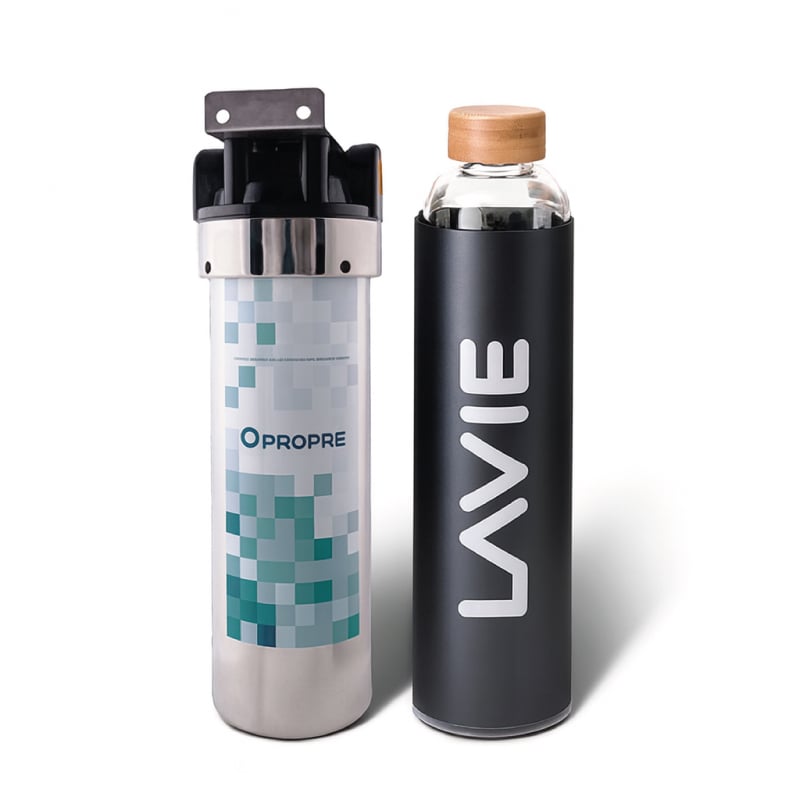
The Opropre under-sink filter range pushes the limits of domestic filtration. Their system relies on high-quality coconut activated carbon, capable of effectively eliminating chlorine, heavy metals, pesticides, microplastics, and other contaminants while preserving essential minerals for the body.
The Turquoise model integrates a specific ion exchange resin that targets the most stubborn pollutants, particularly PFAS, which are responsible for many health concerns.
Their strength also lies in their design: a cartridge and a resin that are deposit-based, rechargeable, and recyclable, to be returned to LAVIE every 6 months. The result: less waste.
Easy to install, durable, and without water rejection, these filters provide an ecological and effective response for quality and healthy water, directly from the tap.
To learn more, check out our comparative article on the best under-sink filter.

UV-A Filter Pitcher: Effective and Healthy Purification Technology
While reverse osmosis seems to filter everything through high pressure on the membrane, it does so at the cost of many compromises. In contrast, LAVIE purifiers rely on gentler, healthier, and far more sustainable systems.
Designed for daily use, the UV-A filter jug is based on a patented technology that uses light to purify water from impurities. Its operation is simple. It effectively eliminates pesticides, chlorine, pharmaceutical residues, and bacteria and viruses, while preserving the essential minerals needed for the body’s balance. Without filters, without disposable plastic, and without water waste.
And to go even further, the Opropre under-sink filters act upstream on the water, as a complement. Thanks to a targeted cartridge and resin, which are collected, rechargeable, and recyclable, they capture the most persistent pollutants, including PFAS that the LAVIE jug alone does not address.
Finally, for large families or workspaces, LaFontaine offers a suitable solution: up to 5 liters of purified water at once, without chemicals, cartridges, or waste.
An effective, quality, healthy, and sustainable purification, without the constraints of reverse osmosis.

Reverse osmosis: a radical method, but largely unnecessary
In the face of promises of absolute purity of water, reverse osmosis treatment may be appealing, but at what cost? Expensive, burdensome, waste-generating, and sometimes a danger to health, this technology goes too far for a need that, in reality, does not necessarily require it.
Alternatives such as UV-A filter jugs and Opropre filters offer a healthier, more balanced, and far more responsible solution, without compromising your health, the environment, or your budget.
With LAVIE products, you choose quality hydration, simple and sustainable, for the whole family.