





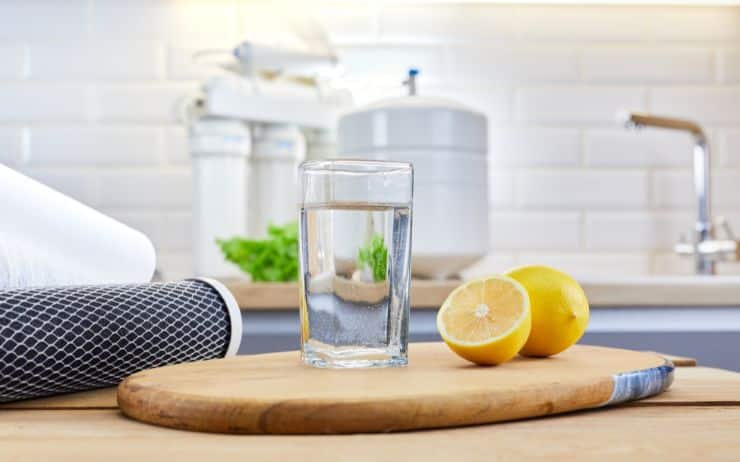
The tap water purifier has become a very common product in French kitchens over the years.
While the quality of tap water is closely monitored by public authorities in France and is subject to serious control, there are still notable differences depending on the regions.
These differences concern the presence of traces and residues of pesticides, bacteria, limestone, or chlorine at varying levels. All these elements impact the taste and smell of tap water.
Despite this, not all tap water filtration solutions on the market are equal.
To help you choose a filter suitable for your needs, we compare in this article 5 types of water purifiers: the filter jug, the under-sink filter, the tap filter, the osmosis system, and the UV-A purifier.
Comparison of different tap water filtration solutions
To begin with, here is a comparison table of the different water filtration or purification systems, based on several criteria such as water quality, price, and the environmental impact of the solutions.
In this buying guide, we will later go into detail about the characteristics of the products to help you choose the option that best suits your needs.

Classic filter jug |
Tap filter |

Reverse osmosis system |

Under-sink Opropre filter |

LAVIE UV-A Jug |
|
| Purification Method | Activated carbon filter | Activated carbon filter | Semi-permeable membrane | Activated carbon filter and targeted anti-PFAS resin | Ultraviolet rays (photolysis of chlorine) |
| Water quality | 💧 | 💧 | 💧 | 💧💧💧 | 💧💧💧 |
| Filtered / Treated Elements | Chlorine Sediments |
Chlorine Sediments |
Chlorine Sediments Bacteria and viruses Heavy metals Pesticides Trace elements |
Chlorine Sediments Heavy metals Pesticides PFAS |
Chlorine Bacteria Viruses Traces of medications Pesticides |
| Installation Difficulty | ✅ Easy |
✅ Easy |
❌ Complex (Professional recommended) |
🟠 Medium (To be installed under the sink) |
✅ Easy (to plug into a power outlet) |
| Environmental impact | ⚠️ High: frequent waste (filters), non-recyclable |
⚠️ High: frequent waste (filters), non-recyclable |
❌ Very high: discharge of polluted water (3–4 L per liter purified) + disposable filters + disposable membrane |
✅ Low: LAVIE cartridges are deposited and refilled. Recycled activated carbon. |
✅ Low: no filter, no consumables, low power consumption. |
| Initial cost | € | € | €€€ | €€ | €€ |
| Maintenance / Consumable Costs | €€ | €€ | €€ | € | None |
| Discover | Discover |
It should be noted that there are many models of water filters. This proliferation of filtration or drinking water treatment systems on the market sometimes tends to raise questions, even confuse the consumer.
Let us discover together the questions to ask to guide you in your purchase.
Not all filters are equal! The experiment conducted by M6 on microplastics
In the report Zone Interdite (“Our health in danger: revelations about this plastic that poisons us,” aired on March 8, 2026), independent researcher Jean-Baptiste Fini, a microplastics specialist, compared three filtration systems using deliberately contaminated water.
The results, analyzed by an independent laboratory, show significant differences in effectiveness:
- The gravity filters are the least effective: they filter only 30% of microplastics, allowing the majority of particles to pass through.
- The reverse osmosis systems retain about 60% of microplastics.
- While the Opropre activated carbon filter proved to be the most effective, eliminating 75% of the microplastics present in the contaminated water!
Conclusion: while filtration generally reduces the presence of microplastics, the choice of system makes a major difference in your actual daily exposure.
Tap water purifier: the 5 questions to ask before purchasing
1. What is the quality of my tap water?
Our first advice for choosing the right water purifier is to know the quality of your tap water.
You can check the quality of the drinking water in your municipality by consulting the Ministry of Health’s website. A water quality test can also help you determine the level of contamination in your water, the pollutants it contains, as well as its hardness level or pH.
2. What is my budget for a tap water purifier?
The different water filtration solutions vary significantly in price.
Filter jug and tap filter
The filter jug and tap filters are generally the cheapest options to purchase, with models ranging from 20 to 120 euros. However, be aware that you will need to add the regular cost of changing the water filter cartridges, which varies depending on the brand, manufacturer, and model.
A device that, in the long run, is not necessarily the most economical, nor the most ecological!
Another drawback: the size of the jug’s container may be too small if you have a large family, and the filling time can take up to 15 minutes! Plastic models quickly become discolored because the filtered water is acidic, and this becomes a true breeding ground for bacteria (Que Choisir study 2016).
To go further and make an informed choice, we invite you to consult our guide dedicated to the best filter jug 2026. You will find a detailed comparison of the models, their advantages, their limitations, and tips for choosing a solution that is truly suited to your daily use.
Under-sink filter
The under-sink filters like those in our Opropre range require a more complex installation and have a higher initial cost (between 100 and 300€), but their filtration method is more effective.
The lifespan of the filters is also longer (to be changed every 6 months compared to every month for a jug!).
To minimize the environmental impact of our Opropre filters, we have chosen to deposit the filtration cartridges to refill them with activated carbon, while the used carbon is recycled in specialized industrial circuits. The PFAS resin from the Turquoise product follows the same circuit to eliminate concentrated pollutants.
You cannot do this in your oven, as these materials need to reach 900 to 1200°C to destroy pollutant loads such as PFAS!

Water osmosis system
A water osmosis system eliminates up to 99% of contaminants present in the water, but its purchase, installation, and maintenance costs are high. You can expect to pay between several hundred and several thousand euros for these devices depending on the brand.
Osmosis systems filter so well… that they retain 95% of minerals through their membrane. It is therefore essential to add them back at the end of the process. But this function is only available on high-end machines, which use an additional consumable in the form of a mineral cartridge. Not to mention that they generate 70% of water concentrated with pollutants during the filtration process…
You also need to be careful of bacteria that may settle after the reverse osmosis membrane, for example in the remineralization filter, the tank, or the pipes leading to the tap. More chlorine means zero bacterial protection, which is somewhat the same problem as with filter jugs.
Filterless water purifier
Yes, it exists!
These innovative filterless water purifiers use UV-A technology to treat tap water and make it purer.
The purification system relies on the emission of ultraviolet light (UV-A) which neutralizes the contaminants present in the water, such as chlorine, bacteria, viruses, and pesticides, without the need for filters or consumables! Isn’t LAVIE beautiful?
In just 15 minutes, the water purifier transforms tap water into water free from its chlorinated taste and impurities. In short, thanks to their innovative and practical design, you use your LAVIE bottle like a filter jug… without needing a filter! Moreover, the one-liter bottle fills in 6 seconds, no more struggling to fill your jug multiple times…
In terms of budget, the price ranges from 100 to 500 euros depending on the size of the tank.

And what about the water softener?
A water softener is a distinct system, as it is designed to reduce water hardness by eliminating limescale and other minerals.
In other words, it is not capable of filtering chlorine, bacteria, heavy metals, and other contaminants from tap water for consumption. It must be specialized for hot water at the risk of completely destroying the quality of your tap water, or use our Odouce salt-free softener, compatible with both hot and cold water.
3. What type and capacity of filtration do I need?
This question relates somewhat to the first, regarding the quality of tap water in your municipality.
For example, if the levels of chlorine are high (thus producing water with odors and a bad taste), a purification method acting directly on chlorine should be favored!
Indeed, there are several methods for purifying tap water, including distillation, reverse osmosis or gravity filtration, activated carbon filtration, and UV-A purification.
Tap-mounted purifiers, under-sink units, and filter jugs primarily use filters that contain activated carbon. The osmosis system uses a semi-permeable membrane to eliminate contaminants, while the UV-A purifier uses ultraviolet rays that transform chlorine into powerful oxidants.
Here is a summary table of the different elements filtered or eliminated according to the solutions:
|
Filtered, reduced, or eliminated element |
Classic filter jug |
Tap filter |
Reverse osmosis system |
Under-sink Opropre filter |
LAVIE Purifier |
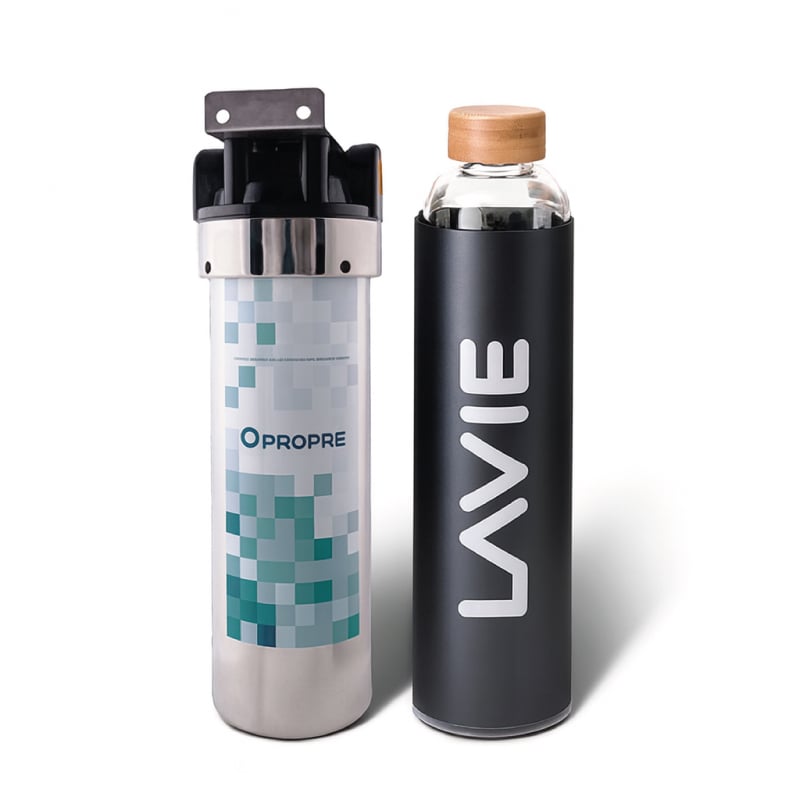
Serenity pack (Opropre + LAVIE PURE) |
| Chlorine | ✅ | ✅ | ✅ | ✅ | ✅ | ✅ |
| Sediments | ✅ | 🟠 | ✅ | ✅ | ❌ | ✅ |
| Bacteria | ❌ | ❌ | ❌ | ❌ | ✅ | ✅ |
| Viruses | ❌ | ❌ | ❌ | ❌ | ✅ | ✅ |
| Medicines | ❌ | ❌ | ✅ | ✅ | ✅ | ✅ |
| Pesticides | ❌ | ❌ | ✅ | ✅ | ✅ | ✅ |
| Heavy metals | 🟠 | 🟠 | ✅ | ✅ | ❌ | ✅ |
| PFAS | ❌ | ❌ | ✅ | ✅ | ❌ | ✅ |
| Microplastics | ❌ | ❌ | ✅ | ✅ | ❌ | ✅ |
| Preservation of beneficial minerals | ❌ | 🟠 | ❌ | ✅ | ✅ | ✅ |
| Discover | Discover | Discover |
Our recommendations for purer tap water on a daily basis?
Combine an Opropre under-sink filter with a LAVIE water purifier to enjoy their respective benefits. Namely, water free from heavy metals, pesticides, and microplastics, as well as bacteria, protozoa, viruses, traces of medications, and other contaminants! All while preserving all the beneficial minerals naturally present in the water.

💧 Are you still hesitating? Discover here the benefits of filtered water with LAVIE products.
4. Is the water purifier easy to install and use?
The installation of your water filter should be quick and its use simple and hassle-free.
The filtering pitcher and the faucet purifier are inherently easy to install and use.
Similarly, the LAVIE water purifier does not require special knowledge for installation as it simply needs to be plugged into a power outlet!
The Opropre filter requires a specific under-sink installation, which can, however, be done easily without the help of a professional.
On the other hand, the installation of an osmosis system requires the intervention of a professional and will require occasional maintenance.
5. Is the water filter eco-friendly?
Depending on their characteristics, some water purifiers consume more energy than others. If you are concerned about the environment of our planet and/or if you want to reduce your electricity bills, choose an energy-efficient model. The LAVIE purifier, for example, uses a low amount of energy, while a water distiller consumes about 40 times more.
Filtering pitchers and faucet and under-sink filters do not consume energy, but produce waste through the filters.
However, keep in mind that the energy expenditures incurred by some purifiers are sometimes largely offset by the abandonment of plastic water bottles. The production of these bottles is not only energy-intensive but also an environmental disaster. And let’s not talk about the waste dumped into the ocean…

The disadvantages of conventional solutions
The relative effectiveness of water filters
Not to mention the environmental impact related to the plastic waste they generate, conventional faucet water filters have other disadvantages that should not be overlooked.
The ANSES has notably issued mixed opinions on conventional filtering pitchers, questioning their effectiveness after finding, following a study, compounds in the filtration output (carbon, silver salts, bacteria in quantities deemed “non-potable water,” etc.) that were absent in the input water (more info here).
In other words, if the cartridge is not replaced regularly and the pitcher is not used under the right conditions, the filters can become real “breeding grounds for bacteria” that degrade the quality of the water instead of improving it and may pose health risks.
Furthermore, any home filtration system for your drinking water requires regular maintenance.
Over time, particles and impurities clog the filters, reducing their effectiveness and leading to poor water quality. The flow rate and pressure of your faucet may also be impacted.
Finally, some filter purifiers such as osmosis systems can be bulky (and not very aesthetically pleasing!) and require space for installation. Prefer a filter with a compact design like our Opropre range.
Thus, it is important to consider all these disadvantages during your analysis, to choose a water filter that suits your needs and lifestyle.
Bottled water, the solution for purer water?
A cause of alarming pollution, bottled plastic water is a solution to be avoided.
Plastic water bottles are among the categories of most polluting products. Their production has a significant impact on the environment, and their daily use contributes to the pollution of oceans and natural spaces. As the site Save4Planet reminds us, plastic waste that pollutes our oceans largely comes from plastic water bottles.
One of the other main disadvantages of plastic bottles is their high purchase cost. Indeed, bottled water is, as Que Choisir reminds us, 65 times more expensive on average than tap water!
An article from Dauphiné also analyzes that a French household can spend between 200 and 800 euros on bottled water purchases per year, depending on its water consumption. Not to mention the unpleasant experience for the back and the impracticality of having to carry hundreds of liters of water and the space taken up for storage… Not sorting bottles in the yellow bin is a luxury you will quickly get used to as well!
Water purifier: a higher level of protection, without a filter
Now, you know most of the disadvantages of the domestic water filter or the purchase of bottled plastic water.
Should we then abandon the idea of obtaining better quality for your domestic water?
It is evident that we should not! Alternative and innovative solutions, without the use of water filtration systems and which provide better results, exist.
The LAVIE water purifiers, which use a filterless purification system, meet this requirement. Instead of using filtration to purify tap water, they use UV-A radiation that will destroy the chlorine present in tap water, thus creating a chain reaction that will purify the water of its other contaminants.
In 15 minutes, your tap water is rid of its chlorine and the undesirable odors and tastes that accompany it. Moreover, the chemical reaction that breaks down chlorine is accompanied by the destruction of other impurities, such as pesticides and pharmaceutical residues.
💧 To learn more, discover our water purifier store or consult the reports of our scientific tests conducted in France.
What is the best tap water filter? Summary
The different filtration systems available on the market allow for improving the taste and quality of tap water.
In terms of filtration finesse, osmosis systems are the best filters as they retain almost all substances present in the water (even the good ones!). However, this high efficiency comes with numerous constraints. Their price is higher than other filtration solutions, and their installation and maintenance are more complex. More importantly, the reverse osmosis process rejects 2 to 4 liters of contaminated water for every liter of filtered water (yes, you read that right!), making its use neither sustainable nor ecological. The output water is acidic as it lacks minerals, and its calcium/magnesium levels are below the minimum set by the WHO. Therefore, it can be said that it is non-potable water, more suited for lead batteries than for humans.
Among the most affordable options on the market, the filtering pitcher is often favored, but its reservoir capacity and filtration efficiency are limited. Its positive effects on water quality can also be “nullified” or even “reversed” if the filters are not changed regularly (every month) and if the pitcher is not used under the recommended conditions.
A practical, economical, and ecological solution, LAVIE water purifiers use a scientifically tested UV-A purification process that makes tap water healthier and purer in just a few minutes (destruction of chlorine, bacteria, reduction of pesticide levels, pharmaceutical residues…), without requiring a filter!
Combined with our under-sink Opropre filter, the LAVIE system is ideal for regular consumption of quality water, without maintenance issues and with the best respect for the environment.
