 French
 Spanish
 German
 Italian
 English
Buying a classic water softener is simple. Maintaining it is much less so.
Checking the salt level, replacing the pre-filter, disinfecting, checking the water hardness… Without this maintenance, bacteria can develop, the risk of breakdown increases, and the water may even become undrinkable.
The good news? These constraints do not apply to all models. Next-generation technologies, as we explain in our review of the salt-free water softener, are completely free from them.
So what maintenance should you actually plan for? How often should you intervene? And what budget should you anticipate?
Why is the maintenance of a water softener essential?
Salt water softeners replace calcium and magnesium, which are precursors to limescale, with sodium. And to continue softening the water effectively, this system must be maintained.
Without it, damage does not take long to occur:
- The treatment loses effectiveness and limescale reappears in the pipes and appliances.
- Salt consumption increases, leading to additional expenses.
- A poor adjustment of the water hardness makes the water more aggressive and corrosive. It can therefore damage pipes and equipment, and may even become undrinkable.
- Bacteria proliferate inside the softener, degrading water quality and potentially impacting your health.
- The risk of breakdown increases, leading to expenses.
Maintaining your softener is therefore essential to protect your home and drink healthy water.
The 4 checks to perform on your water softener
To protect your softener, several checks should be performed throughout the year. Here are the main ones.
Monitor the salt level
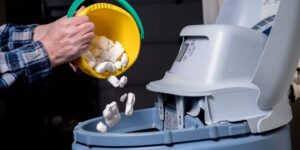
Salt is essential for the proper functioning of a classic water softener. It allows the resin to continue eliminating limescale over time.
But if its level becomes too low (less than one-third of the salt tank), softening loses effectiveness and limescale reappears.
So check the quantity in the tank every month and fill it as needed. Also take the opportunity to check that no crust has formed. Known as “salt bridge,” this compact block disrupts the activity of the tank.
Check the condition of the pre-filter
Not all models are equipped with a pre-filter, but when it is part of the system, it needs to be replaced. Why? It is the one that retains impurities present in the water.
However, over time, it becomes clogged, loses effectiveness, and promotes the growth of bacteria.
It is generally recommended to replace it every six months, or more often if your water is particularly loaded with impurities.
The result: a clean filter protects your softener, preserves its performance, and limits the risk of breakdown.
Disinfect the softener and its resin
Water flows daily through your softener. However, over time, bacteria can settle in the resin and the brine tank.
If nothing is done, they can degrade the quality of the water and pose a risk to your health.
That is why it is recommended to clean the tank and disinfect the resin at least once a year, or after a long period of inactivity.
This necessary maintenance helps to maintain a high-performing system and healthy water.
Check the water hardness
It is recommended to check the water hardness once or twice a year using a TH test. This monitoring ensures that your softener is properly adjusted.
Indeed, its role is not to completely eliminate calcium and magnesium, but to reduce their quantity to limit limescale while maintaining balanced water.
However, a poor adjustment can have significant consequences. A decrease of only 5% in their content can be enough to destabilize the water.
It then becomes more acidic and corrosive, to the point of becoming undrinkable.
How often should a water softener be maintained?
The maintenance frequency of a water softener depends on several factors: the chosen model, the water balance, the number of people in your household, as well as your daily consumption.
In other words, the more the installation is used, the more it requires regular monitoring.
To ensure nothing is forgotten, keep these few guidelines in mind:
- Every 1 to 2 months: check the brine tank.
- Every 6 months: replace the filter, if your device has one.
- 1 to 2 times a year: check the water balance using a TH test.
- Once a year: have a complete maintenance performed by a specialist (adjustment checks, cleaning of the resin and various components…).
A few regular checks are enough to avoid unpleasant surprises.
How much does it cost to maintain a water softener?
| Expense | Salt water softener | Salt-free Odouce softener |
| Salt | Approximately €200/year | None |
| Maintenance contract or labor costs |
€200 – €300 / year | None |
| Average annual cost | €400 | €0 |
| Cost over 10 years | €4000 | €0 |
| Discover |
The cost of a classic softener does not stop on the day of purchase. Each year, you need to budget for salt, consumables, and often maintenance performed by a professional. In total, the budget generally ranges between €300 and €500 per year.
Over the lifespan of the device, this can represent up to €5,000 over ten years.
To go further, discover our guide dedicated to the price of a water softener, which compares classic models and those of the new generation.
Maintenance contract: good or bad idea?
When you discover everything that needs to be checked on a water softener, a maintenance contract may seem like the ideal solution. No need to think about the checks: a professional takes care of it.
Generally, these contracts include an annual (or semi-annual) visit, disinfection of the device, analysis of the settings, resin, valve, as well as monitoring the optimal functioning of the system. Some also include the replacement of consumables and intervention in case of breakdown.
But beware!
Before signing, take the time to read the terms (and the fine print at the bottom of the page, of course). Some contracts impose several years of commitment, while repairs, spare parts, and certain products may remain your responsibility.
Ultimately, the bill can quickly add up, without necessarily covering all the costs.
Odouce: the salt-free softener that requires no maintenance
There is a softener that requires no maintenance. It is called Odouce.
Specifically, when water passes through Odouce, a reaction releases a tiny amount of zinc ions. These transform limescale into aragonite, a fine white powder that does not settle in pipes or appliances.
The result: up to 76% less limescale, without consumables, without electricity, and without salt.
Its installation is much simpler. Odouce attaches directly to the main pipeline, without electrical supply, without drainage, and without calling a plumber. Once activated, you have nothing more to do.
With a price of €499, you invest once and save several thousand euros in the long term.
If you are still hesitant, our comparison of salt-free softeners will allow you to discover the available technologies and choose the one that best suits your needs.