Four million bottles blocked. Drilling suspended. Repeated contamination. Over the last few months, the water situation in France has given cause for concern. Today's news, the Perrier brand is concerned. At its historic site in Vergèze, health alerts have multiplied, with 27 episodes of non-compliance reported and detection of bacteria potentially harmful to humans.
Long perceived as safer than tap water, plastic bottles are now seeing their reputation seriously called into question. Despite being sold with the label «natural mineral», they have found themselves at the heart of scandals involving a number of brands: banned treatments, inadequate controls, the presence of microplastics from polyethylene and polypropylene, the discovery of PFAS or even drug residues...
The question then becomes: which health hazards hidden in these bottles?
Plastic water bottles: should we be worried about their quality?
For a long time, the bottle provided reassurance, but this is no longer the case in France.
First of all, contrary to popular belief, mineral and spring waters are not not protected from environmental pollution. Intensive agriculture, industrial waste, soil contamination... Groundwater is exposed to chemical substances, increasing the likelihood that toxic elements will be found in our everyday food.
Next, the recent scandals have highlighted the worrying practices of several brands. In particular, investigations have revealed the use of treatments banned in Nestlé Waters factories, In addition, there are inadequate controls, largely based on self-monitoring by manufacturers. On top of this, there are inadequate controls, relying to a very large extent on self-monitoring by manufacturers.
The result: pesticides, nitrates, as well as drug residues and other toxic substances. PFAS contaminate the water and accumulate in the body, with very real health risks.
Containers are also a problem. Made of polyethylene, polypropylene or polystyrene, packaging breaks up and releases microplastics and nanoplastics, capable of settling in the body. In particular, these bottles can release bisphenols (BPA), endocrine disruptors whose effects are now well known.
Of course, let's not forget the catastrophic environmental impact! Plastic waste takes up to 450 years to degrade. And every year, more than 10 million tonnes of plastic find their way into the oceans and into the environment, then into our air and our food. Pollution that could easily be avoided.
The dangers of mineral water are therefore to be taken very seriously.
What are the dangers of the plastic in these bottles?
Drinking bottled water every day exposes us to harmful products. Why should this be? Over time, the packaging degrades and releases plastic and chemical particles in our glass of water. Which ones?
Polyethylene, used in the majority of bottles, and polypropylene, often found in corks, are the cause. Over time, these materials break up and release microplastics and especially nanoplastics, which are able to cross the digestive barrier, enter the bloodstream and reach certain organs.
Several studies even suggest that they provoke inflammatory reactions, impact certain cellular functions and contribute to oxidative stress.
These bottles also contain chemicals such as bisphenols (BPS). These compounds are endocrine disruptors. They can disrupt hormonal function and are associated with complications for fertility, development and long-term metabolism.
And without our being aware of it, our habits accentuate these risks In these conditions, the release of particles intensifies, and so do the problems for our health.
Bottles therefore represent a real risk, one that is still underplayed.
What contaminants can be found in plastic packaging?
In addition to the danger posed by polyethylene and polypropylene containers, spring and mineral waters contain contaminants that have a direct impact on health. Even when taken from deep underground, it is not totally protected from pollution.
Originating mainly from intensive farming, these substances contaminate groundwater, and hence our food and water. The result: repeated exposure is linked to hormonal imbalances, overload of the liver and kidneys, an increased risk of metabolic disorders, and can even encourage the formation of nitrosamines, molecules suspected of being carcinogenic. In infants and young children, nitrates are also suspected of affecting the blood system.
- PFAS, the “eternal pollutants”
Very persistent, PFAS accumulate in our organs and can remain there for several years. They are associated with lowered immune defences, hormonal imbalances and increased cholesterol levels, as well as possible effects on fertility and foetal development. This is very worrying information.
Antibiotics, anti-inflammatories... These molecules can be found in trace amounts in these waters, increasing pollution. And even at low doses, chronic exposure can disrupt hormonal balance and interfere with certain biological functions, particularly in children and the most vulnerable people. Not to mention the “cocktail” effect, the danger of which is almost impossible to anticipate.
The accumulation of this toxicity in our food and water is a serious health hazard.
Is bottled water healthier than tap water?
Tap water or bottled water? These containers made of several plastics seemed purer, safer and healthier. Today, this image is being challenged, even by the major brands.
Before talking about quality, we need to look at the ecological reality. The manufacture of this packaging is based on an extremely polluting model. Every year, billions of single-use bottles are produced, transported and then thrown away (around 15 billion bottles a year in France). And despite efforts to sort bottles, barely one bottle in two is actually recycled.
The rest ends up in the environment, particularly in the oceans. These fragments of plastic are now everywhere, even on our plates.
In terms of health, the advantage is clearly in favour of tap water. In France, tap water is the most closely monitored foodstuff. It is subject to a system involving hundreds of analyses every year. This constant monitoring means that even the slightest anomaly can be detected quickly. Bottled water, on the other hand, is not checked with the same regularity.
On a day-to-day basis, the choice is also financial and practical. Water from your pipes is up to 300 times cheaper than bottled water. It avoids the need to transport heavy packs, and the storage and accumulation of plastic waste.
So tap water is still the most reliable, economical and environmentally-friendly way to stay hydrated.
Does that mean it's perfect? Well, not always. It too is a victim of pollution. Depending on the region, it may contain traces of contaminants or have a pronounced chlorine taste. But unlike bottled water, it can be easily purified, directly at home.
That's where LAVIE solutions come in. Thanks to their filtration technology, they improve the quality of your water by removing pollutants, while preserving essential minerals, without generating waste.
A simple and responsible way to achieve safe, long-lasting and economical hydration.
👉 See also: Tap water or bottled water: which is better?
How can you replace plastic bottles in your everyday life?
Replacing the bottle is an excellent decision. But beware: not all alternatives are created equal.
Some solutions that are presented as being more environmentally friendly, such as conventional filter carafes, are dubious and increase the pollution of contaminants. Plastic packaging, disposable filters that have to be changed every 3 to 4 weeks, waste that is difficult to recycle, risk of bacterial proliferation... Their impact on health and the planet is very serious. far from neutral.
So which carafe filter to choose ? Fortunately, there are healthier and more sustainable technologies that are suitable for the whole family to replace these plastic packaging materials.
Stop persistent pollutants and microplastics
When it comes to the most difficult pollutants to eliminate, such as micro and nanoplastics from polyethylene and polypropylene containers, as well as PFAS and heavy metals, not all solutions are effective. Many conventional systems only act partially, if at all, on these invisible contaminants.
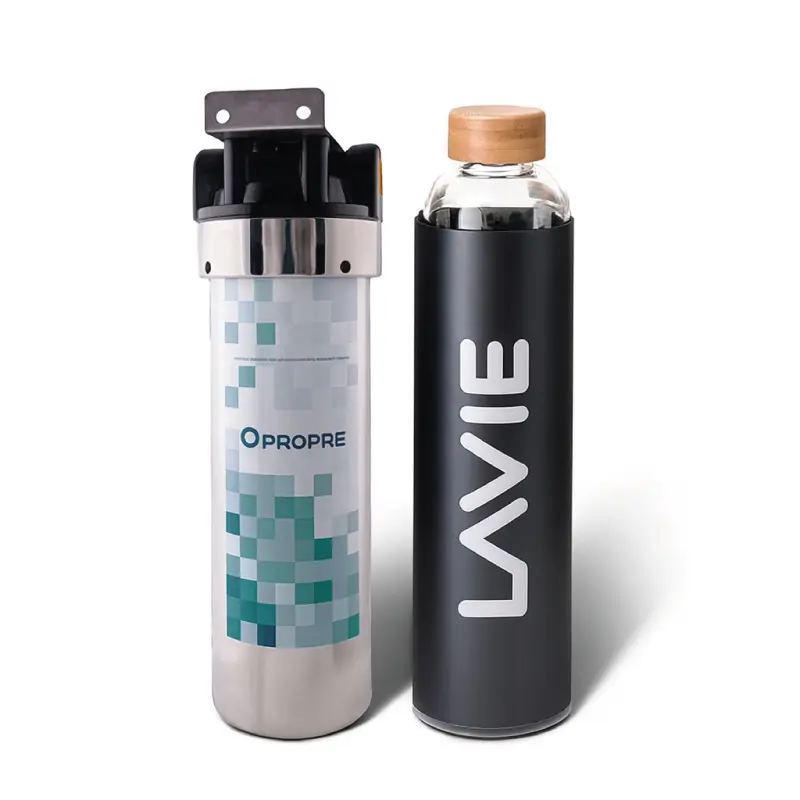
This is precisely where Opropre Turquoise comes in. Installed directly under the sink, this purification system combines activated coconut carbon and a specific resin, capable of capture the most stubborn particles while allowing essential minerals to pass through.
Opropre Turquoise domestic filtration reduces your daily exposure to fragments and products that are hazardous to your health.
Its other major advantage lies in the way it works. Opropre Turquoise uses a returnable, refillable and recyclable cartridge. Every six months, you send it back to LAVIE, it is refilled with new activated carbon, then put back into circulation, while the old materials are fully recycled. A solution designed for reduce waste, without compromising efficiency.
A real plus for the environment!
The result: healthier, safer water, without the need for bottles made from different plastics.
Yes to healthier, better quality water every day
Drinking healthier water every day should be simple, safe and sustainable. That's exactly what LAVIE UV-A carafes offer!
Their patented UV-A technology is based on a natural phenomenon called photolysis. When UV-A rays pass through the glass bottle, they transform the chlorine naturally present into reactive compounds. These are then able to neutralise pesticides, traces of medicines, bacteria and viruses.
In concrete terms, the LAVIE UV-A carafe destroys these pollutants in just 15 minutes, without chemicals or consumables. And the essential minerals are preserved.
No cartridges to throw away, no filters to change. Once treated, the water can be enjoyed calmly throughout the day.
On a day-to-day basis, the LAVIE UV-A decanter provides a sustainable replacement for plastic packaging, while maintaining a high level of health standards and premium taste pleasure.
Take back control of your water with LAVIE products.
Opropre filter + UV-A carafe LAVIE
Serenity pack