




PFAS, commonly known as “forever pollutants,” encompass thousands of chemical substances used for decades in our everyday products. Unfortunately, they circulate in the environment, in our plumbing, and find their way into our glasses.
Their extreme resistance raises concerns among health authorities, as these harmful compounds accumulate in the body and are suspected of promoting certain cancers, disrupting hormonal balance, or weakening the immune system. The problem is that very few devices can effectively eliminate them. So, how can we filter PFAS from tap water? In this article, we review market products and the most reliable PFAS water filter to protect your home.
Why are PFAS contaminating our drinking water?
PFAS, or per- and polyfluoroalkyl substances, are toxic compounds created by humans since the 1950s. Used for their non-stick, waterproof, and heat-resistant properties, they are found in many everyday products. However, these contaminants do not degrade and accumulate everywhere in the environment (in soil and groundwater), even in household drinking water.
In France, several investigations have revealed alarming levels in the waters. On July 30, 2025, the Ministry of Ecology published a map listing the presence of PFAS in water: 39 sampling points exceed regulatory thresholds.
Their significant impact on health is very concerning: hormonal disruptions, weakened immune system, increased cancer risks (PFOA and PFOS are now classified as “carcinogenic to humans”) and effects on child development. And unfortunately, eliminating PFAS is not easy: conventional wastewater treatment plants cannot achieve this, and most domestic technologies only partially retain them, if at all. So, which PFAS water filters can truly make a difference?
Domestic filtration solutions against PFAS
In light of the danger posed by PFAS, more and more households are wondering which treatment to choose to protect their health. But the question is: are they really effective against these chemical substances? To help clarify this, here is a comparative table that reviews the main filtration solutions and their actual results against PFAS and other contaminants.
|
Filtered, reduced, or eliminated element |

Classic filter jug |

Tap filter |

Reverse osmosis system |

Under-sink Opropre filter |
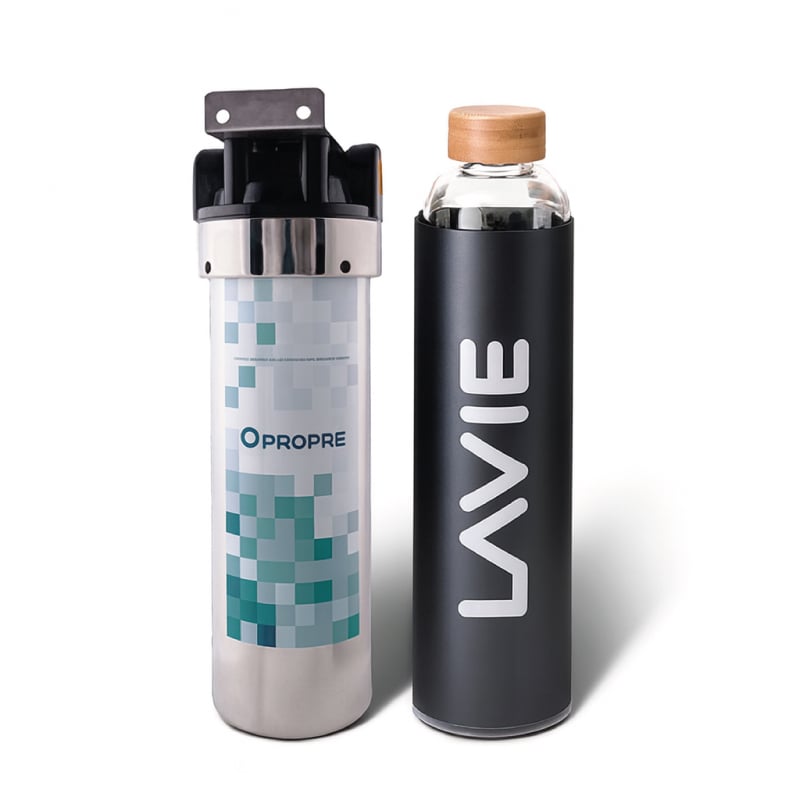
Serenity pack (Opropre + LAVIE PURE) |
| Chlorine | ✅ | ✅ | ✅ | ✅ | ✅ |
| Sediments | ✅ | 🟠 | ✅ | ✅ | ✅ |
| Bacteria | ❌ | ❌ | ❌ | ❌ | ✅ |
| Viruses | ❌ | ❌ | ❌ | ❌ | ✅ |
| Medicines | ❌ | ❌ | ✅ | ✅ | ✅ |
| Heavy metals | 🟠 | 🟠 | ✅ | ✅ | ✅ |
| Pesticides | ❌ | ❌ | ✅ | ✅ | ✅ |
| PFAS | ❌ | ❌ | ✅ | ✅ | ✅ |
| Microplastics | ❌ | ❌ | ✅ | ✅ | ✅ |
| Preservation of beneficial minerals | ❌ | 🟠 | ❌ | ✅ | ✅ |
| Discover | Discover |
Filtered carafes and PFAS: why doesn’t this filtration work?
Classic filtered carafes (Brita, Philips, Amazon…) are appealing due to their practicality: they reduce chlorine, correct taste, and retain certain impurities. But against PFAS, the answer is simple: they are not up to the task! Designed with activated carbon (sometimes combined with an ion-exchange resin), filtered carafes are not effective against PFAS. Additionally, there are other issues: filters need to be changed every 3 to 4 weeks, unrecycled plastic waste, frequent bacterial growth, and even leaching of microplastics and various toxic products.
In summary, using a filtered carafe does not protect your health against the presence of PFAS in tap water.
💧 Read also: Filtered carafe: Is it effective against PFAS?
Tap filters and PFAS: a very limited system
Tap filters are appealing due to their simplicity: easy to install, compact, and effective against chlorine, certain odors, heavy metals, and microplastics. But in the face of the persistence of PFAS in water, the verdict is clear: they are not designed to retain these forever pollutants. Their technology mainly relies on activated carbon, useful for improving taste, but insufficient against such resistant substances.
And other limitations arise: flow rate is often reduced, cartridges must be replaced every 30 days, and they are not recyclable. A supplementary solution, but far from being a sustainable and powerful treatment against PFAS.
Before choosing a model, it may be helpful to consult a tap water filter comparison to better understand the differences between available technologies. This helps identify systems that are truly effective based on targeted pollutants and avoid limiting oneself to a solution that only improves the taste of water without addressing the most persistent contaminants.
Under-sink filters and PFAS: which one really makes a difference?
Not all under-sink filters are created equal. Many rely solely on activated carbon: effective for removing certain impurities, but insufficient against compounds as stubborn as PFAS. However, one system stands out: Opropre Turquoise, developed by LAVIE in France!
Its secret? A dual performance, combining high-quality coconut activated carbon and an anti-PFAS ion-exchange resin, capable of permanently trapping these persistent substances. Independent tests conducted by the laboratory of Aix-Marseille University confirmed it: up to 27.4 mg of PFOA and 23.8 mg of PFBA retained per gram of resin, which are higher quantities than found in drinking water in France.
And the list of advantages continues: Opropre cartridges are returned and recharged to avoid unnecessary plastic waste. The used carbon and resin are recycled in specialized circuits. The result: quality water, balanced, and a sustainable solution, good for your health and that of the planet!

Water osmosis systems and PFAS: a system that conceals significant drawbacks
Reverse osmosis is one of the few solutions capable of eliminating up to 99% of PFAS. A formidable performance, used both in industry and by individuals. But this effectiveness comes at a price:
- High cost: purchase, installation, and regular maintenance (filters, membranes, remineralization cartridges), amounting to several hundred euros per year.
- Enormous water waste: up to 4 liters discarded to produce 1 liter filtered, resulting in hundreds of liters of drinking water lost each week.
- Heavy ecological impact: non-recyclable disposable filters, electricity consumption, and discharges of polluted water into the environment.
- Demineralized water: deprived of calcium, magnesium, and potassium, the water is acidic and unbalanced, which is detrimental to your health.
- Bacterial risk: without chlorine, osmosis water becomes a breeding ground for bacteria if the device is poorly maintained.
In summary, reverse osmosis treatment eliminates PFAS, but its various constraints make it not a recommended option for domestic use. A system to avoid.
💧 Read also: Osmosis system against PFAS: effective, but at what cost?
Which filtration systems really work against PFAS?
Reverse osmosis: why does this filtration work?
Reverse osmosis treatment relies on a very advanced process: water is forced at high pressure through an ultra-fine membrane composed of several layers. This barrier retains almost all substances, even those necessary: nitrates, pesticides, heavy metals, pharmaceutical residues, and of course, PFAS. An effectiveness close to 99%.
But this performance comes at a price: demineralized water, disastrous waste, and high usage costs. A radical method, but dangerous in the long term for your health and that of the environment.
To learn more, discover the advantages and disadvantages of reverse osmosis in this article.
Activated carbon: effective on some PFAS, but not all
Activated carbon works like a sponge. Its porous surface captures certain molecules present in drinking water, notably chlorine, organic residues, pesticides, and some PFAS.
But this effectiveness remains limited: this process mainly acts on long-chain PFAS, much less on short chains, which are more difficult to retain. The result: a useful technology, but insufficient alone against PFAS contamination.
Ion-exchange resin: the most reliable anti-PFAS filtration
Ion-exchange resin is a formidable technology against PFAS. Specifically, its microporous beads act by exchanging certain ions present in the water for ions of similar charge. This process allows for trapping PFAS, including the most stubborn ones. And unlike activated carbon, which mainly targets long chains, the resin also retains short-chain PFAS, which are more difficult to eliminate.
This is precisely the technology used by the Opropre Turquoise tap water filter: by combining it with high-quality coconut activated carbon, it removes both long and short-chain PFAS while preserving essential minerals. The result: healthy, balanced drinking water and a sustainable solution that protects both your health and the planet.
Bottled water: why it is not a solution against PFAS?
Bottled water often appears as a reassuring alternative to water contamination by PFAS. However, this option is far from ideal for your health, your budget, and the environment.
Indeed, studies have revealed the presence of microplastics in the majority of bottles, and some analyses have even detected traces of PFAS.
Practically speaking, drinking only bottled water is much more expensive than a home filtration system, not to mention the constraints of transportation and storage.
Finally, the ecological impact is immense: catastrophic pollution from billions of plastic bottles each year on our planet.
You will have understood: bottled water is not the solution. Far from it.
How to reduce exposure to PFAS (in addition to a water filter)?
Filtering drinking water is a first step to limit exposure to PFAS. But these pollutants are not only hidden in our pipes. Designed to resist water, grease, and heat, they can be found in many everyday products: non-stick pans, waterproof textiles, food packaging, fire-fighting foams, or even waterproof cosmetics.
To reduce your exposure, a few simple actions can make a difference:
- In the kitchen: prefer stainless steel, steel, or cast iron over Teflon.
- Regarding food: avoid food packaging that is resistant to grease and heat.
- For your clothing: limit “water-repellent” textiles in favor of durable materials.
- In the bathroom: choose cosmetics and products with a short ingredient list, without fluoropolymer.
Added to a PFAS water filter, these habits reduce your exposure and slow the spread of PFAS in the environment.
What is the best water filter against PFAS?
Not all filtration systems are equal when it comes to PFAS present in water. Carafes and faucet filters are insufficient, while reverse osmosis is effective but dangerous for health, not to mention its ecological impact.
But an innovative treatment stands out! The Opropre Turquoise under-sink filter is today the most reliable and healthiest solution. Thanks to its combination of coconut activated carbon and anti-PFAS ion exchange resin, it eliminates these eternal pollutants while preserving the essential minerals for your body. And no need for chemicals.
Result: for safe and sustainable hydration, Opropre Turquoise is the ideal choice.