What if the bottled water you drink to «look after your health» did the opposite? Scientific research into presence of microplastics in the water seem to be moving in this direction.
A microplastic is a tiny fragment of plastic, less than 5 millimetres in size. Resulting from the degradation of packaging, synthetic textiles and industrial processes, it is now contaminating our environment on a massive scale. Nanoplastics are the smallest compounds in this family, with a size of less than one micron, i.e. invisible to the human eye.
According to a study published in 2025, Each individual ingests between 39,000 and 52,000 per year. And this figure soars among people who drink bottled water. They absorb up to 90,000 more than those who prefer tap water.
This is all the more worrying given that these plastic particles accumulate in our organs over time, right to the brain!
So is it still possible to drink a microplastic-free water bottle?
In this guide, we'll help you to see things more clearly and identify solutions for avoiding this pollution on a daily basis.
What research into microplastics in water reveals
Scientists are sounding the alarm. Why are they sounding the alarm? Analyses show that spring and mineral water from a number of brands has become one of the world's most toxic substances. main causes of exposure to microplastics.
L'study by Columbia University and Rutgers University revealed a staggering figure: a single one-litre plastic bottle can contain almost 250,000 particles of microplastics and nanoplastics. These pollutants are so small that they pass through the body's natural barriers, circulate in the bloodstream and become lodged in various organs.
But they don't just come from PET plastic. Researchers have shown that they are also linked to the industrial use of water, i.e. the various stages of treatment, filtration and preparation.
The most worrying thing is that these fragments don't just pass through our bodies. They accumulate! In less than ten years, the quantity found in the brain has increased by around 50 %. Analyses carried out on human samples have even revealed that microplastics in the brain are now more abundant than in the liver and kidneys, which are specialised in eliminating toxic substances.
Although the exact mechanisms are still being studied, several works are already suggesting possible links with certain neurodegenerative diseases, such as Alzheimer's and Parkinson's.
This is a serious warning signal, and one that calls for a rethink of the way we hydrate on a daily basis, for the sake of the health of millions of consumers.
Is it possible to find a microplastic-free water bottle?
You're not going to like the answer... On paper, microplastics are being closely monitored in Europe, particularly in France via the European directive 2020/2184 on the quality of drinking water. But in reality, most of these harmful residues are still flying under the radar.
From work carried out by researchers from the CNRS and the University of Toulouse show that 98 % of microplastics detected in water measure less than 20 micrometres. A size not covered by the current thresholds in the European directive. So what about nanoplastics, which are even smaller? In other words, most of this pollution escapes control methods.
As a result, their presence and therefore their health risks are largely underestimated.
But the survey also points out that there are many sources of water contamination.
Water can be exposed to microplastics:
- by the gradual degradation of PET plastic bottles,
- by the cork, which is subjected to opening, closing and rubbing,
- throughout the industrial process, including the treatment and filtration stages, where certain materials, such as polyamide, fragment.
- but also upstream, via pollution of rivers, lakes and groundwater.
In addition conditions of use heat, exposure to sunlight, prolonged storage... All these factors accelerate the release of microplastics and nanoplastics from packaging, regardless of the brand.
The researchers also point out that mineral water contains more fragments than spring water, and that sparkling water is generally more contaminated than still water.
Clearly, even if concentrations can vary from one brand to another, it is now very difficult, if not impossible, to guarantee quality bottled water that is totally free of these particles.
A reality that highlights the dangers of plastic water bottles on health.
Are there microplastics in glass bottles?
You might think that the glass bottle would solve the problem. No plastic, so no degradation of the material. And yet the figures are staggering.
A study carried out by ANSES and relayed by Que Choisir revealed a situation that is surprising, to say the least: these fragments are more in glass bottles than those made of plastic.
The result: up to 5 to 50 times more microplastics per litre were detected in certain glass-packed drinks.
In the case of water, ANSES found that contamination averaged 4.5 particles per litre in glass bottles, compared with 1.6 particles in plastic bottles. This difference is far from insignificant when comparing packaging that is supposed to be safer.
So where do these microplastics come from?
Suspicion fell on the metal capsules, and more specifically on the paint that covered them. As a result of friction and storage, this painting fragments and releases pieces.
So the risk of pollutants is never totally absent.
What is the best water to avoid microplastics?
The studies are clear People who drink mainly bottled water (spring or mineral). ingest up to 90,000 microplastics a year, compared with around 4,000 for those who drink tap water.
The researcher Sarah Sajedi, doctoral student at Concordia University, sums it up very clearly: «Drinking bottled water is fine for emergencies, but not for everyday use. »
Tap water is more reliable for our health. It is strictly controlled, regularly analysed, and above all, it is not permanently stored in packaging likely to degrade and release chemicals.
But let's be honest: the water in your home isn't perfect either. So how can you enjoy its benefits with complete peace of mind?
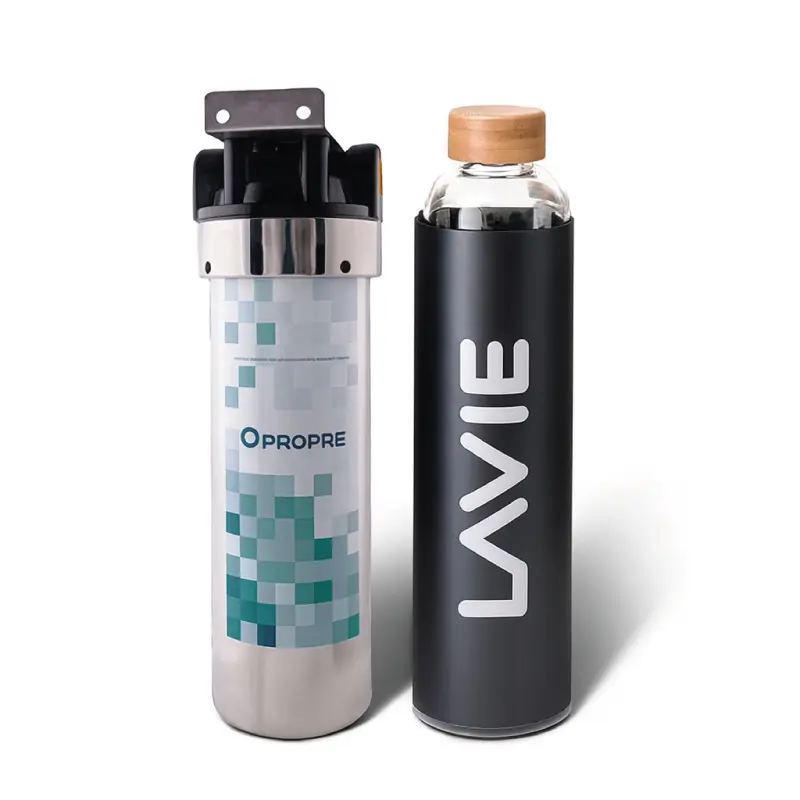
That's where LAVIE makes the difference! With the under-sink filter Clean, water is filtered directly at source, even before it reaches your glass. Microparticles, PFAS, heavy metals and other contaminants are removed, without disposable plastic and without altering the essential minerals.
Result: quality water and a sustainable, long-term solution.
The best microplastic-free water is the water you drink at home, efficiently filtered with Clean, then purified using LAVIE technology.
Opropre filter + UV-A carafe LAVIE
Serenity pack