

Our technology
Our water purification technology
LAVIE, how does it work?
We are the only ones in the world to go this far in the field of water filtration without any filter or consumable.


We use the power of light
Light possesses an extraordinary power that manifests in nature.
Did you know that it is capable of purifying our environment?
Its ability to interact with molecules allows it to break down harmful substances and eliminate impurities.
At LaVie, light is our ally in combating undesirable molecules 🤺
The different UV light rays: UV-A, UV-B, and UV-C
There are several types of UV rays emitted by the Sun: UV-A, UV-B, and UV-C, each possessing their own characteristics. UV-A rays are considered the most powerful in terms of purification as they can degrade undesirable substances, oxidize them, and break them down into simpler and less harmful compounds.
UV-B and UV-C rays are more energetic, but less purifying. That said, UV-C rays are very often used to disinfect polluted water loaded with bacteria and viruses.
The purification of water by UV-A
The tap water is potable, but its quality is not optimal everywhere.
To improve the quality of the water, we utilize the power of UV-A:

Destruction of chlorine

Destruction of chlorine derivatives
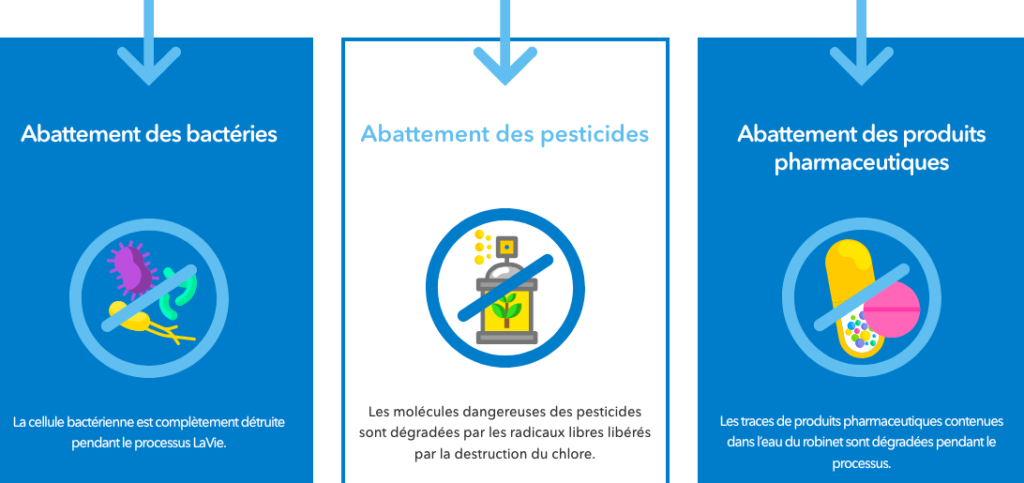
Significant reduction
of pesticide traces and
pharmaceutical
contaminants.

Destruction of
100% of bacteria
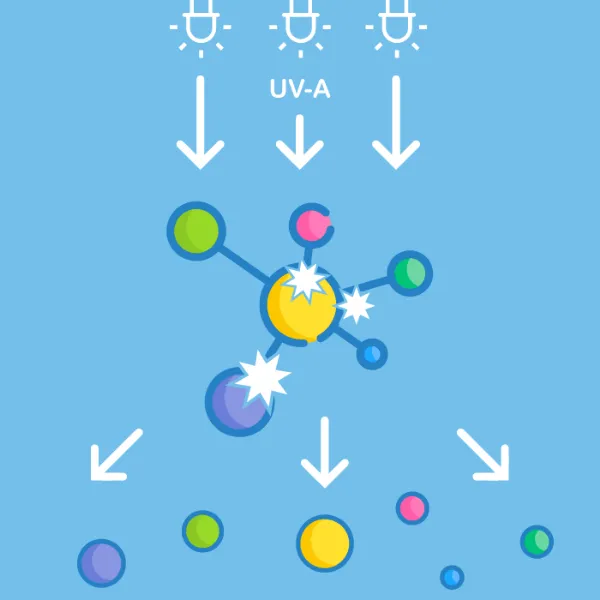
The UVA LEDs of our purifiers emit 6 times more photons than the Sun!
Our patented technology
A process used by mountain lakes
The photolysis of chlorine
The photolysis of chlorine is a chemical process that occurs when chlorine is exposed to sunlight, specifically UV-A rays. The chlorine molecule then decomposes into atoms (oxygen, hydrogen, and chlorides).
These atoms are highly reactive and can react with organic pollutants present in water. By reacting with these pollutants, the atoms decompose them, which helps to purify the water. In a way, our water purifiers transform chlorine into a kind of pollutant fighter before making it disappear 👋
The advanced oxidation
process
Advanced oxidation is a water purification process that uses oxidizing agents to accelerate the decomposition of pollutants present in the water. It is this chemical reaction that occurs during the photolysis of chlorine.
Bye bye harmful substances! ⚡️
Water purifiers LaVie in action
All you need to do is insert your bottle into our purifiers…
The light turns on and bam 👇
We answer the questions you may be asking
Does this technology pose health risks?
No!
Is this UV disinfection?
No!
UV disinfection uses UV-C rays and not the UV-A rays from our purifiers. These UV-C rays are unnecessary on drinking water, which by definition does not need to be disinfected. It already is! Its quality can be improved.
Where does the chlorine go?
Chlorine, whose molecule is written as HOCL or OCL, is transformed by UV-A photolysis. Once its molecule is broken, it remains:
– Chlorides (Cl from table salt and mineral water, which we drink in total immunity)
– Hydrogen (H) and oxygen (O), which will recombine into water, H2O
No gas or dichlorine (Cl2) is thus generated.
Where do the traces of harmful substances go?
When the bond between pesticide and medication molecules is broken, free radicals are released, with an average lifespan of about 10 nanoseconds, after which, having acted, they will recombine into chlorides or H2O.
It takes several seconds to remove the bottle and be able to consume the water.
Thus, no radical can reach the body.