On 24 November 2025, a national recall rocked the shelves of bottled water. Four popular brands, Rosaline, Munzur, Mevlana and Perlyne, A number of French retailers have withdrawn these products as a matter of urgency due to a “manufacturing defect”. We have no further details. Bottling error? Bacterial growth? Chemical residues? A mystery!
The authorities simply asked to no longer consume this water and return them to the shop.
This news comes at a time when the situation is already fragile. For several months now, one scandal has followed another: contamination at Perrier, banned treatments in factories, etc. Nestlé Waters, presence of microplastics, PFAS, drug residues, etc.
Mineral water, long considered “purer”, is no longer as reassuring. On the contrary, the public now perceives the risk.
Is natural mineral water safe and of good quality? This question is coming up more and more consumers question the composition of mineral waters after these successive reminders.
So the real question is: what should I drink to protect my health and that of my family?
The good news is that there are simple, ecological, economical and reliable solutions. Tap water, purified using efficient technology, remains the best choice.
Is the quality of mineral water as well controlled as people think?
People often think that natural mineral water is better controlled than tap water. In reality, there are rules in France, but they are not enough to guarantee water that is genuinely free from pollutants.
What the regulations say :
- The water must come from a protected groundwater source.
- Sources must be officially recognised before they can be used.
- The mineral composition of these waters must remain stable over time.
- Chemical treatments are prohibited (no chlorine, no disinfection).
- The producer must carry out analyses at the capture and packaging stages.
- The State and the Regional Health Agencies must carry out regular health checks.
However, these rules have not prevented several incidents in recent months. On 24 November 2025, four brands (Rosaline, Munzur, Mevlana and Perlyne) were recalled as a matter of urgency due to a «manufacturing defect», without the problem being known.
At the same time, the Perrier plant was facing repeated contamination, This was particularly the case after the removal of very fine filters, revealing bacteriological non-compliance in the water.
And practices at Nestlé Waters showed that some brands were using unauthorised treatments to continue selling water that was presented as “naturally pure”.
And that's not all! This study shows the presence of TFA (a PFAS), pesticides and pharmaceutical residues, substances that are not always included in regulatory controls.
Another important point concerns the bottles themselves. They release microplastics and nanoplastics in these waters. This is not without consequences! These particles are capable of crossing the digestive barrier, reaching the bloodstream and potentially certain organs.
In short: same compliance, these waters contain traces of pollutants. Current quality controls are not enough to guarantee hydration that is totally healthy for you.
What contaminants can be found in mineral water?
Mineral water has long been associated with purity. But it's not! Even when taken from deep underground, it is not immune to contamination that can have a harmful impact on health. Here's what we can find in our bottled water:
- Pesticides, derivatives and nitrates :
Some groundwater still contains traces of old pollution. Pesticides, their metabolites and nitrates are sometimes found there. Unfortunately, their repeated presence causes hormonal disruption, the potential formation of nitrosamines (molecules suspected of being carcinogenic) and an overload on the kidneys. These are effects that count over time.
- PFAS: pollutants that accumulate :
PFAS travel easily in the environment, reaching groundwater and springs. The risk is simple: they reduce immunity and are associated with various metabolic disorders. Even in trace amounts, these substances have no place in what we drink every day.
These active molecules can be found at very low levels in various brands of natural mineral water. But chronic exposure raises health issues. They can affect hormonal balance, fertility and certain bodily functions, particularly in young children and the most vulnerable.
- Microplastics, nanoplastics and bisphenols :
It's one of the quietest risks, but the most present: it's not just the source that pollutes, but also the packaging. It breaks down over time, releasing microplastics and nanoplastics that can accumulate in certain organs.
These waters may also contain residues of bisphenols, endocrine disruptors derived from plastics, whose potential effects on fertility, metabolism and development are being increasingly documented. Their presence in water that is supposed to be “pure” is nonsense.
As you can see, mineral water contains traces of invisible but persistent pollutants.
Is mineral water really healthier than tap water?
In the face of recent scandals over the quality and contamination of several brands, what should you drink for safe, balanced hydration?
In France, tap water remains the most strictly controlled foodstuff with strict regulations. It is regularly analysed, under the supervision of the health authorities, to ensure that the drinking water is compliant. And unlike mineral water, it can be adjusted and treated if any anomalies are detected. This is why drink tap water is the most logical option.
But the benefits don't stop there. Water at home is up to 250 times cheaper than bottled water. For a family, that's a huge difference. It's also much more practical: no packs to carry, no storage, no trips to the supermarket. It's simply available whenever you want it.
In ecological terms, the difference is even greater: no transport, no plastic pollution, no energy-consuming systems. In other words: an infinitely smaller carbon footprint than mineral water.
Does that mean it's perfect? Not completely. It may contain traces of chemicals and sometimes an unpleasant taste, depending on the region of France. But unlike bottled water, it can be upgraded easily, right in your own home.
That's where the LAVIE solution comes in. With the UV-A decanter, it takes just 15 minutes to neutralise pesticides, drug residues, viruses and bacteria, while preserving essential minerals.
Its patented technology is based on photolysis, a natural process: when UV-A rays pass through the glass bottle, they transform chlorine into reactive compounds capable of degrading and removing contaminants. For those looking for the best water purifier, This solution is a no-brainer.
By combining the safety of tap water with the efficiency of LAVIE treatment, you get water that's safer, longer-lasting and more economical.
What is the environmental impact of bottled water?
It only takes a few minutes to drink a bottle of water, but it will take centuries for the planet to recover.
Before it even reaches your hand, it has already travelled a long way: plastic manufacture, transport, storage... A heavy, energy-consuming and polluting cycle for all these natural mineral waters.
It takes an average of 2 to 3 litres of water to produce 1 litre of water. Then there are the resources needed to manufacture the container: a single plastic bottle uses around 100 ml of oil and 42 litres of gas. And the carbon footprint is no better: according to ADEME, drinking a litre of bottled water emits up to 400g of CO₂, compared with 0.1g for tap water.
The problem doesn't stop there. In France, almost 25 % of bottles are imported, adding to their carbon footprint. And although sorting is improving, only just over one in two bottles is actually recycled. The rest is incinerated, buried or dispersed into the environment in various parts of the world. What's more, every year more than 10 million tonnes of plastic reach the oceans, where they fragment into microplastics and nanoplastics, which are now found everywhere: in fish, in the air, in the soil and in the water we drink. These data show that this pollution always ends up back in our bodies.
All these treatments and practices when you can get instant water at home, without generating the slightest waste.
In contrast, a solution like LAVIE reduces this impact to almost zero. The UV-A carafe works without filters, cartridges or consumables. An eco-responsible use for the planet.
Drinking without polluting: it's possible!
How can I replace bottled water on a daily basis?
Replacing bottled water doesn't require a revolution: just go back to tap water and filter it properly. This is where LAVIE solutions really come into their own.
The UV-A carafe neutralises chlorine, pesticides, drug residues, viruses and bacteria in just 15 minutes, without filters or consumables.
For continuously purified water, the LAVIE fountain offers absolute comfort, designed for the whole family.
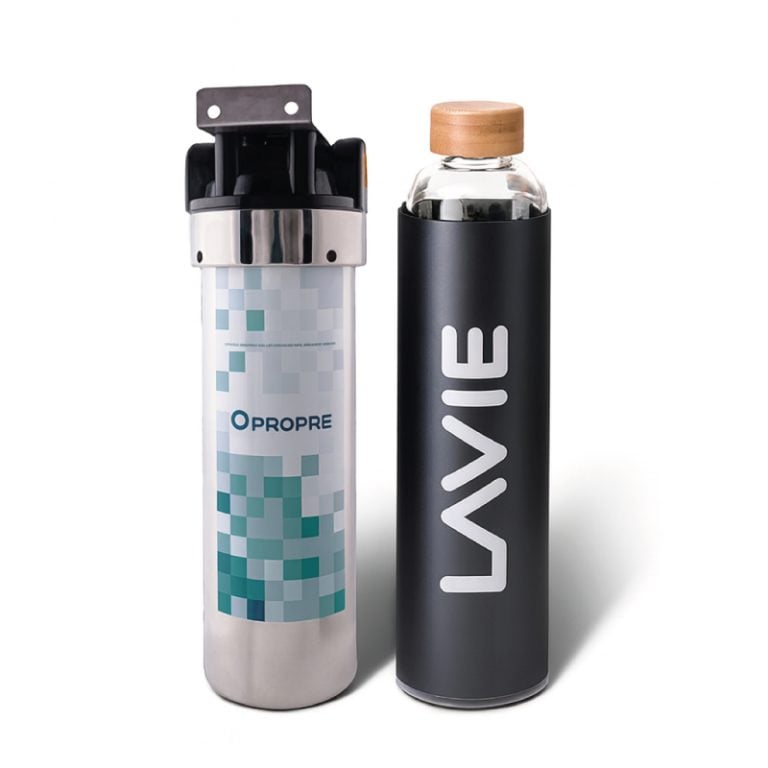
And to treat it directly at source, Opropre Turquoise eliminates PFAS, pesticides, heavy metals and microplastics while preserving essential minerals.
With LAVIE, you can enjoy water that's better for your health, more economical and more environmentally friendly than mineral water.
A modern, zero pollution, zero waste solution that transforms the way you hydrate every day.
Opropre filter + UV-A carafe LAVIE
Serenity pack