This pollutant attacks the kidneys, weakens the bones and increases the risk of cancer. Its name: cadmium.
A toxic heavy metal, It's invisible to the naked eye, but it's all around us: in the soil, in our food, and sometimes even in our tap water.
And that's the problem: even though water quality is rigorously controlled in France, the level of cadmium in drinking water is a growing cause for concern.
Why is this? Because this element accumulates in the body and becomes a real health hazard. According to Pierre Souvet, cardiologist and Chairman of the Association Santé Environnement France, le cadmium «worsens overall mortality ».
So how do you protect yourself?
Let's decipher this silent pollutant: its origins, its effects on the body, and the solutions for limiting its presence in your glass of water.
Cadmium: a ubiquitous contaminant in our daily lives
Cadmium is a naturally occurring element in the earth's crust. In minute quantities, it poses no problem for our bodies. But human activity has caused its levels in the environment to soar.
Today, cadmium is everywhere. It is mainly found in agricultural phosphate fertilisers. People living in rural areas are more likely to be affected by the disease. According to INRAE analyses, these fertilisers are responsible for 60 to 75 % of cadmium concentrations in soils. Added to this are discharges from industrial production, particularly from the metallurgy industry.
Unsurprisingly, as it is spread more and more, this pollutant infiltrates, accumulates and eventually finds its way up our drains.
Despite repeated warnings, cadmium is still used in France. Resistant to heat, it is used in particular to manufacture rechargeable batteries, pigments, metal coatings and alloys. But once it is released into the environment, it never really disappears: it circulates through plant roots, contaminating and settling in soils over the long term.
The main concern is its toxicity and its ability to accumulate in living organisms and then end up in our food. Classified as a «definite human carcinogen», cadmium finds its way into our food. Cadmium is found in cereal-based products (particularly those used by children for breakfast), but also in bread and potatoes (which account for 22 % and 12 % of the population's exposure respectively). But that's not all: chocolate, certain vegetables and seafood are also affected by cadmium. Almost everything is affected.
Faced with this list of everyday products, repeated consumption, even in very low doses, is a cause for concern for both human health and that of the planet.
Cadmium in water: where does this contamination come from?
If cadmium is particularly present in drinking water in France today, it's not by chance. This heavy metal infiltrates groundwater and water sources mainly as a result of human activity.
This contamination is a real « sanitary spray », according to the experts.
The main source of’exposure to cadmium from agricultural work. Phosphate fertilisers, widely used to fertilise soils, naturally contain cadmium. Over time, this toxic product accumulates and is diluted in rainwater before reaching groundwater.
And the figures are not good: the cadmium content of French fertilisers is significantly higher than the European average.
The second culprit is discharges into the environment from industrial plants, particularly from metallurgy and battery production. By dispersing into the air and waste water, this concentration contributes to the pollution of rivers and soil.
Even old galvanised steel pipes release cadmium into the water and end up in our glasses. A phenomenon similar to that observed for other heavy metals in tap water, such as lead, mercury, arsenic, chromium and zinc.
You'd think that treatment plants would be able to eliminate this pollutant, but in reality only part of the cadmium is filtered out. Why is this? Because it binds easily with different particles, making it difficult to remove completely.
Result: traces of this toxic contaminant persists in drinking water. And in the long term, repeated exposure is a health concern.
💧Read also: Heavy metals and tap water: the invisible danger
Why is cadmium dangerous to health?
Cadmium is a silent poison, recognised as a definite human carcinogen. Invisible, it settles slowly inside the body, causing no immediate symptoms until it's too late.
Once absorbed, cadmium circulates in the blood then settles in the kidneys, liver and bones, where it can remain for decades.
This progressive accumulation weakens our metabolism: kidney damage, brittle bones, osteoporosis... But it also increases the risk of cancer, particularly of the pancreas and lungs. In fact, pancreatic cancer is «particularly worryingThis is because of the levels of heavy metals in the body,» stresses cardiologist Pierre Souvet, Chairman of the Association Santé Environnement France.
The cardiovascular system and fertility are also affected. Cadmium acts as a hormone disrupter, altering the production of sex hormones and promoting hypertension. Women are all the more sensitive to this, especially in cases of iron deficiency, which increases its absorption.
The danger of cadmium should not be overlooked! It is vital to reduce exposure and ingestion.
Cadmium in water: strict but insufficient regulation?
In France, water is strictly controlled to guarantee its quality and potability. European Directive 2020/2184 sets a clear limit on cadmium No more than 5 µg/L in water. On paper, this standard is reassuring. But in reality, it's not so simple.
Because even though water is regularly tested by the Regional Health Agencies, these regulations are not enough to protect us completely. Why? Because cadmium doesn't just contaminate water. Because cadmium doesn't just contaminate water: it is spread by industrial activities and also finds its way into our food, sometimes in worrying quantities.
They are found in cereals, bread, potatoes, certain vegetables, shellfish, but also in chocolate. The algae are all the more at risk. According to the analyses, a quarter of them exceed the recommended concentrations.
Today, the health authorities have set a tolerable dose of 0.35 µg/kg/day for humans.
However, in children, dietary exposure is even more worrying: nearly 15 % of them exceed the indicated weekly standard of 2.5 µg/kg.
And for smokers, it's more than alarming: each cigarette is thought to contain around 2 µg of cadmium.
Another example: a simple a 20 g chocolate bar can contain up to 9 µg of cadmium, This is 85 % of the maximum rate for a child, and almost a third for an adult.
The findings are clear: even when water complies with standards, pollution levels can exceed tolerable thresholds. Clearly, regulations reduce the danger, but do not eliminate it.
Reducing the intake of cadmium through water is essential, especially when our diet already contains far more cadmium than we realise.
What are the solutions for protecting yourself from cadmium in water?
Too present in our food, cadmium should at least be eliminated from our drinking water. The good news is that this is entirely possible.
But not with just any system. Conventional filter jugs (Brita, Philips, Amazon...) improve taste and retain chlorine, but that's about it. Their effect on heavy metals such as cadmium is limited and doesn't last long. Worse still: if not properly maintained, they become a veritable breeding ground for bacteria, releasing microplastics and generating plastic waste each time the cartridge is changed.
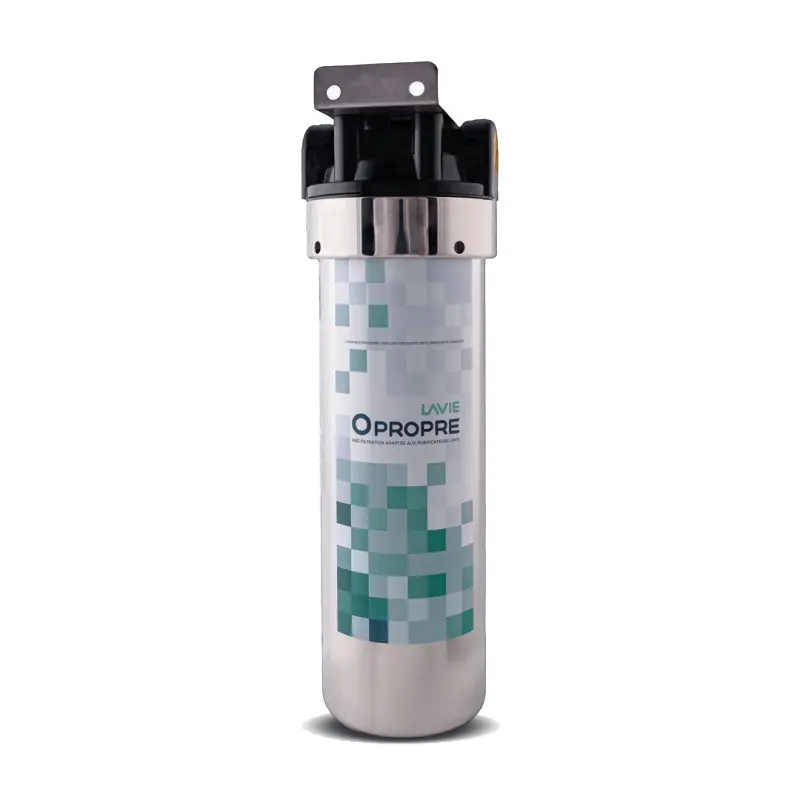
The opposite, Opropre Turquoise under-sink filter stands out for its performance. Its combination of coconut activated carbon and targeted resin eliminates levels of heavy metals (lead, mercury, zinc, etc.), microplastics, nanoplastics, pesticides and even PFAS, pollutants that are virtually impossible to remove.
And above all: it preserves essential minerals, for healthy, high-quality, beneficial water.
Add to that a returnable, refillable and recyclable cartridge, and you have a durable, reliable solution for everyday use.
With Opropre Turquoise, filtering tap water becomes a real act of protection for you and your children.
To find out which best home water filter, To find out more, read our article comparing the different tap water filtration and purification systems.
Under-sink filter
Opropre Turquoise