Binchotan carbon: is it really effective for filtering tap water?
Table of contents
You wish to purify your tap water with binchotan charcoal, or the Chinese version made from bamboo charcoal?
Presented as natural, ecological and reusable, the binchotan coal promises to filter contaminants from tap water and improve its taste. But is it really true?
What is the scientific consensus on binchotan coal?
Are there any dangers in using it on a daily basis?
And above all, what is the best activated carbon for purifying water?
In this article, we take a closer look at this natural purification methodto help you decide whether binchotan charcoal deserves a place in your decanter or whether you're better off with other alternatives.
What is binchotan?
For those who don't use it, the first thing to do is to explain the exact nature of this particular type of charcoal.
Binchotan is an activated carbon
Binchotan carbon is a type of activated carbon. made from organic materials such as wood, coconut shells or sugar residues. It is made by burning these materials at high temperatures, creating microscopic pores in the charcoal. These pores allow the activated carbon to capture certain impurities in the water. or air (a phenomenon called "adsorption", which is different from absorption).
Activated carbon is often used in the following applications cartridges of your filter jugs for example (But is it effective? See our opinion on the carafe filter).
Binchotan: a specific type of Japanese wood
Le white charcoal binchotan is a type of Japanese activated carbon made from the Japanese ubamegashi holm oak. This oak grows mainly in a region formerly known as the province of Kishu and more specifically in the town of Wakayama (other towns and regions in Japan produce it today).
It is made using a low-temperature combustion process in which wood is burnt in an earthen furnace for several days. This creates very dense, very hard charcoal sticks with a relatively smaller specific surface area than conventional activated carbons, but with a higher adsorption capacity.
Some people therefore consider binchotans to be effective for water and air purification because of their ability to adsorb impurities and odours.
Le Binchotan coal from Kishu is considered to be of the highest quality, thanks to the quality of the wood used and the know-how and experience of local producers.
What do scientists have to say about the effectiveness of binchotan charcoal?
Binchotan carbon can have an effect on the taste of water, something that many users experience on a daily basis.
To date, however, there are very few scientific studies independent tests that clearly demonstrate its effectiveness in eliminating certain pollutants from tap water, such as heavy metals, pesticides and drug residues.
The analyses available are therefore still limited in terms of accurately assessing its action on these various contaminants.
Several sources, including this article from L'Express, In their report, the authors also highlight the lack of solid scientific results, particularly concerning the real effectiveness of binchotan coal on chemical pollutants.
Binchotan coal: what are the dangers?
Binchotan charcoal, when genuine and correctly used, is not considered dangerous in itself.
However, as with many natural products, quality can vary depending on the manufacturing methods used and the origin of the charcoal. Not all products marketed under the name “binchotan” have the same characteristics.
It is therefore important for consumers to check provenance, quality and manufacturing conditions of the product, to ensure that it is used safely.
Furthermore, scientific data remains limited regarding its effectiveness on certain pollutants present in tap water, such as heavy metals, pesticides, drug residues and PFAS.
It is therefore important to bear in mind that binchotan coal is not a complete filtration solution, and that its use alone does not guarantee overall elimination of contaminants.
Binchotan coal is often presented as a natural and ecological solution for filter tap water.
But in reality, its environmental impact is more nuanced than it seems.
It is manufactured by burning wood at very high temperatures for several hours, or even several days. An energy-intensive process, which generates emissions, in particular of CO₂ and particulates.
Added to this are the transport stages, often over long distances, and the packaging needed to preserve it, which also contribute to its overall carbon footprint.
In other words, even though it is a product of natural origin, binchotan charcoal is not not as environmentally friendly as you might think at first glance.
However, it has an advantage at the end of its life: it is biodegradable and can be reused or recycled more easily than some traditional filters.
Is boiling the binchotan enough to regenerate it?
Boiling the binchotan charcoal cleans it and removes all traces of dirt. limit the growth of bacteria.
However, this is not enough to restore its adsorption capacity. To really “reactivate” the coal, temperatures of up to around 1200°C are required! A far cry from what a domestic oven can offer.
Another point to bear in mind is that there are few precise benchmarks for how long it will last. The recommended replacement frequency remains unclear, as does the volume of water it can actually treat over time.
Some recommendations suggest boiling it once a week. While this may help to maintain it, it also involves additional energy consumption, which adds to its environmental impact.
In other words, binchotan maintenance is still useful, but does not guarantee constant efficiency over time.
How much does binchotan coal cost?
Binchotan coal represents a certain budget over time.
A Japanese model used in a 1-litre carafe costs around €40 a year. Over 5 years, that works out at nearly €200. That's less than buying plastic bottles on a regular basis, but it's not a free solution either.
There are also cheaper versions on the market. But it depends on the product, Quality may vary, depending in particular on the origin and method of manufacture.
So it's best to take the time to check what you're buying, to avoid unpleasant surprises.
What's the best carbon for purifying water?
Between binchotan, the more advanced activated carbon-based filters, and complementary solutions such as UV-A purification, performance and uses can vary.
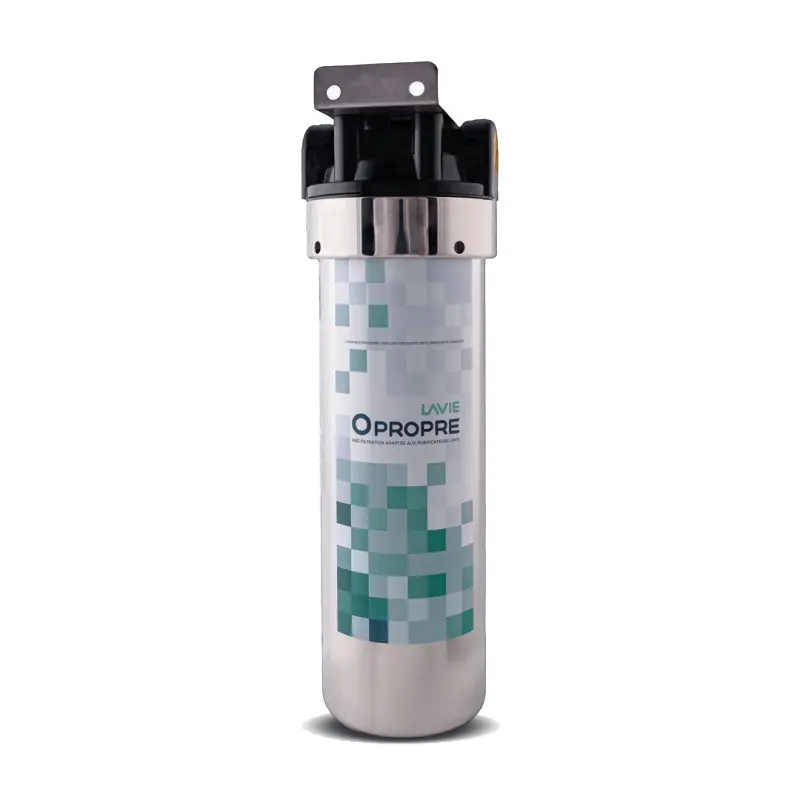
For a clearer picture, here's a comparison between binchotan carbon and the solutions offered by LAVIE, such as the Opropre Turquoise under-sink filter and the UV-A water purifier, which supplements filtration at drinking time.
Opropre, the under-sink filter with coconut activated carbon
This under-sink filtration uses high quality coconut activated carbon and a resin specially developed to capture PFAS, the "eternal pollutants" that escape most consumer filters.
The advantages of the Opropre Turquoise filter :
💧 Scientifically proven effectiveness by tests carried out in an independent laboratory
💧 Purer, healthier water The filters are capable of removing chlorine, heavy metals, microplastics and nanoplastics, as well as PFAS.
💧 An ecological and responsible solution The cartridges in our filters have a life of 6 months and are returned and refilled. The activated carbon and resin are then recycled in dedicated industrial circuits.
In short, Opropre Turquoise guarantees pure, high-quality water at homewithout compromising on your wallet or the environment!
What if purify your tap water didn't need a filter? That's exactly whatLAVIE water purifiersThanks to an innovative, patented technology: photolysis of chlorine using UV-A radiation.
How does it work?
In just 15 minutes, UV-A rays act on the water to eliminate chlorine and its by-products, neutralise pesticides, drug residues, bacteria and micro-organisms, while preserving essential trace elements and minerals !
The result: healthy water, with no unpleasant taste or smell, that's good for your health. It's as simple as a carafe filter, but without the drawbacks!
How much water can be filtered daily using binchotan charcoal?
There is no precise recommendation for the amount of water that binchotan charcoal can filter on a daily basis.
Some sources suggest an onset of action of around 4 hours, but these figures remain unchanged. difficult to verify in practice. In practice, this often means filtering 1 to 2 litres of water at a time, anticipating your needs.
For a single person, this may be enough. But for a family or a larger consumer, it means having to refill several times... and can quickly become a daily burden.
Charcoal binchotan or carafe filter?
La carafe filter equipped with activated carbon cartridges remains more efficient than binchotan coalThese include the reduction of chlorine, heavy metals and certain traces of pesticides. However, the best alternative today is the LAVIE UV-A purifierThis guarantees that the water is free from chlorine, bacteria and traces of pesticides or medicines.
Does binchotan charcoal really purify water?
Binchotan charcoal slightly improves the taste of the water. On the other hand, no scientific study has proved effective against the major pollutants in tap water, such as heavy metals, pesticides, drug residues, endocrine disruptors and PFAS.
What's more, the amount of water it can treat each day is very limited (2 to 3 litres maximum, with a waiting time of around 4 hours per litre).
For truly healthy water, it is preferable to use alternatives to activated carbon such as under-sink filters Opropre Turquoise.
Pascal Nuti - CIO Solable - Passionate about energy, I'm constantly on the lookout for new targets for improvement, exploring cross-disciplinary paths using novel methods.