Can't decide which water to drink? Many French people are asking themselves the question: «Do you know what kind of water to drink?tap water or bottled water?». And that makes sense.
The tap water is a cause for concern: nitrates, chlorine, PFAS, heavy metals... Traces of contaminants that raise questions.
As for bottled water, mineral or spring water, long perceived as «safer», no longer inspires the same confidence. Visit Nestlé scandal marked a turning point: the group had been using banned treatments for years. As a result, the image of these waters was weakened.
So what should you drink every day?
There are three issues behind this question: health risk, The budget, because packs are becoming increasingly expensive; and the environment, with millions of plastic bottles produced and transported, causing catastrophic pollution.
So, which water is the healthiest and most logical to drink today? We take a look.
Why is tap water so worrying?
Tap water is often criticised for being the most controlled food in France. Strict health regulations, daily analyses and tests and ongoing monitoring.
If mistrust persists, it's mainly because of its sometimes chlorinated taste, the differences in quality from one region to another and its composition, particularly the discovery of traces of certain pollutants. However, in the majority of cases, drink tap water remains safe, supervised and perfectly compliant.
And it even has a few trump cards that make all the difference.
The benefits of tap water
The first advantage is its unbeatable price. It's up to 250 times cheaper than bottled water. On a family scale, each litre represents huge savings.
Then there's practicality. No need to run to the supermarket, carry packs or find a place to store them. The water is already there, in your kitchen, available at will. It couldn't be simpler.
Ecologically, it ticks all the boxes too. No transport and no plastic waste. On the other hand, commercial production requires a heavy, energy-intensive and highly polluting cycle, which has a negative impact on the environment.
It also has one very important advantage: it is subject to strict and regular monitoring, guaranteeing quality in line with French requirements. Treatment and safety features that are not as present in bottled spring and mineral water.
And above all, it never runs out. No empty shelves, no shortages, no unforeseen interruptions. It remains a reliable and permanently accessible resource.
Tap water has serious benefits. But that doesn't mean it's perfect. Let's take a look at what can go wrong.
The disadvantages of tap water
The first drawback is traces of certain chemicals. Even if the standards are strict, certain quantities of pesticides, PFAS, drug residues and heavy metals can be found.
It also depends on the region: its composition varies from one region to another. In rural areas, for example, agricultural use over several years increases the presence of pesticide metabolites. These levels remain regulated, but they naturally fuel mistrust of distribution networks.
Then there's the question of taste and smell. Chlorine, which is essential, can give an unpleasant taste and smell. This is often what drives consumers towards bottled spring or mineral water. It's not a real health problem, but it's an unpleasant tasting experience.
Faced with these limitations, more and more households are choosing to install the best tap water filter adapted to their needs. The aim is to improve taste, reduce the presence of contaminants and make everyday drinking easier.
Bottled water enjoys greater consumer confidence. They are said to be “natural” and therefore necessarily healthier. But in reality, this is far from the case. Several analyses have shown the presence of PFAS and other elements.
Contrary to popular belief, commercial water is not monitored as closely as tap water.
On closer examination, it even has a number of major health drawbacks.
The benefits of bottled water
Even though we now know that bottled water is not as pure as we thought, it does have a few advantages. The first is its generally neutral taste. As it is not chlorinated, it may be more pleasant to drink for some people, especially in regions where tap water has a strong taste.
It is also theoretically free from chemical treatment. Taken from deep underground, it is supposed to be protected from certain types of surface pollution, which in principle means that it does not have to be disinfected with chlorine to ensure that it is safe to drink. This has to be put into perspective, whether for mineral or spring water, but it does go some way to explaining the confidence that consumers have in it.
Another benefit is that it's practical when you're on the move, particularly in areas where the mains water is undrinkable or when you're travelling abroad. Its nomadic one-litre format is also a positive point, even if it's not an everyday requirement.
These are advantages, but they quickly become limited when you compare them with the disadvantages.
The disadvantages of bottled water
Bottled water is reassuring. But in reality, it has many disadvantages for us and for the planet.
The first is its disastrous impact on the environment. To produce it, you need plastic, oil, energy and then heavy road transport. All this for just a few minutes of consumption.
The result is a huge volume of plastic waste. Bottles cause pollution that is hard to get rid of, and recycling is still inadequate.
The second problem is its very high cost. Bottled water is up to 250 times more expensive than tap water. On a family scale, the financial difference is quickly enormous.
Then comes the actual composition of these so-called spring or mineral waters. Several tests have shown the presence of microplastics, nanoplastics, PFAS and pesticide metabolites in certain bottles, even among the best-known brands. As the What to choose, Of the particles detected, 90 % are nanoplastics, capable of crossing the digestive barrier, reaching the bloodstream and potentially certain organs.
Another health issue is that it is not subject to the same controls as piped water. It is not obliged to comply with drinking water standards. Some mineral and spring waters, for example, have fluoride levels above the thresholds recommended by the WHO.
In short, bottled water may seem safe, but scientific studies prove otherwise.
Tap water or bottled water: which is better?
One thing is certain: none is perfect. Bottled water is reassuring, but it is expensive, pollutes enormously and may contain traces of harmful contaminants.
Tap water can have a chlorinated taste and contain certain chemical residues. On the other hand, it has one decisive advantage: it's much more supervised, accessible and economical.
Let's go through it point by point:
In terms of health, both options can contain toxic elements that impact our metabolism. However, tap water has one major advantage: its quality can be improved very easily through appropriate filtration.
When it comes to taste, bottled spring or mineral water seems more pleasant. But once filtered, the water in your home loses its chlorine taste and becomes more neutral, more flavoursome.
As far as the budget is concerned, the maths is quick: the water in your home is up to 250 times cheaper than bottled water. So investing in a filtration system pays off handsomely.
And when it comes to ecology, there's no debate: zero transport, zero waste. Tap water wins hands down.
The answer is clear: tap water, especially filtered water, is still the most logical, healthy and sustainable choice.
How can we improve the quality of our tap water?
Improving the quality of your drinking water involves a simple solution: filtering it at home. Filtration makes your water much more pleasant and healthier every day.
But between filter carafes, under-sink filters, UV systems and reverse osmosis, it's hard to know how to make the most of your water. filter tap water efficiently.
Here's a table of filtration technologies to help you identify which give the best results.
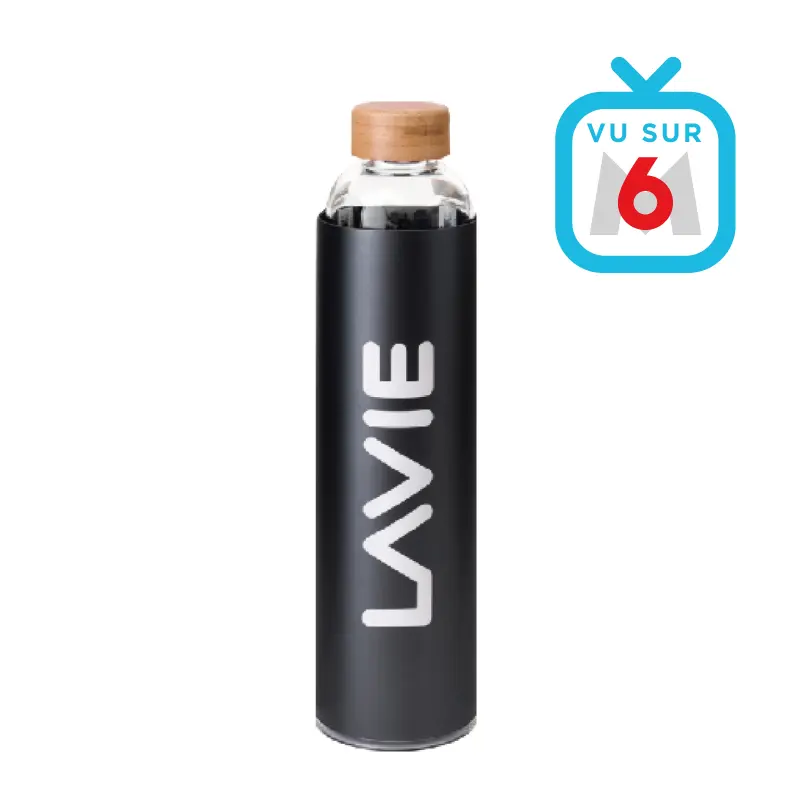
For healthy, beneficial water every day, the LAVIE UV-A carafe provides a simple, long-lasting and truly effective solution for treating your water.
Its patented technology is based on photolysis, a natural process that can degrade and neutralise contaminants. In concrete terms, when UV-A rays pass through the glass bottle, they transform the chlorine into reactive compounds capable of remove pesticides, traces of medicines, bacteria and viruses.
In just 15 minutes, treatment with UV-A light reduces these substances while preserving the elements essential to your body, such as calcium and magnesium.
The result is drinking water that is more balanced and more pleasant to drink, without filters or consumables.
Modern purification, designed for today and for future generations.
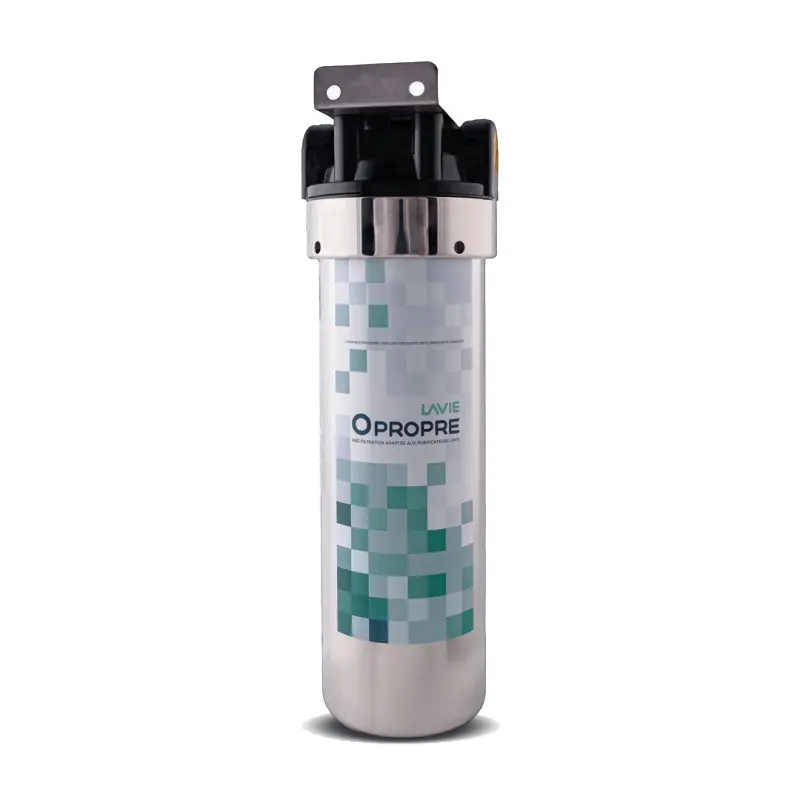
Opropre Turquoise: the solution against persistent pollutants
For your drinking water, Opropre Turquoise intervenes where conventional treatments reach their limits.
Its system combines very high performance coconut activated carbon with a specific resin capable of retain the most persistent pollutants PFAS, heavy metals, nitrates, drug residues, pesticides, etc.
And unlike other under-sink filters, it allows essential minerals to pass through, arriving naturally in your glass for beneficial hydration.
The second advantage is its returnable and refillable cartridge. Every six months, you send it back; LAVIE refills it with new activated carbon and the old one is entirely recycled. A circular system, clean and without unnecessary waste.
Opropre Turquoise offers deep, long-lasting filtration that complements the LAVIE UV-A carafe.
Conventional filter carafes (from brands such as Brita, Philips, Amazon...) give the impression of “doing the job”. But in reality, they are far from up to today's challenges.
Above all, they improve taste by reducing chlorine. At the same time, they deplete the water and lower its pH, making it more acidic. Which is not ideal for daily hydration, because it no longer meets drinking water standards of the WHO.
As for persistent substances (heavy metals, drug residues, viruses, etc.), they pass through the cartridge and end up in your glass, then in your body.
And that's not all: as soon as the filter is not changed in time, the carafe becomes a veritable hotbed of bacteria, as several analyses have shown.
The magazine Que Choisir devoted an article to the subject, entitled : «Useless or worse!».
Add to that disposable, non-recyclable cartridges that have to be replaced every month. A treatment that is neither environmentally friendly, economical nor reassuring.
Filter carafes are practical, yes. But the effect is limited if the aim is to drink healthier drinking water.
Filtered tap water: the best choice today
In view of the pollution and scandalous revelations surrounding mineral and spring water, and the dubious composition of tap water, filtering water has become a necessity. the simplest and safest solution for daily hydration.
Why is this?
With reliable, long-lasting technologies like those offered by LAVIE, you eliminate contaminants while preserving the trace elements essential to your health in every litre.
And unlike branded water, it's economical, environmentally friendly and infinitely more practical. In other words, you're doing your body, your wallet and the planet a favour.
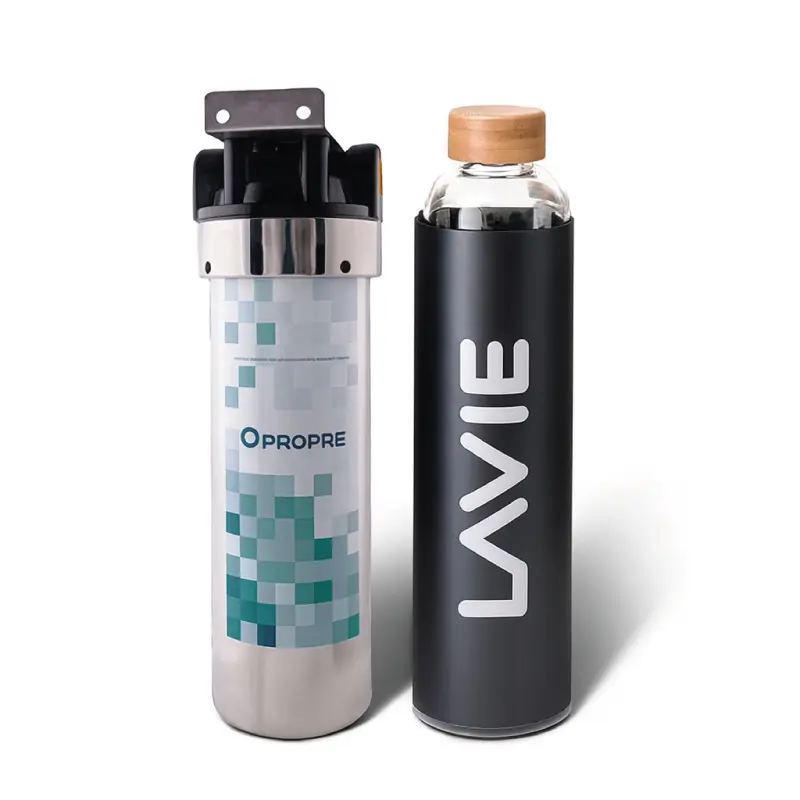
The best combination? Opropre Turquoise + the UV-A LAVIE decanter: purer, more pleasant and truly beneficial drinking water for all the family.
Opropre filter + UV-A carafe LAVIE
Serenity pack
Eliminates chlorine and odours, improves the taste of water
Filters out hazardous pollutants: PFAS, heavy metals, microplastics, etc.
None of them are perfect! But they are, filtered tap water is still the healthiest solution. Bottled water, whether spring or mineral, can contain microplastics and chemical residues. And tap water, although highly controlled, can also contain traces of toxic elements.
The difference is that it can easily be improved. With a high-performance filtration system, it becomes purer, safer and better than any bottled water.
Is it safe to drink tap water in France?
Yes, tap water is the most closely monitored food in the country. It is drinkable, safe and complies with strict standards and controls.
However, depending on the region, the water supply may contain traces of pesticide metabolites, PFAS, heavy metals and other harmful elements.
For risk-free consumption, suitable filtration like LAVIE remains the best option.
Does bottled water contain microplastics?
Yes, several studies show that the majority of bottled water contains microplastics and even nanoplastics. They are even more worrying because they are capable of crossing the intestinal barrier and spreading through the body. Some mineral or spring waters also contain traces of PFAS, pesticides or chemical residues.
To avoid this dangerous exposure, filtering your water is the best alternative.
What kind of water for a baby?
In France, the health authorities recommend tap water for infants, This is because it is subject to strict regulations every day. And contrary to popular belief, not all mineral waters are suitable.
Combined with a safe purification system like LAVIE's UV-A carafes, water becomes more reliable. It reduces contaminants while preserving essential minerals for your child.
To find out more, read our complete guide to best baby water.
Article written on 07/12/2025 by Pascal Nuti - CIO Solable - Passionate about energy, I'm constantly on the lookout for new targets for improvement, exploring cross-disciplinary paths using novel methods.