 French
 Spanish
 German
 Italian
 English
You probably haven’t noticed, but there is a hidden paradox in our glasses of water. When it comes to bottled mineral water, we only talk about the benefits of mineral salts (calcium, magnesium, potassium…) that nourish our bodies.
But as soon as we mention tap water, it’s a different story: calcium carbonate, this natural mineral which, as we will see, is a source of calcium, is suddenly perceived as an enemy to be eliminated at all costs!
And yet, this famous calcium, sourced from the depths of the Earth, deserves much more than this villain role. Let me tell you about its incredible journey, from underground rock to your glass of water, and what it truly brings to your body.
What is calcium used for?

Without calcium, let’s be frank, you would be in quite a bad position! This mineral, which makes up 2% of our weight, is absolutely essential for the proper functioning of our body: it regulates our muscles, strengthens our bones, and contributes to the solidity of our teeth. About 99% of the calcium present in our body is stored in our bones and teeth, and the remaining 1% circulates in the blood, playing a key role in the transmission of nerve signals, muscle contraction, and even blood coagulation.
The calcium ion in water: Where does it come from and how does it act?
But where does this famous calcium found in water come from? In nature, calcium exists in the form of calcium ions (Ca²⁺), dissolved in water as it passes through rocks rich in calcium carbonate (CaCO₃) such as limestone. This process is entirely natural and explains why hard water is often rich in dissolved calcium. This ionic calcium remains stable in water until it is heated or evaporated, at which point it can form solid deposits of limestone (or scale), responsible for inconveniences in your household appliances.
Hard water: A valuable source of calcium for your health

For an adult, the recommended daily intake is about 900 mg of calcium, and the good news is that hard water can contribute between 15% and 30% of this need, depending on the region. You see, drinking tap water, even if it is rich in calcium, is not just safe, it is beneficial for your health! In fact, contrary to what you may have heard, the calcium present in water is not less good than that from dairy products or vegetables. Moreover, studies show that the calcium contained in plant-based products (such as spinach, broccoli, or almonds) is often better absorbed than that from dairy products.
So, the next time you are told that hard water (also called hard water) should be avoided, remember that these calcium ions play a vital role for your health.
However, they can also turn into scale when heated, causing deposits in your household appliances – which can reduce their efficiency over time.
Better calcium in bottled water?

It is often said that bottled mineral water would offer better quality calcium than tap water. But let’s be clear: this claim is completely false! Imagine the lovely scientific study that would be available if this were true. The quality differences between bottled water and hard tap water are, at best, marketing arguments.
In reality, tap water can contain as much, if not more, calcium than some bottled waters.
Read: What are the environmental impacts of plastic water bottles and how to avoid them
So, before turning to plastic bottles, remember that tap water is not only economical and ecological, it also contributes to your daily calcium needs. Furthermore, a plastic bottle releases chemicals into the water over time or even microplastics, which could pose health risks. Think about it the next time you fill your glass!
Read: It’s confirmed, bottled water poses a real health danger due to plastic
Scale or calcium: Where do these deposits in your appliances really come from?
You have surely heard that hard water contains calcium, right? I mentioned it myself earlier to facilitate the understanding of my point. Well, this is frequent misinformation! There are no chunks of rock floating in tap water. What we call calcium in water is actually a combination of dissolved ions like calcium and magnesium called Calcium Carbonate (CaCO₃). As long as these ions remain dissolved, they cause no problems.
So, where does this famous scale that you see in your kettles or water heaters come from? It’s simple: when water is heated to over 60°C, calcium and magnesium ions react with the carbon dioxide dissolved in the water, and transform into solid deposits of calcium, also known as scale. These crystals adhere to the walls of your appliances, creating deposits that reduce their efficiency. Don’t panic, this does not happen in your body at 38°C!
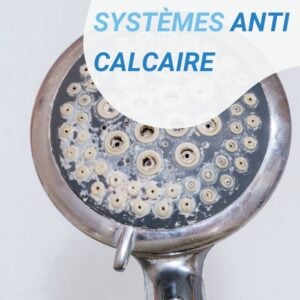
These deposits can be avoided by using anti-scale systems that prevent scale formation, or simply by regularly descaling your household appliances with natural solutions.
For the curious and tech-savvy, to protect your water heater, you would simply need to use stainless steel bowls or balls, and attach a heating film to the outer surface. This decreases the power density by a factor of 10 to 100 times, and no longer creates the thermal shock favorable to the initiation of the reaction responsible for scale formation.
A water softener to protect your appliances?

The main argument of water softener sellers is simple: protect your household appliances (dishwashers, washing machines), water heaters, and pipes from the harmful effects of scale. But is it really the miracle solution they sell you for the good health of your appliances?
From scaled to corroded…
In reality, it’s not that obvious. By removing calcium and magnesium from the water, traditional softeners use salt to replace these minerals with sodium, which can make the water acidic and potentially corrosive to your installations. The result? Your household appliances might be spared from scale, but they suffer the effects of salty and acidic water that can ultimately damage certain metal components. Is this really preferable to hard water? Because you can always descale an appliance, but certainly not cure it from corrosion!
And what about the pollution caused by the salty water discharges from these costly machines?
To learn more: A water softener, why do it?

Salt-free water softeners
So, what is the solution? There are salt-free alternatives that respect both your equipment and the environment.
For example, salt-free anti-scale systems like odouce neutralize calcium without affecting essential minerals or altering the chemical composition of the water. You can learn more in our article titled:
In the meantime, if your kettle or coffee machine is scaling, there are natural tips, simple and effective, to tackle it. Discover our advice in the article
How to descale a kettle and extend its lifespan? or consult our guide on water hardness to understand everything about the difference between soft water and hard water.

I hope that by reading this article, you will have grasped the vital importance of calcium, provided by so-called hard tap water, a true pillar for our health. Let us avoid purchasing costly and polluting devices like water softeners, which eliminate these precious minerals, which we then seek to compensate for with dairy products, which are also heavy on the environment.
Common sense invites us to preserve what nature offers us rather than to fight against it. Let us be proactive and aware of our surroundings: by adopting simple and respectful solutions, we make better choices for ourselves and for the planet.