How do you filter microplastics from tap water effectively?
LaVie ,Water purifier ,Water quality
01/28/2026
Table of contents
Long considered safer, bottled water is now being called into question by scientific studies, which show that people are much more exposed to microplastics than tap water. As a result, many households are now looking for reliable solutions to effectively filter microplastics from tap water and limit their exposure to this invisible pollution.
Read our articles as they happen
Join our Newsletter and get -5% on your first order!
If you drink bottled water, you could absorb up to 90,000 microplastics each year.
It's a hard figure to believe, especially when you choose this format to «look after your health».
These plastic particles have invaded our daily lives. Air, food, drink: no route of ingestion is spared. And water, whether mineral, spring or tap, is no exception - quite the contrary!
The real problem is that this contamination is largely invisible. A CNRS study shows that 98 % of microplastics in drinking water measure less than 20 micrometres. Fragments so tiny that they escape current detection methods, suggesting that their actual number and potential effects on the body could be far greater than imagined, despite increased monitoring by the European Commission. European directive 2020/2184.
So the question is no longer whether they are present, but how to eliminate this harmful exposure. And that starts with a key action: filter out microplastics.
In this article, we compare existing filtration solutions to help you choose the most effective, reliable and sustainable technology to combat plastic micro-particles, without compromising health, ecology or practicality.
How do microplastics contaminate our drinking water?
The presence of microplastics in drinking water is no accident. It is the result of an ongoing cycle of propagation that begins long before it reaches your tap.
It all starts in the environment. Massive plastic pollution of rivers, lakes and groundwater leads to direct contamination. Under the effect of time, sun, heat and wear, this waste breaks down into ever smaller particles, The result is microplastics and nanoplastics.
But the problem doesn't stop there. The route taken by the water can exacerbate the situation. Distribution networks, reservoirs, chemicals and even certain stages of industrial treatment can release additional fragments. Certain materials, such as the polyamide used in filtration processes, are also susceptible to decay.
The result is drinking water that complies with standards, but contains invisible and largely under-detected microplastics.
It is precisely for this reason that obtaining a microplastic-free water can no longer rely solely on traditional controls.
Taking action as close as possible to the point of consumption, directly in the home, is becoming a necessary step.
What are the effects of microplastics on our health?
The exact effects of microplastics and nanoplastics on the human body and health are still being studied. But one thing is clear: the health risks are very real. These invisible particles don't just pass through our bodies. They settle there and accumulate over the years.
Fragments of the plastics have already been found in several organs. And even more worryingly, research now confirms the presence of microplastics in the brain. According to scientists, The amount detected in the human brain has increased by around 50 % in ten years. This rapid increase illustrates the extent of invisible, omnipresent pollution.
Why is this so worrying?
Because these chemical elements are likely to disrupt the normal functioning of our bodies. Scientific studies point to well-known biological mechanisms, such as chronic inflammation, oxidative stress and the disruption of cell development.
In practical terms, this contamination could already be having an impact on several systems:
digestive system,
breathing,
immune system,
hormonal balance,
metabolism.
But the concerns go further. These disruptions are now probably linked to neurodegenerative diseases, such as Alzheimer's and Parkinson's. Although science is still proceeding cautiously on these risks, the warning signs are sufficiently serious that they should no longer be ignored.
Faced with these facts, reducing the ingestion of microplastics is becoming a major health issue.
Bottled or tap water: which contains the least microplastics?
Contrary to popular belief, the bottle is no safer for your health. The researchers confirm this time and time again.
People who drink mainly bottled water are thought to ingest up to 90,000 microplastics a year, compared with around 4,000 particles for those who drink tap water. This considerable difference is largely due to prolonged contact with packaging, whether plastic or even glass.
Contrary to what you might think, glass is not an absolute guarantee either. Studies have shown that water packaged in glass bottles contains more microplastics, mainly because of the degradation of the capsules and coatings used.
The water in your home has one major advantage: it is currently the least contaminated by microplastics. It is strictly controlled, regularly analysed and, above all, not stored in containers likely to be damaged and release plastic particles.
Of course, it is not perfect and may come into contact with other products along the way. To get the best out of it, one step is essential: filtration.
Filtered tap water is now the most reliable solution to limit your daily contact with microplastics.
Microplastics in drinking water: which filters should you choose?
When it comes to plastic products in water, not all filtration solutions are created equal. Some partially reduce exposure, while others offer more complete protection.
Consult our comparison of tap water filters on the market, based on this essential criterion: effectiveness against microplastics and other pollutants.
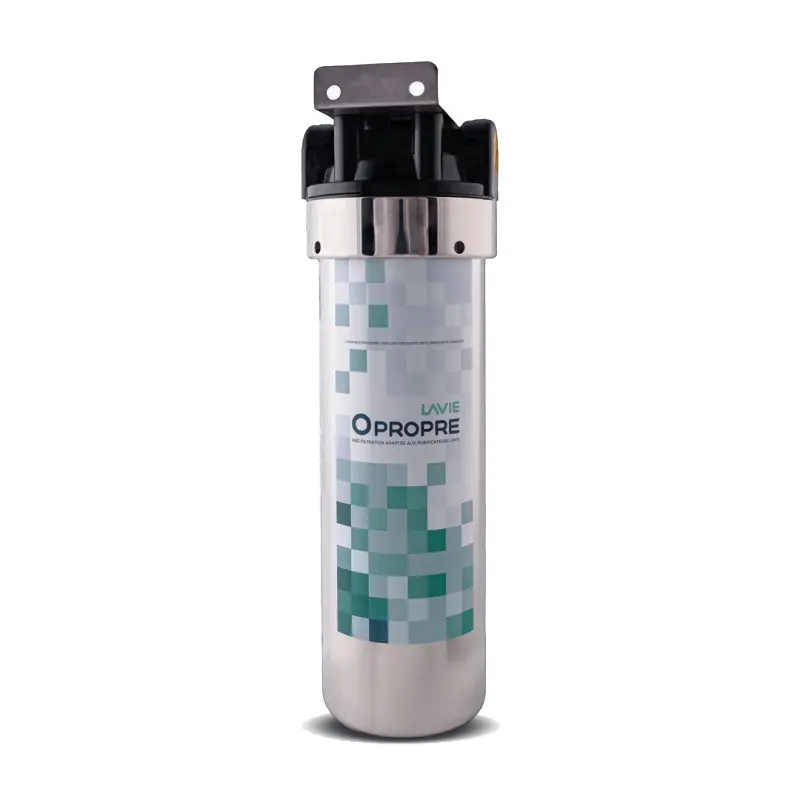
Opropre: the under-sink filter that traps microplastics
When it comes to microplastics, filtering water at source makes all the difference. This is precisely what LAVIE offers with the Opropre under-sink filter, designed to act before the water even reaches your glass.
Unlike conventional filters, Opropre does more than just improve taste. It aims to achieve a real reduction in microplastics, It also covers the pollutants of greatest concern, such as PFAS, heavy metals, pesticides and drug residues.
Its effectiveness is based on a dual technology combining very high-performance coconut activated carbon and a specific resin capable of trapping the most stubborn materials.
This performance is confirmed by tests carried out by the Aix-Marseille University laboratory, With up to 27.4 mg of PFOA and 23.8 mg of PFBA retained per gram of resin. All without altering the essential minerals that are vital for quality hydration.
A recent study has shown that activated carbon provides an effective barrier against micro- and nanoplastics. These particles are adsorbed to the surface of the activated carbon by electrostatic interactions.
In conditions close to those of natural water, observed elimination efficiencies of up to 90 %, These results confirm the value of activated carbon in reducing microplastics in drinking water. These results confirm the value of activated carbon in reducing microplastics in drinking water.
Another key feature of Opropre is its returnable, refillable and recyclable cartridge, which limits unnecessary plastic waste and is part of an eco-responsible approach.
The result is an effective, high-quality, proven solution designed to reduce exposure to microplastics in everyday life.
Reverse osmosis: a radical solution with many drawbacks
Reverse osmosis is capable of removing up to 99 % of microplastics, as well as many other contaminants (pesticides, heavy metals, nitrates, drug residues, bacteria, viruses and PFAS). This performance explains why this system is used in industry.
But should it be used for domestic purposes?
This very high level of efficiency has significant constraints, and it is essential to be aware of these before making your choice.
High cost This involves buying the appliance, having it installed by a professional, and regular maintenance with replacement of filters, membranes and cartridges. It all adds up over the long term.
Mass wastage To produce 1 litre of filtered water, up to 4 litres of drinking water can be discharged, concentrated in pollutants. This represents a significant loss on a daily basis.
Catastrophic ecological impact These include non-recyclable disposable filters and cartridges, electricity consumption and contaminated water discharged down the drain, all of which are inconsistent with an eco-responsible approach.
Demineralised water Reverse osmosis also removes essential minerals such as calcium, magnesium and potassium. As a result, the water becomes acidic. Even after remineralisation, levels remain below WHO recommendations.
Bacterial risk In the absence of chlorine, poor maintenance can encourage the growth of bacteria in the system.
To sum up’water osmosis is a technically very effective solution, but it is not suitable for daily hydration.
What is the best solution for filtering microplastics from water?
The studies are clear: tap water contains the least amount of microplastics and nanoplastics, much less than that in bottles, whether plastic or glass.
But there is still room for improvement. Although it is the least contaminated by plastic, it still comes into contact with a number of harmful elements along the way.
The most coherent solution is therefore to combine filtration at source with purification just before consumption.
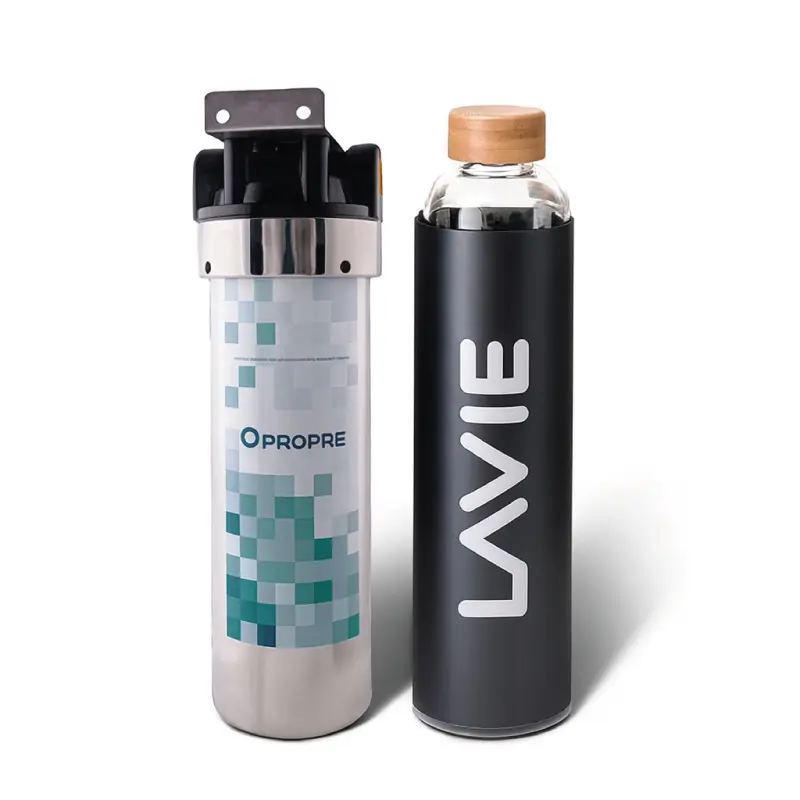
This is precisely what LAVIE offers with its Serenity Pack:
The Opropre under-sink filter, installed directly under the sink, acts upstream. It effectively eliminates microplastics, as well as other pollutants, while preserving essential minerals.
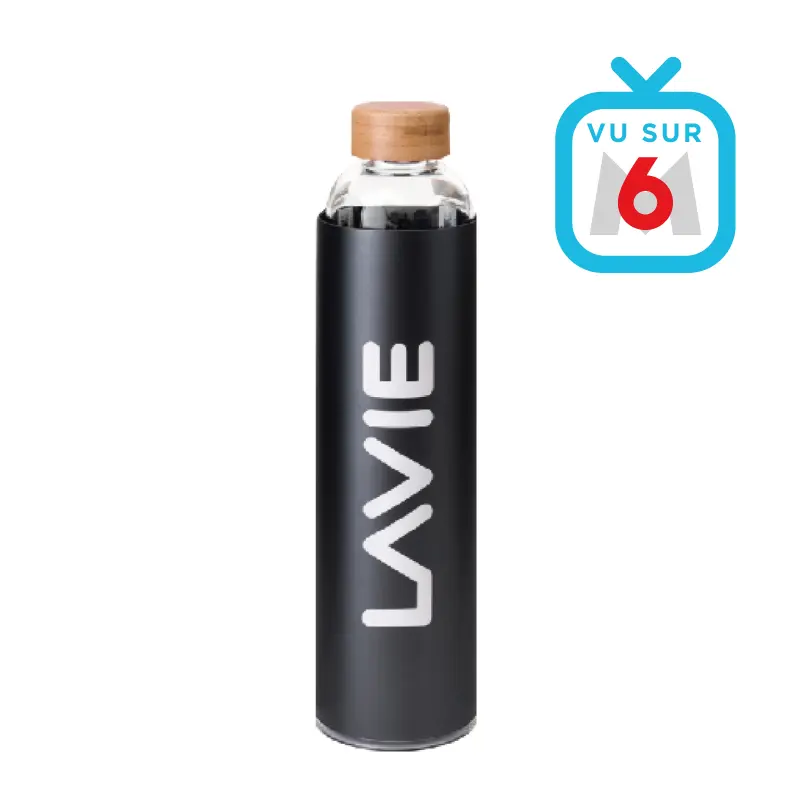
LAVIE UV-A filter carafe comes afterwards. Thanks to the photolysis of chlorine triggered by UV-A rays, it neutralises bacteria, viruses and pesticides, without disposable filters or leaching, and without altering the quality of the water.
The result: better drinking water thanks to a complete, sustainable and easy-to-use solution.
You can now drink your water with complete confidenceday after day.
Pre-filtration + Purifier
Serenity Pack
Eliminates chlorine and odours, improves the taste of water
Filters out hazardous pollutants: PFAS, heavy metals, microplastics, etc.
Are filter carafes effective against microplastics?
Conventional filter jugs are limited when it comes to microplastics. Most of them improve taste and reduce certain impurities, but they are not designed to eliminate microplastics.
What's more, cartridges have to be replaced regularly and can release particles over time. These “light” solutions also alter the mineral content, which is not ideal for daily consumption.
For truly effective action against plastic waste, filtration at source remains the most reliable choice.
Is filtered water better than bottled water against microplastics?
Yes, filtered water is preferable to bottled water. Researchers show that people who drink mostly bottled water can ingest up to 90,000 microplastics a year, compared with around 4,000 for tap water.
Tap water is strictly controlled and is not stored in packaging likely to deteriorate. When properly filtered, it becomes the best option to limit its contact with microplastics.
Article written on 28/01/2026 by Pascal Nuti - CIO Solable - Passionate about energy, I'm constantly on the lookout for new targets for improvement, exploring cross-disciplinary paths using novel methods.
Pure, healthy water at home thanks to LAVIE
Discover our different water filtration and purification technologies: