 French
 Spanish
 German
 Italian
 English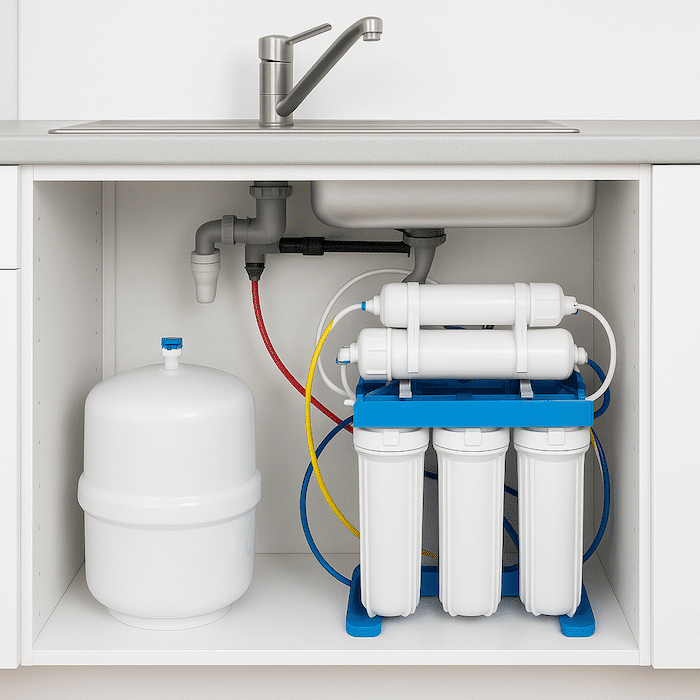
Following the numerous recent scandals regarding tap water pollution, more and more households are seeking to improve the quality of their water through filtration solutions. The domestic reverse osmosis system is frequently presented as the most effective system on the market, and for good reason: it could eliminate up to 99% of water contaminants.
Such effectiveness raises questions, as the reverse osmosis system goes so far as to remove the beneficial minerals naturally present in our drinking water, which raises concerns about the safety of consuming osmosis-treated water (considered non-potable as defined by the WHO!). Not to mention its ecological impact: the reverse osmosis system consumes 3 to 4 liters of water to produce only 1 liter of purified water.
So, is the reverse osmosis system for the tap a miracle solution for healthier water or a system that is too radical, impacting both the wallet and the planet? This is what we will explore in this article.
The reverse osmosis system: what is it and how does it work?
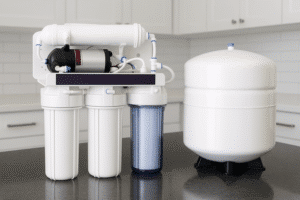
A reverse osmosis system is a water purification device based on the principle of reverse osmosis. It uses a semi-permeable membrane to remove dissolved impurities, such as minerals, heavy metals, and certain organic contaminants. This system is sometimes used in households to improve the quality of tap water, although it is more commonly found in industries and laboratories.
A reverse osmosis system filters water in three main stages:
- Pre-filtration: Removal of solid particles such as sand, sediments, and reduction of certain chemical components present in the water, such as chlorine.
- Membrane filtration: By applying pressure to the water, molecules pass through an ultra-fine membrane that retains unwanted ions and substances.
- Post-filtration: Final adjustment to remove odors or enhance taste.
The promises of the water reverse osmosis system
So no, reverse osmosis systems promise nothing, we agree ;). But let us instead revisit the supposed benefits that the installation of a domestic reverse osmosis system and its production of osmosis-treated water are supposed to bring you.
In general, the following arguments are put forward by manufacturers:
- Improvement of water quality: Reverse osmosis systems could effectively filter contaminants and impurities from water.
- Healthier drinking water: Osmosis-treated water would be healthier for consumption than standard tap water.
- Better taste of osmosis-treated water: Water filtered by a reverse osmosis system would have a better taste and odor than tap water.
- Filtration of harmful contaminants: thanks to the filtration of water by reverse osmosis systems, harmful contaminants such as heavy metals, chemicals, pesticides, pharmaceutical residues, bacteria, and other microorganisms would be eliminated.
- Eco-friendly option: By avoiding the purchase of bottled water, reverse osmosis systems would be a more environmentally friendly solution.
Our use of the conditional above should certainly make you understand that, in our opinion, these arguments are, at best, inaccurate, and at worst, completely false.
Thus, we will demonstrate in this article the uselessness of a reverse osmosis system in your home.
The reverse osmosis unit: effective… but not against microplastics?
In the report Zone Interdite (“Our health in danger: revelations about this plastic that poisons us,” aired on March 8, 2026), independent researcher Jean-Baptiste Fini, a microplastics specialist, compared three filtration systems using deliberately contaminated water.
The results, analyzed by an independent laboratory, show significant differences in effectiveness:
- The gravity filters are the least effective: they filter only 30% of microplastics, allowing the majority of particles to pass through.
- The reverse osmosis systems retain about 60% of microplastics.
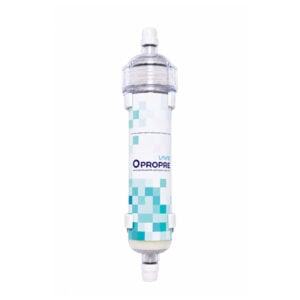
- While the Opropre activated carbon filter proved to be the most effective, eliminating 75% of the microplastics present in the contaminated water!
Conclusion: while filtration generally reduces the presence of microplastics, the choice of system makes a major difference in your actual daily exposure.
The advantages and disadvantages of a tap reverse osmosis system
Advantages
✅ Eliminates a large majority of pollutants (chlorine, sediments, heavy metals, pesticides, viruses, bacteria)
✅ Very fine filtration
✅ Autonomous filtration
Disadvantages
❌ Bacterial proliferation in tanks and pipes
❌ Removes good minerals (calcium, magnesium…)
❌ Acidic water output caused by the absence of mineral salts
❌ Discharge of 2 to 4 liters of polluted water for 1 liter filtered
❌ Significant bulk under the sink
❌ High purchase and maintenance costs (membrane, filter, remineralization…)
❌ Non-ecological disposable consumables
❌ Very low flow rate, around 1l/min
❌ A noisy pump on some models
❌ An additional faucet to install on the countertop (drilling)
As you can see in the table above, reverse osmosis has many disadvantages, the main one being its high water consumption to produce a small amount of purified water (water that, in addition to being wasted, is concentrated with pollutants and will be discharged into the environment!).
Moreover, essential minerals for health (such as magnesium and calcium) are also eliminated, which makes the water nutrient-depleted. Let us take a closer look at these various disadvantages.
💧 Read also: Reverse osmosis: what are the advantages and disadvantages?
How much does a tap reverse osmosis system cost?
The recurring costs of a domestic reverse osmosis system
Let us first talk about a strong trend emerging in the current market for products sold for water treatment or to improve its quality: we consistently find recurring revenue products.
Filtered pitchers, water softeners, reverse osmosis systems, and many others, make us regularly purchase consumables (mostly filters).
These are always recurring purchases that will create an additional budget in your household (in addition to generating a certain amount of non-recyclable waste).
Installing a reverse osmosis system: a significant cost
To further illustrate this observation, let us detail a basic offer, which can be found for around €250 on the market. Note that a standard reverse osmosis system costs more in the €1500 range, so this is a “first price”.
If you manage to install it yourself, great, otherwise double the price of the device to include installation, bringing it to nearly €500 once installed. (here is a video detailing how to install a domestic reverse osmosis system under the sink: not so simple!)
Let us do the math: you should budget around €100 every 6 months for filter changes, and €70 to replace the membrane. Over 3 years, this amounts to over €500 additional for maintenance, resulting in a budget of €1000 to €1500 for the purchase, installation, and maintenance of your reverse osmosis system!
You must also consider the energy cost to operate the device’s electric pump, as well as the overconsumption of water (on average, 3 liters of water are discharged for 1 liter of osmosis-treated water).
It is therefore difficult to see a benefit!
Is osmosis-treated water good for health?
Removal of essential minerals
A reverse osmosis system was originally designed for Nasa space stations or boats, as it allows for recycling water laden with salt or urine, for example. However, since salt is regulated in drinking water, it is not necessary to osmosis tap water.
These devices produce ultra-processed osmosis-treated water, “dead” in terms of minerals and dissolved oxygen, and unfit for consumption, thus non-potable! Drinking water must contain at a minimum regulated amounts of calcium and magnesium, which this device will have extracted 80 to 90% through its membrane. Therefore, before investing in a filtration system, it is important to inform oneself about the possible dangers of reverse osmosis for health.
💧 Read also: Does reverse osmosis make water dangerous to consume?
Production of acidic water
According to the WHO, drinking water should have a pH around neutral, or between 6.5 and 8.5, ideally 7.5. However, your reverse osmosis system will produce osmosis-treated water that is acidic, corrosive, with a pH value around 6, just like a filtered pitcher.
💧 To go further: Understanding the pH of tap water
Fertile ground for bacteria
A drinking water contains few or no bacteria. However, the 6l tank of your reverse osmosis system, devoid of the chlorine that protected the water from contamination, will quickly serve as a nest for these little creatures (as with filtered pitchers).
Finally, let us not forget that the storage of osmosis-treated water is at 20°C, or even 30°C in summer, a temperature very favorable to bacterial growth.
Of course, some more expensive models incorporate mineralization cartridges (calcium and magnesium). Yet another excellent method to catch a few more bacteria. And, why artificially reintroduce what was naturally present in the water at the input?
Comparison: what alternatives to reverse osmosis are there to improve tap water quality?
Filtered pitcher, faucet filter, or under-sink filter, UV-A purifier… among all these offers, how to choose the best filter for tap water?
Here is a comparative table of the elements filtered by the LAVIE product range compared to various solutions on the market (including the domestic reverse osmosis system).
|
Filtered, reduced, or eliminated element |

Classic filter jug |
Tap filter |

Reverse osmosis system |

Under-sink Opropre filter |

LAVIE Purifier |
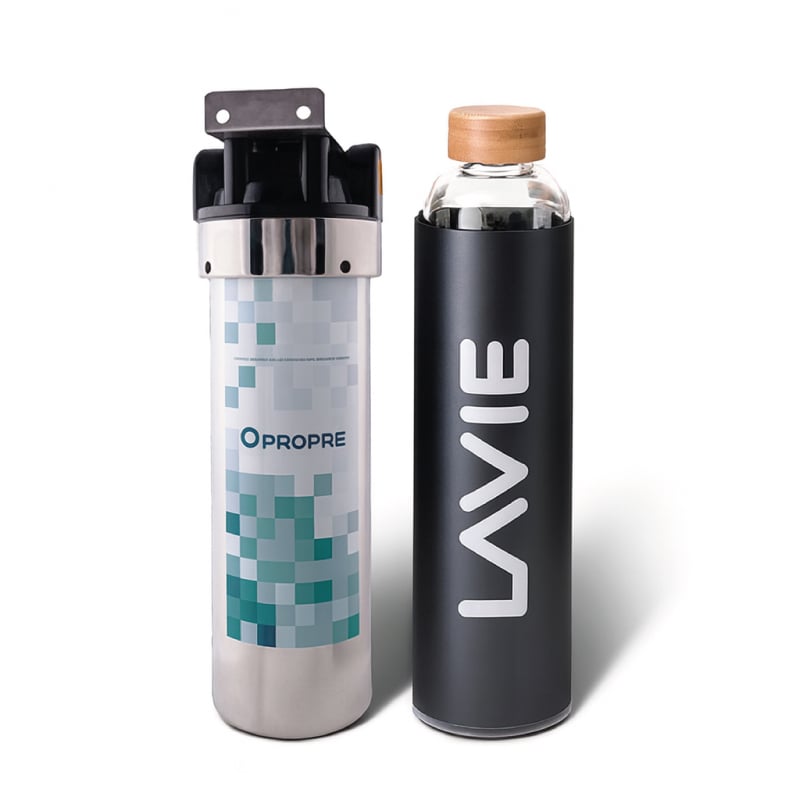
Serenity pack (Opropre + LAVIE PURE) |
| Chlorine | ✅ | ✅ | ✅ | ✅ | ✅ | ✅ |
| Sediments | ✅ | 🟠 | ✅ | ✅ | ❌ | ✅ |
| Bacteria | ❌ | ❌ | ❌ | ❌ | ✅ | ✅ |
| Viruses | ❌ | ❌ | ❌ | ❌ | ✅ | ✅ |
| Medicines | ❌ | ❌ | ✅ | ✅ | ✅ | ✅ |
| Pesticides | ❌ | ❌ | ✅ | ✅ | ✅ | ✅ |
| Heavy metals | 🟠 | 🟠 | ✅ | ✅ | ❌ | ✅ |
| PFAS | ❌ | ❌ | ✅ | ✅ | ❌ | ✅ |
| Microplastics | ❌ | ❌ | ✅ | ✅ | ❌ | ✅ |
| Preservation of beneficial minerals | ❌ | 🟠 | ❌ | ✅ | ✅ | ✅ |
| Discover | Discover | Discover |
💧 Read also: Comparison of the best filtration systems for the home
The under-sink filter Opropre Turquoise
Our under-sink filters Opropre use high-quality coconut activated carbon, capable of removing chlorine, heavy metals, pesticides, microplastics, and other contaminants from tap water, while preserving all the beneficial trace elements for the body.
To combat PFAS, we have also developed a specific ion exchange resin in our Opropre Turquoise filters, which targets these persistent pollutants.
Easy to install and with no water waste, the cartridges of our Opropre filters are also designed to be deposited and reused, thereby reducing waste and their impact on the environment. Once used, they are sent back to LAVIE to be refilled with new activated carbon, while the used carbon and anti-PFAS resin are recovered and recycled in specialized industrial circuits.
💧 Read also: What is the best under-sink filter?
The LAVIE UV-A Filter Jug
While reverse osmosis has the reputation of “filtering everything” due to the pressure exerted on its membrane, it does so at the cost of numerous compromises: water wastage, loss of minerals, cumbersome and expensive maintenance…
In contrast, the LAVIE water purifiers rely on innovative, natural, and much more sustainable technology. Our filter jugs use UV-A rays to eliminate pesticides, chlorine, pharmaceutical residues, as well as bacteria and viruses, while preserving all the benefits of water.
It’s simple: no filter to change, no disposable plastic, and above all, no water waste! To learn more about our patented technology, find all our tests and scientific reviews here.

Is the reverse osmosis system the best solution for domestic filtration?
As you will have understood from this article, the reverse osmosis system is far from being the best solution to improve tap water quality. Indeed, it removes up to 99% of contaminants thanks to its membrane, but at the cost of numerous disadvantages: a rejection of 3 to 4 liters of polluted water to produce just one liter of purified water, the removal of essential minerals from water such as calcium and magnesium, as well as a purchase and maintenance price among the most expensive on the market.
Moreover, the osmosis water produced is acidic and more vulnerable to bacteria, raising concerns about health risks associated with its consumption.
Fortunately, several effective alternatives exist. The Opropre under-sink filters combined with the LAVIE UV-A purifiers offer you a filtration level just as high as reverse osmosis systems, without compromising your wallet or the planet! With LAVIE products, enjoy healthy and pure water every day.