 French
 Spanish
 German
 Italian
 English
Long considered safer, bottled water is now being questioned by scientific studies, which show a much higher exposure to microplastics than tap water. As a result, many households are now seeking reliable solutions to effectively filter microplastics from tap water and limit their exposure to this invisible pollution.
If you consume bottled water, you could absorb up to 90,000 microplastics each year.
A difficult figure to hear, especially when choosing this format to “take care of your health”.
These plastic particles have invaded our daily lives. Air, food, drinks: no ingestion pathway is spared. And water, whether mineral, spring, or tap, is no exception, quite the contrary!
The real problem is that this contamination is largely invisible. A study by CNRS shows that 98% of microplastics in drinking water measure less than 20 micrometers. Fragments so tiny that they escape current detection methods, leading to the belief that their actual number and potential effects on the body could be much greater than imagined, despite increased monitoring by the European directive 2020/2184.
The question is no longer whether they are present, but how to eliminate this harmful exposure? And it starts with a key action: filtering microplastics.
In this article, we compare existing filtration solutions to help you choose the effective, reliable, and sustainable technology against plastic microparticles, without compromising health, ecology, and practicality.
Microplastics in drinking water: which filter to choose?
In the face of the presence of plastic products in water, not all filtration solutions are equal. Some partially reduce exposure, while others offer more comprehensive protection.
Consult our comparison of tap water filters on the market, based on this essential criterion: effectiveness against microplastics and other pollutants.
|
Filtered, reduced, or eliminated element |

Classic filter jug |
Tap filter |

Reverse osmosis system |

Under-sink Opropre filter |

LAVIE Purifier |
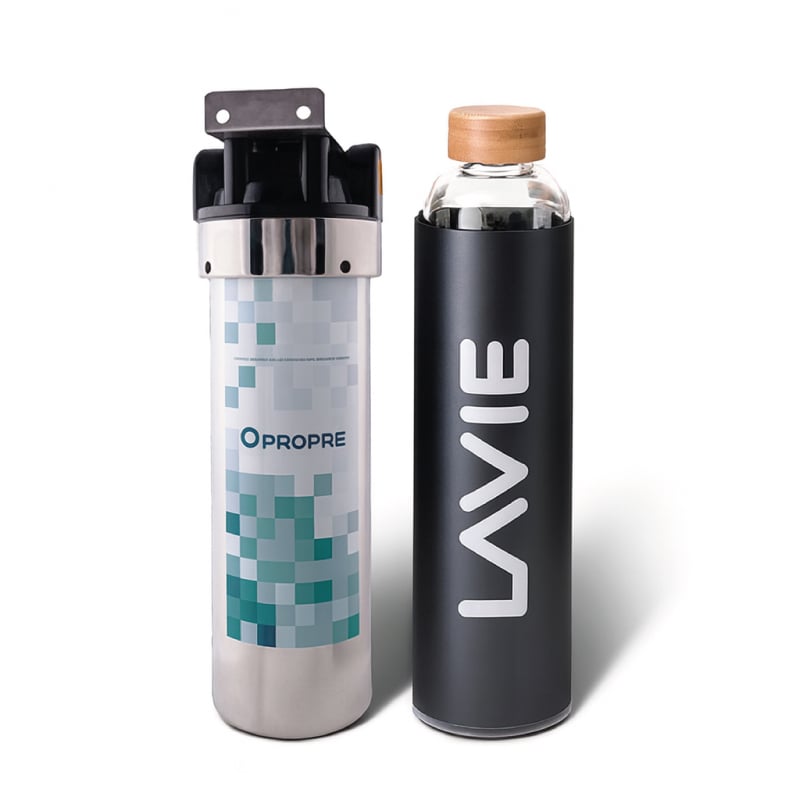
Serenity pack (Opropre + LAVIE PURE) |
| Chlorine | ✅ | ✅ | ✅ | ✅ | ✅ | ✅ |
| Sediments | ✅ | 🟠 | ✅ | ✅ | ❌ | ✅ |
| Bacteria | ❌ | ❌ | ❌ | ❌ | ✅ | ✅ |
| Viruses | ❌ | ❌ | ❌ | ❌ | ✅ | ✅ |
| Medicines | ❌ | ❌ | ✅ | ✅ | ✅ | ✅ |
| Pesticides | ❌ | ❌ | ✅ | ✅ | ✅ | ✅ |
| Heavy metals | 🟠 | 🟠 | ✅ | ✅ | ❌ | ✅ |
| PFAS | ❌ | ❌ | ✅ | ✅ | ❌ | ✅ |
| Microplastics | ❌ | ❌ | ✅ | ✅ | ❌ | ✅ |
| Preservation of beneficial minerals | ❌ | 🟠 | ❌ | ✅ | ✅ | ✅ |
| Discover | Discover | Discover |
Not all filters are equal! The experience conducted by Zone Interdite
In the report Zone Interdite (“Our health in danger: revelations about this plastic that poisons us,” aired on March 8, 2026), independent researcher Jean-Baptiste Fini, a microplastics specialist, compared three filtration systems using deliberately contaminated water.
The results, analyzed by an independent laboratory, show significant differences in effectiveness:
- The gravity filters are the least effective: they filter only 30% of microplastics, allowing the majority of particles to pass through.
- The reverse osmosis systems retain about 60% of microplastics.
- While the Opropre activated carbon filter proved to be the most effective, eliminating 75% of the microplastics present in the contaminated water!
Conclusion: while filtration generally reduces the presence of microplastics, the choice of system makes a major difference in your actual daily exposure.
Opropre: the under-sink filter that retains microplastics
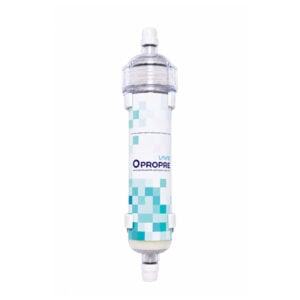
When it comes to microplastics, filtering water at the source makes all the difference. This is precisely what LAVIE offers with the Opropre under-sink filter, designed to act before the water even reaches your glass.
Unlike traditional filters, Opropre is not limited to improving taste. It aims for a real reduction of microplastics, as well as the most concerning pollutants such as PFAS, heavy metals, pesticides, and pharmaceutical residues.
Its effectiveness relies on a dual technology combining very high-performance coconut activated carbon and a specific resin capable of trapping the most stubborn materials.
This performance is confirmed by tests conducted by the laboratory of Aix-Marseille University, with up to 27.4 mg of PFOA and 23.8 mg of PFBA retained per gram of resin. All without altering essential minerals, which are indispensable for quality hydration.
A recent study has shown that activated carbon constitutes an effective barrier against micro- and nanoplastics. Thanks to electrostatic interactions, these particles are adsorbed onto the surface of the activated carbon.
Under conditions close to those of natural water, the observed elimination efficiency can reach up to 90%, especially when nanoplastics aggregate, facilitating their capture. These results confirm the interest of activated carbon in reducing microplastics in drinking water.
Another key point of Opropre: its returnable, rechargeable, and recyclable cartridge, which limits unnecessary plastic waste and aligns with an eco-responsible approach.
Result: an effective, quality solution, proven and designed to concretely reduce exposure to microplastics in daily life.
Reverse osmosis: a radical solution to many drawbacks
Reverse osmosis often has the reputation of having the best filtration efficiency. However, the experience conducted during the M6 report presented above demonstrated that this system was not sufficient to eliminate microplastics from tap water, as 40% of particles were still present after filtration (compared to 25% for the Opropre filter!).
Furthermore, water osmosis systems are not without drawbacks:
- High cost: purchase of the device, installation by a professional, regular maintenance with replacement of filters, membranes, and cartridges. The budget becomes heavy in the long term.
- Massive waste: to produce 1 liter of filtered water, up to 4 liters of drinking water can be rejected, concentrated with pollutants. This represents a significant loss on a daily basis.
- Catastrophic ecological impact: non-recyclable disposable filters and cartridges, electricity consumption, and discharges of contaminated water into the pipes, inconsistent with an eco-responsible approach.
- Demineralized water: reverse osmosis also removes essential minerals such as calcium, magnesium, and potassium. Water thus becomes acidic. Even after remineralization, the levels remain below WHO recommendations.
- Bacterial risk: in the absence of chlorine, poor maintenance can promote the development of bacteria in the system.
How do microplastics contaminate our drinking water?
The presence of microplastics in drinking water is not an accident. It results from a permanent propagation cycle, which begins long before it reaches your tap.
It all starts in the environment. The massive plastic pollution of rivers, lakes, and aquifers leads to direct contamination. Over time, under the influence of sunlight, heat, and wear, these waste materials degrade into ever smaller particles, until they become microplastics and nanoplastics.
But the problem does not stop there. The journey of water can exacerbate the situation. Distribution networks, reservoirs, chemical products, or certain stages of industrial treatment can release additional fragments. Some materials, such as polyamide used in filtration processes, are also likely to deteriorate.
Result: drinking water compliant with standards, but which contains invisible and largely under-detected microplastics.
This is precisely why obtaining water without microplastics can no longer rely solely on traditional controls.
Acting as close to the point of consumption as possible, directly at home, becomes a necessary step.
💧Read also: Are there really water bottles without microplastics?
What are the effects of microplastics on our health?
The exact effects of microplastics and nanoplastics on the body and human health are currently under study. But one thing is clear: the health risks are very real. These invisible particles do not just pass through our bodies. They settle in and accumulate over the years.
Fragments of plastics have already been found in several organs. And even more concerning, research today confirms the presence of microplastics in the brain. According to scientists, the amount detected in the human brain has increased by about 50% in ten years. A rapid evolution that illustrates the extent of an omnipresent invisible pollution.
Why is this so concerning?
Because these chemical elements are likely to disrupt the normal functioning of our bodies. Scientific studies highlight well-known biological mechanisms, such as chronic inflammation, oxidative stress, and disruption of cellular development.
Specifically, this contamination could already have effects on several systems:
- digestive,
- respiratory,
- immune,
- hormonal balance,
- metabolism.
But concerns go further. These disruptions are today likely linked to neurodegenerative diseases, such as Alzheimer’s and Parkinson’s. While science still proceeds cautiously regarding these risks, the warning signals are serious enough to no longer be ignored.
In light of these findings, reducing the ingestion of microplastics becomes a major health issue.
Bottled water or tap water: which contains the least microplastics?
Contrary to popular belief, bottled water is not safer for health. Researchers continue to confirm this.
Individuals who primarily drink bottled water may ingest up to 90,000 microplastics per year, compared to about 4,000 particles for those who consume tap water. This considerable discrepancy is largely explained by prolonged contact with packaging, whether plastic or even glass.
For contrary to what one might think, glass is not an absolute guarantee either. Studies have shown that water packaged in glass bottles contains more microplastics, particularly due to the degradation of caps and coatings used.
So, what should be done? Tap water or bottled water?
The water from your home has a major advantage: it is currently the least contaminated by microplastics. It is strictly controlled, regularly analyzed, and most importantly, not stored in containers that may deteriorate and release plastic particles.
Of course, it is not perfect and may come into contact with other products during its journey. To make the most of it, one step is therefore essential: filtration.
Filtered tap water is currently the most reliable solution to limit its contact with microplastics on a daily basis.

What is the best solution to filter microplastics from water?
Studies are clear: tap water contains the least microplastics and nanoplastics, significantly less than bottled water, whether plastic or glass.
However, this water can still be improved. While it is the least contaminated by plastic, it remains in contact with various harmful elements during its journey.
The most coherent solution is therefore to combine source filtration with purification just before consumption.
This is precisely what LAVIE offers with its Serenity Pack:
- The Opropre under-sink filter, installed directly under the sink, acts upstream. It effectively eliminates microplastics, as well as other pollutants while preserving essential minerals.
- The LAVIE UV-A filtering carafe acts afterward. Thanks to the photolysis of chlorine triggered by UV-A, it neutralizes bacteria, viruses, and pesticides, without disposable filters or leaching, and without altering the quality of the water.
Result: better drinking water thanks to a complete, sustainable, and easy-to-use solution.
You can now drink your water with complete confidence, day after day.
Pre-filtration + Purifier